Center for Integrative Imaging, Hefei National Laboratory for Physical Sciences at the Microscale, University of Science and Technology of China, Hefei, Anhui 230026, China; McGovern Institute for Brain Research, Department of Brain and Cognitive Sciences, Massachusetts Institute of Technology, Cambridge, MA 02139, USA; Stanley Center for Psychiatric Research, Broad Institute of MIT and Harvard, Cambridge, MA 02142, USA.
McGovern Institute for Brain Research, Department of Brain and Cognitive Sciences, Massachusetts Institute of Technology, Cambridge, MA 02139, USA.
Neuron. 2020 Jul 8;107(1):38-51.e8. doi: 10.1016/j.neuron.2020.03.032. Epub 2020 Apr 29.
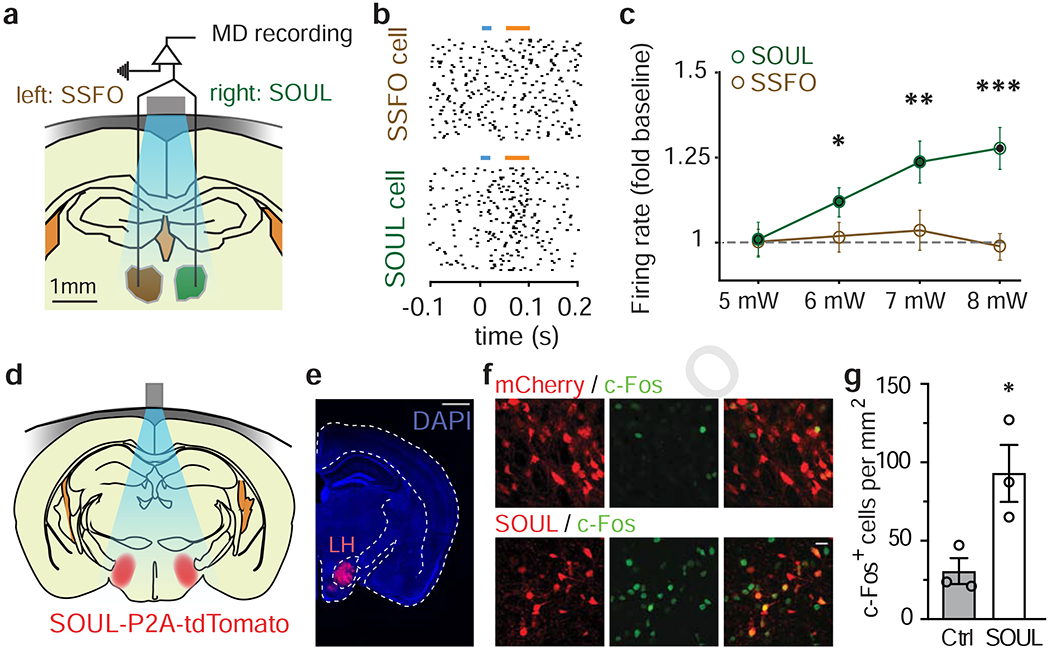
Optogenetics is among the most widely employed techniques to manipulate neuronal activity. However, a major drawback is the need for invasive implantation of optical fibers. To develop a minimally invasive optogenetic method that overcomes this challenge, we engineered a new step-function opsin with ultra-high light sensitivity (SOUL). We show that SOUL can activate neurons located in deep mouse brain regions via transcranial optical stimulation and elicit behavioral changes in SOUL knock-in mice. Moreover, SOUL can be used to modulate neuronal spiking and induce oscillations reversibly in macaque cortex via optical stimulation from outside the dura. By enabling external light delivery, our new opsin offers a minimally invasive tool for manipulating neuronal activity in rodent and primate models with fewer limitations on the depth and size of target brain regions and may further facilitate the development of minimally invasive optogenetic tools for the treatment of neurological disorders.
光遗传学是最广泛应用于操纵神经元活动的技术之一。然而,一个主要的缺点是需要侵入性地植入光纤。为了开发一种克服这一挑战的微创光遗传学方法,我们设计了一种具有超高光敏感性的新型阶跃功能视蛋白(SOUL)。我们表明,SOUL 可以通过颅外光学刺激激活位于小鼠大脑深部区域的神经元,并在 SOUL 基因敲入小鼠中引起行为变化。此外,SOUL 可用于通过硬膜外的外部光刺激来调节灵长类皮质中的神经元尖峰活动并诱导其可逆振荡。通过实现外部光传递,我们的新型视蛋白为在啮齿动物和灵长类动物模型中操纵神经元活动提供了一种微创工具,对目标大脑区域的深度和大小的限制更少,并且可能进一步促进用于治疗神经障碍的微创光遗传学工具的发展。