Heo Tae-Young, Kim Kyoung Min, Min Hyun Kyu, Gu Sun Mi, Kim Jae Hyun, Yun Jaesuk, Min Jung Kee
Department of Information and Statistics, Chungbuk National University, Chungdae-ro 1, Seowon-gu, Cheongju-si, Chungbuk 28644, Korea.
College of Pharmacy and Medical Research Center, Chungbuk National University, 194-31 Osongsaengmyeong 1-ro, Osong-eup, Heungdeok-gu, Cheongju-si, Chungbuk 28160, Korea.
Diagnostics (Basel). 2020 Apr 28;10(5):261. doi: 10.3390/diagnostics10050261.
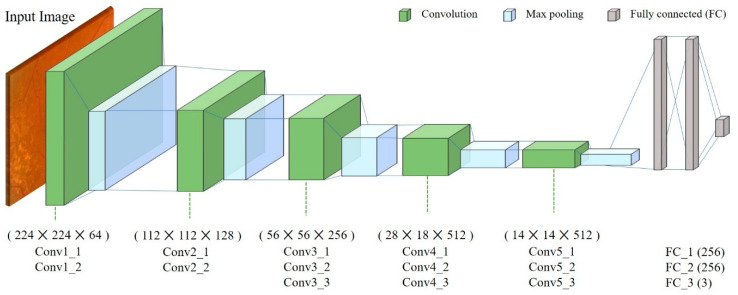
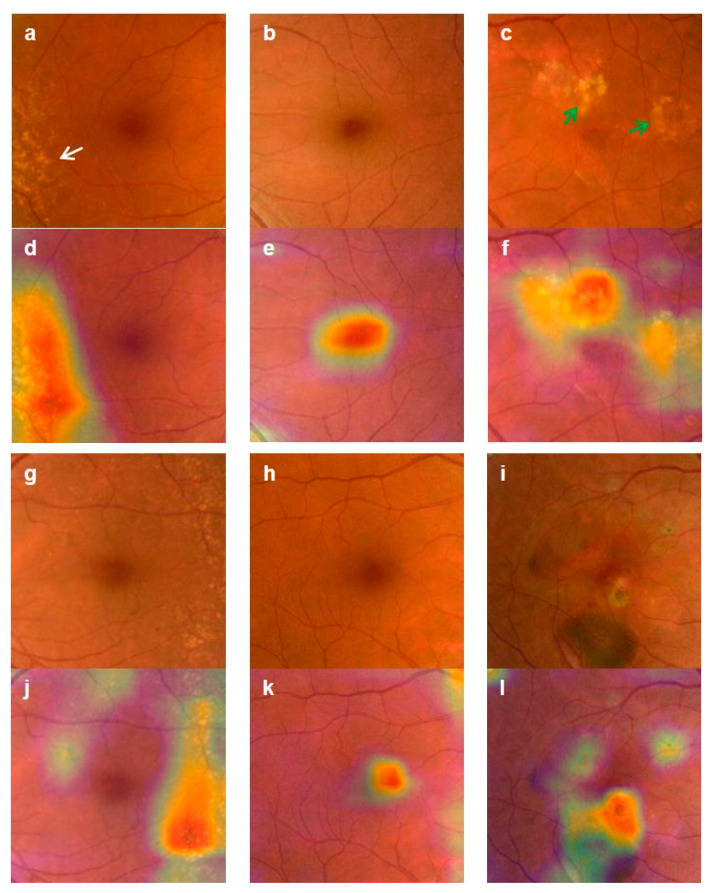
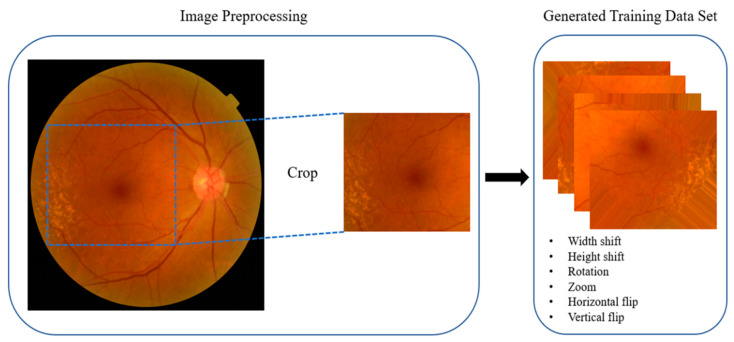
The use of deep-learning-based artificial intelligence (AI) is emerging in ophthalmology, with AI-mediated differential diagnosis of neovascular age-related macular degeneration (AMD) and dry AMD a promising methodology for precise treatment strategies and prognosis. Here, we developed deep learning algorithms and predicted diseases using 399 images of fundus. Based on feature extraction and classification with fully connected layers, we applied the Visual Geometry Group with 16 layers (VGG16) model of convolutional neural networks to classify new images. Image-data augmentation in our model was performed using Keras ImageDataGenerator, and the leave-one-out procedure was used for model cross-validation. The prediction and validation results obtained using the AI AMD diagnosis model showed relevant performance and suitability as well as better diagnostic accuracy than manual review by first-year residents. These results suggest the efficacy of this tool for early differential diagnosis of AMD in situations involving shortages of ophthalmology specialists and other medical devices.
基于深度学习的人工智能(AI)在眼科领域的应用正在兴起,其中AI介导的新生血管性年龄相关性黄斑变性(AMD)和干性AMD的鉴别诊断是制定精确治疗策略和预后的一种有前景的方法。在此,我们开发了深度学习算法,并使用399张眼底图像预测疾病。基于全连接层的特征提取和分类,我们应用了具有16层的视觉几何组(VGG16)卷积神经网络模型对新图像进行分类。我们的模型中使用Keras ImageDataGenerator进行图像数据增强,并使用留一法进行模型交叉验证。使用AI AMD诊断模型获得的预测和验证结果显示出相关性能和适用性,并且比一年级住院医师的人工检查具有更高的诊断准确性。这些结果表明,在眼科专家和其他医疗设备短缺的情况下,该工具对AMD的早期鉴别诊断具有有效性。