Griffiths Sarah M, Fox Graeme, Briggs Peter J, Donaldson Ian J, Hood Simon, Richardson Pen, Leaver George W, Truelove Nathan K, Preziosi Richard F
1Faculty of Life Sciences, University of Manchester, Manchester, M13 9PT UK.
2Bioinformatics Core Facility, Faculty of Life Sciences, University of Manchester, Manchester, M13 9PT UK.
Conserv Genet Resour. 2016;8(4):481-486. doi: 10.1007/s12686-016-0570-7. Epub 2016 Aug 2.
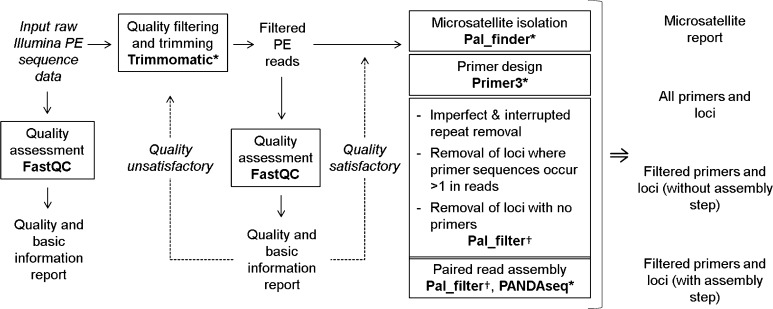
Microsatellites are useful tools for ecologists and conservationist biologists, but are taxa-specific and traditionally expensive and time-consuming to develop. New methods using next-generation sequencing (NGS) have reduced these problems, but the plethora of software available for processing NGS data may cause confusion and difficulty for researchers new to the field of bioinformatics. We developed a bioinformatics pipeline for microsatellite development from Illumina paired-end sequences, which is packaged in the open-source bioinformatics tool Galaxy. This optimises and streamlines the design of a microsatellite panel and provides a user-friendly graphical user interface. The pipeline utilises existing programs along with our own novel program and wrappers to: quality-filter and trim reads (Trimmomatic); generate sequence quality reports (FastQC); identify potentially-amplifiable microsatellite loci (Pal_finder); design primers (Primer3); assemble pairs of reads to enhance marker amplification success rates (PANDAseq); and filter optimal loci (Pal_filter). The complete pipeline is freely available for use via a pre-configured Galaxy instance, accessible at https://palfinder.ls.manchester.ac.uk.
微卫星对于生态学家和保护生物学家来说是有用的工具,但它们具有物种特异性,并且传统上开发起来成本高昂且耗时。使用下一代测序(NGS)的新方法减少了这些问题,然而,大量可用于处理NGS数据的软件可能会给生物信息学领域的新手研究人员带来困惑和困难。我们开发了一个用于从Illumina双端序列开发微卫星的生物信息学流程,该流程打包在开源生物信息学工具Galaxy中。这优化并简化了微卫星面板的设计,并提供了一个用户友好的图形用户界面。该流程利用现有的程序以及我们自己的新程序和包装器来:对 reads 进行质量过滤和修剪(Trimmomatic);生成序列质量报告(FastQC);识别潜在可扩增的微卫星位点(Pal_finder);设计引物(Primer3);组装 reads 对以提高标记扩增成功率(PANDAseq);以及筛选最佳位点(Pal_filter)。完整的流程可通过一个预配置的Galaxy实例免费使用,可在https://palfinder.ls.manchester.ac.uk访问。