Whittaker Carly, Macalpine William, Yates Nicola E, Shield Ian
Agro-ecology Department, Rothamsted Research, Harpenden, Hertfordshire AL5 2JQ UK.
Bioenergy Res. 2016;9(3):820-835. doi: 10.1007/s12155-016-9728-0. Epub 2016 Apr 13.
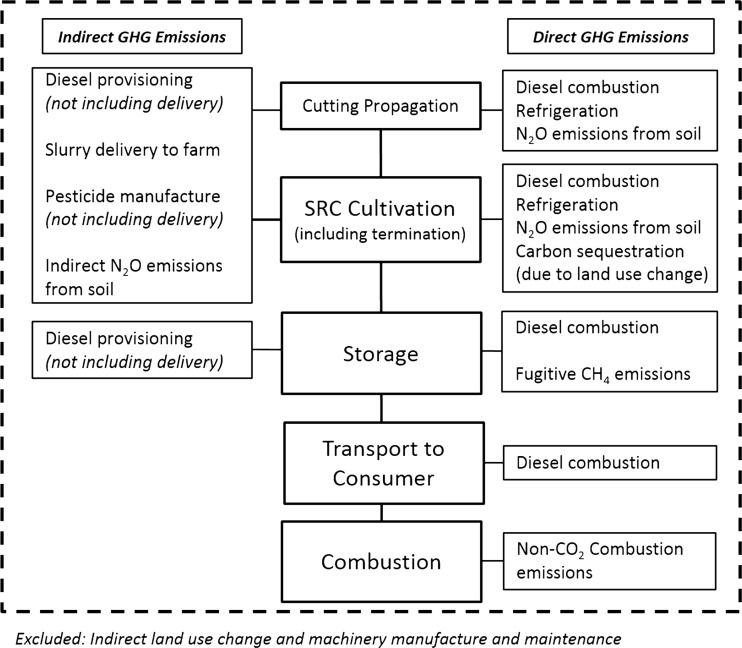
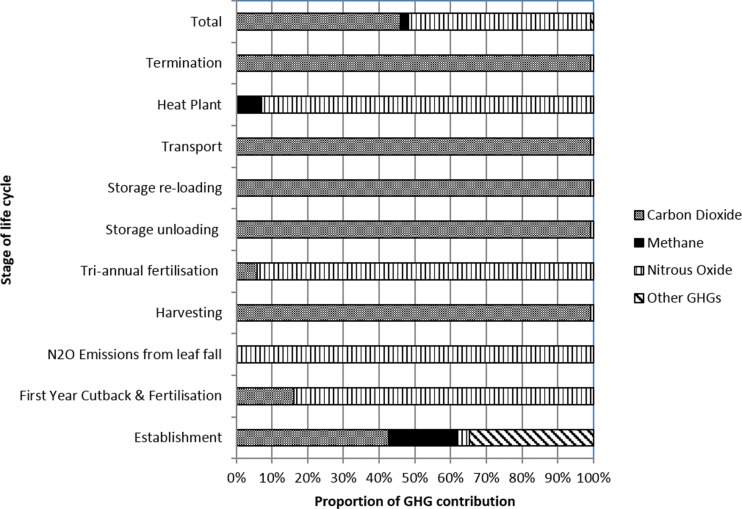
A life cycle assessment (LCA) approach was used to examine the greenhouse gas (GHG) emissions and energy balance of short rotation coppice (SRC) willow for heat production. The modelled supply chain includes cutting multiplication, site establishment, maintenance, harvesting, storage, transport and combustion. The relative impacts of dry matter losses and methane emissions from chip storage were examined from a LCA perspective, comparing the GHG emissions from the SRC supply chain with those of natural gas for heat generation. The results show that SRC generally provides very high GHG emission savings of over 90 %. The LCA model estimates that a 1, 10 and 20 % loss of dry matter during storage causes a 1, 6 and 11 % increase in GHG emissions per MWh. The GHG emission results are extremely sensitive to emissions of methane from the wood chip stack: If 1 % of the carbon within the stack undergoes anaerobic decomposition to methane, then the GHG emissions per MWh are tripled. There are some uncertainties in the LCA results, regarding the true formation of methane in wood chip stacks, non-CO emissions from combustion, NO emissions from leaf fall and the extent of carbon sequestered under the crop, and these all contribute a large proportion of the life cycle GHG emissions from cultivation of the crop.
采用生命周期评估(LCA)方法来研究用于供热的短轮伐期矮林(SRC)柳树的温室气体(GHG)排放和能量平衡。所模拟的供应链包括扦插繁殖、立地造林、养护、收获、储存、运输和燃烧。从生命周期评估的角度,研究了木屑储存过程中干物质损失和甲烷排放的相对影响,并将短轮伐期矮林供应链的温室气体排放与用于供热的天然气的温室气体排放进行了比较。结果表明,短轮伐期矮林通常能实现超过90%的温室气体排放大幅减排。生命周期评估模型估计,储存期间干物质损失1%、10%和20%会导致每兆瓦时温室气体排放分别增加1%、6%和11%。温室气体排放结果对木屑堆中的甲烷排放极为敏感:如果堆中1%的碳进行厌氧分解生成甲烷,那么每兆瓦时的温室气体排放将增加两倍。生命周期评估结果存在一些不确定性,涉及木屑堆中甲烷的实际生成、燃烧产生的非二氧化碳排放、落叶产生的一氧化氮排放以及作物下土壤的碳固存程度,这些因素在该作物种植的生命周期温室气体排放中占很大比例。