Centre for Healthcare Resilience and Implementation Science, Australian Institute of Health Innovation, Macquarie University, Level 6, 75 Talavera Road, Sydney, New South Wales, 2109, Australia.
Institute for Evidence-Based Health Care, Faculty of Health Sciences and Medicine, Bond University, Level 2, Building 5, 14 University Drive, Robina, Queensland, 4226, Australia.
BMC Med. 2020 May 4;18(1):102. doi: 10.1186/s12916-020-01563-4.
Healthcare represents a paradox. While change is everywhere, performance has flatlined: 60% of care on average is in line with evidence- or consensus-based guidelines, 30% is some form of waste or of low value, and 10% is harm. The 60-30-10 Challenge has persisted for three decades.
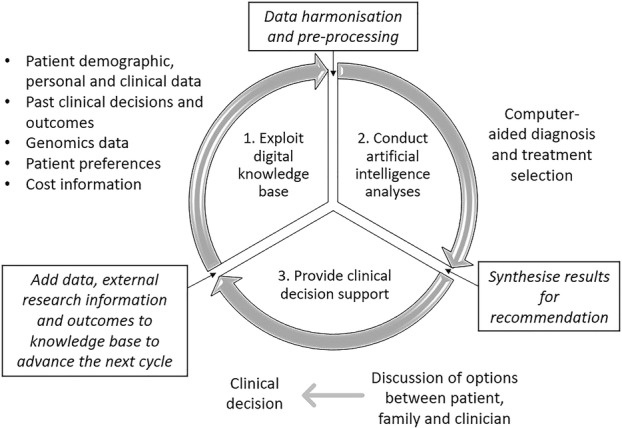
Current top-down or chain-logic strategies to address this problem, based essentially on linear models of change and relying on policies, hierarchies, and standardisation, have proven insufficient. Instead, we need to marry ideas drawn from complexity science and continuous improvement with proposals for creating a deep learning health system. This dynamic learning model has the potential to assemble relevant information including patients' histories, and clinical, patient, laboratory, and cost data for improved decision-making in real time, or close to real time. If we get it right, the learning health system will contribute to care being more evidence-based and less wasteful and harmful. It will need a purpose-designed digital backbone and infrastructure, apply artificial intelligence to support diagnosis and treatment options, harness genomic and other new data types, and create informed discussions of options between patients, families, and clinicians. While there will be many variants of the model, learning health systems will need to spread, and be encouraged to do so, principally through diffusion of innovation models and local adaptations.
Deep learning systems can enable us to better exploit expanding health datasets including traditional and newer forms of big and smaller-scale data, e.g. genomics and cost information, and incorporate patient preferences into decision-making. As we envisage it, a deep learning system will support healthcare's desire to continually improve, and make gains on the 60-30-10 dimensions. All modern health systems are awash with data, but it is only recently that we have been able to bring this together, operationalised, and turned into useful information by which to make more intelligent, timely decisions than in the past.
医疗保健领域存在一个悖论。尽管处处都在发生变化,但绩效却停滞不前:平均有 60%的护理符合基于证据或共识的指南,30%属于某种形式的浪费或低价值,10%则造成了伤害。“60-30-10 挑战”已经持续了三十年。
目前,解决这一问题的自上而下或链式逻辑策略,基本上基于线性的变革模型,并依赖于政策、层级结构和标准化,已被证明是不够的。相反,我们需要将复杂性科学和持续改进的理念与创建深度学习医疗体系的建议相结合。这种动态学习模型有可能整合相关信息,包括患者病史以及临床、患者、实验室和成本数据,以便实时或接近实时地进行决策。如果我们做对了,学习型医疗系统将有助于提高护理的循证水平,减少浪费和危害。它将需要一个专门设计的数字骨干和基础设施,应用人工智能来支持诊断和治疗方案,利用基因组和其他新型数据类型,并在患者、家属和临床医生之间进行知情的选择讨论。虽然该模型会有许多变体,但学习型医疗系统需要传播,并通过创新模型的扩散和本地化适应来鼓励这种传播。
深度学习系统可以使我们更好地利用不断扩大的健康数据集,包括传统和更新形式的大数据和较小规模数据,例如基因组学和成本信息,并将患者偏好纳入决策。在我们的设想中,深度学习系统将支持医疗保健不断改进的愿望,并在 60-30-10 维度上取得进展。所有现代医疗系统都充斥着数据,但直到最近,我们才能够将这些数据整合起来,使之运作,并转化为有用的信息,以便做出比过去更明智、更及时的决策。