Julius Center for Health Sciences and Primary Care University Medical Center Utrecht Utrecht University Utrecht the Netherlands.
Dutch Heart Foundation The Hague the Netherlands.
J Am Heart Assoc. 2020 May 5;9(9):e014733. doi: 10.1161/JAHA.119.014733. Epub 2020 May 4.
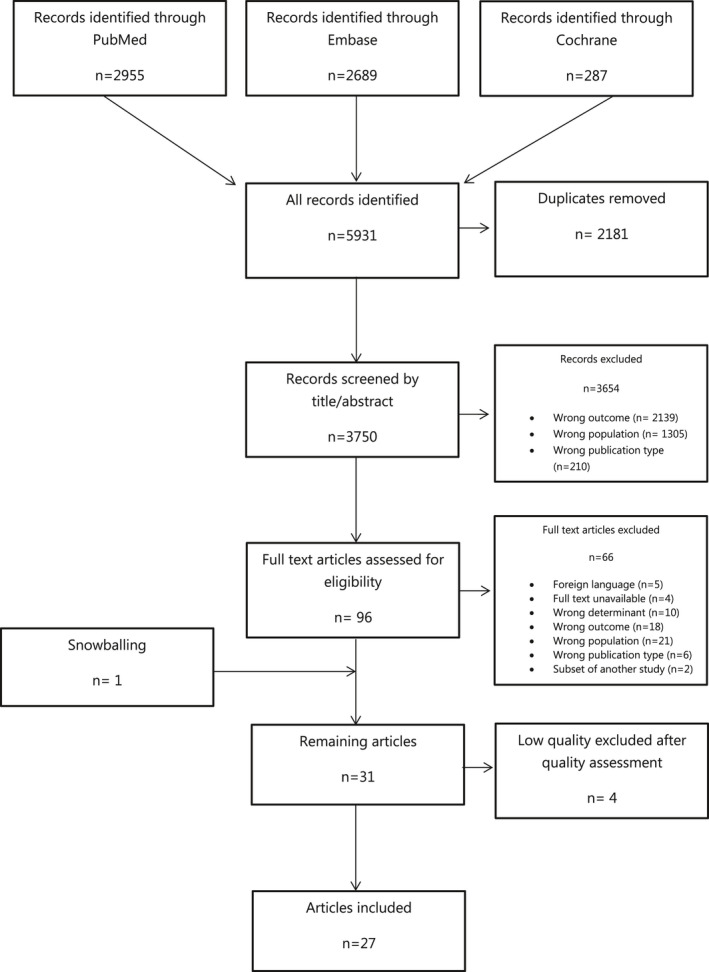
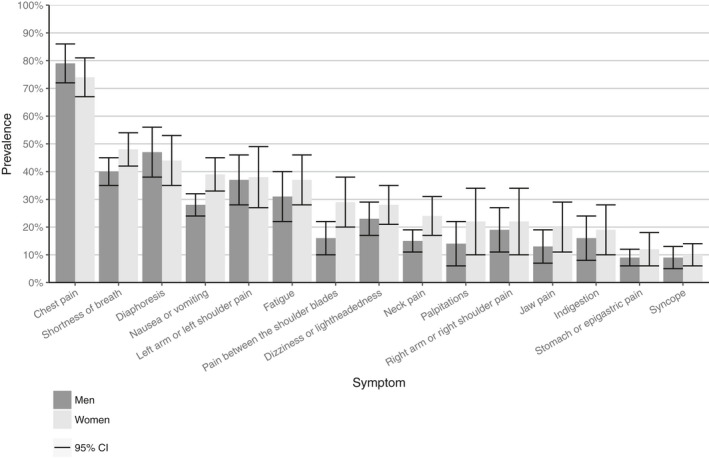
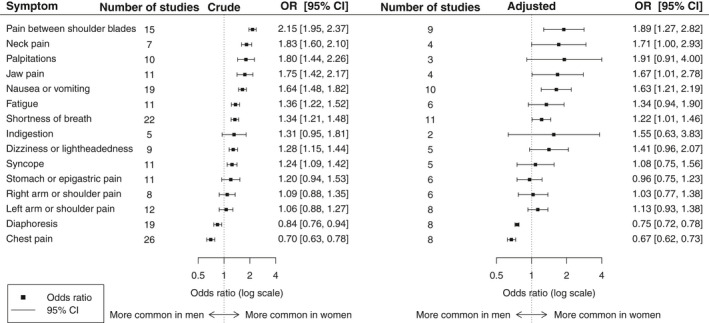
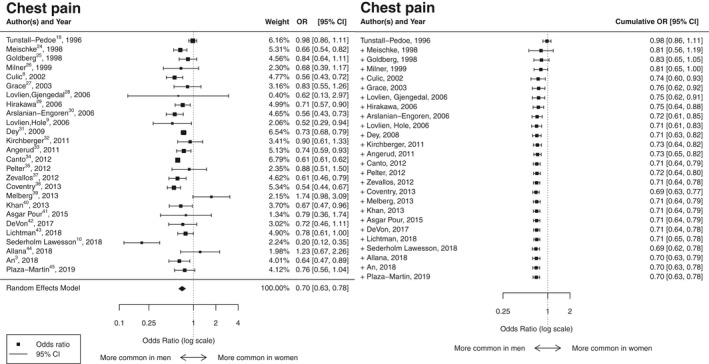
Background Timely recognition of patients with acute coronary syndromes (ACS) is important for successful treatment. Previous research has suggested that women with ACS present with different symptoms compared with men. This review assessed the extent of sex differences in symptom presentation in patients with confirmed ACS. Methods and Results A systematic literature search was conducted in PubMed, Embase, and Cochrane up to June 2019. Two reviewers independently screened title-abstracts and full-texts according to predefined inclusion and exclusion criteria. Methodological quality was assessed using the Newcastle-Ottawa Scale. Pooled odds ratios (OR) with 95% CI of a symptom being present were calculated using aggregated and cumulative meta-analyses as well as sex-specific pooled prevalences for each symptom. Twenty-seven studies were included. Compared with men, women with ACS had higher odds of presenting with pain between the shoulder blades (OR 2.15; 95% CI, 1.95-2.37), nausea or vomiting (OR 1.64; 95% CI, 1.48-1.82) and shortness of breath (OR 1.34; 95% CI, 1.21-1.48). Women had lower odds of presenting with chest pain (OR 0.70; 95% CI, 0.63-0.78) and diaphoresis (OR 0.84; 95% CI, 0.76-0.94). Both sexes presented most often with chest pain (pooled prevalences, men 79%; 95% CI, 72-85, pooled prevalences, women 74%; 95% CI, 72-85). Other symptoms also showed substantial overlap in prevalence. The presence of sex differences has been established since the early 2000s. Newer studies did not materially change cumulative findings. Conclusions Women with ACS do have different symptoms at presentation than men with ACS, but there is also considerable overlap. Since these differences have been shown for years, symptoms should no longer be labeled as "atypical" or "typical."
及时识别急性冠状动脉综合征(ACS)患者对于成功治疗非常重要。先前的研究表明,女性 ACS 患者的症状与男性不同。本综述评估了已确诊 ACS 患者在症状表现上的性别差异程度。
在 PubMed、Embase 和 Cochrane 中进行了系统文献检索,截至 2019 年 6 月。两位审查员根据预先设定的纳入和排除标准独立筛选标题-摘要和全文。使用纽卡斯尔-渥太华量表评估方法学质量。使用聚合和累积荟萃分析以及每个症状的特定性别汇总患病率来计算存在症状的汇总优势比(OR)和 95%置信区间(CI)。
共纳入 27 项研究。与男性相比,ACS 女性出现肩胛骨之间疼痛(OR 2.15;95%CI,1.95-2.37)、恶心或呕吐(OR 1.64;95%CI,1.48-1.82)和呼吸急促(OR 1.34;95%CI,1.21-1.48)的可能性更高。女性出现胸痛(OR 0.70;95%CI,0.63-0.78)和出汗(OR 0.84;95%CI,0.76-0.94)的可能性更低。两种性别最常出现胸痛(汇总患病率,男性 79%;95%CI,72-85,女性汇总患病率 74%;95%CI,72-85)。其他症状的患病率也存在相当大的重叠。自 21 世纪初以来,就已经确定了性别差异的存在。新的研究并没有实质性地改变累积发现。
ACS 女性在发病时的症状与 ACS 男性不同,但也有相当大的重叠。由于这些差异已经存在多年,因此症状不应再被标记为“非典型”或“典型”。