Department of Physics, Faculty of Sciences and Letters, Istanbul Kultur University, 34158 Istanbul, Turke.
Department of Chemistry, CQC, University of Coimbra, P-3004-535 Coimbra, Portugal.
Molecules. 2020 Apr 29;25(9):2079. doi: 10.3390/molecules25092079.
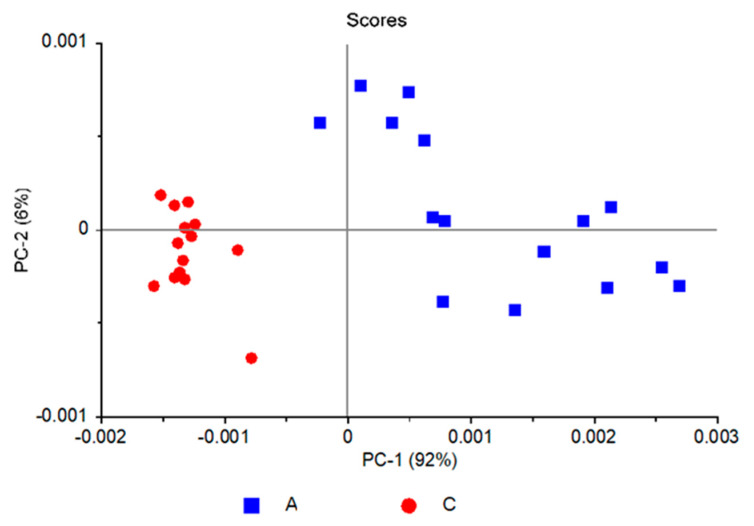
Autism spectrum disorder (ASD) is a neurodevelopmental disorder that begins early in life and continues lifelong with strong personal and societal implications. It affects about 1%-2% of the children population in the world. The absence of auxiliary methods that can complement the clinical evaluation of ASD increases the probability of false identification of the disorder, especially in the case of very young children. In this study, analytical models for auxiliary diagnosis of ASD in children and adolescents, based on the analysis of patients' blood serum ATR-FTIR (Attenuated Total Reflectance-Fourier Transform Infrared) spectra, were developed. The models use chemometrics (either Principal Component Analysis (PCA) or Partial Least Squares Discriminant Analysis (PLS-DA)) methods, with the infrared spectra being the -predictor variables. The two developed models exhibit excellent classification performance for samples of ASD individuals vs. healthy controls. Interestingly, the simplest, unsupervised PCA-based model results to have a global performance identical to the more demanding, supervised (PLS-DA)-based model. The developed PCA-based model thus appears as the more economical alternative one for use in the clinical environment. Hierarchical clustering analysis performed on the full set of samples was also successful in discriminating the two groups.
自闭症谱系障碍(ASD)是一种神经发育障碍,始于生命早期,并持续终生,对个人和社会都有很大的影响。它影响着全球约 1%-2%的儿童。缺乏可以补充 ASD 临床评估的辅助方法增加了该疾病被错误识别的可能性,尤其是对于非常年幼的儿童。在这项研究中,基于对患者血清 ATR-FTIR(衰减全反射-傅里叶变换红外)光谱的分析,开发了用于儿童和青少年自闭症辅助诊断的分析模型。这些模型使用化学计量学(主成分分析(PCA)或偏最小二乘判别分析(PLS-DA))方法,将红外光谱作为预测变量。这两个开发的模型对于 ASD 个体与健康对照组的样本表现出出色的分类性能。有趣的是,最简单的、无监督的基于 PCA 的模型结果与要求更高的、基于监督的(PLS-DA)模型具有相同的全局性能。因此,基于 PCA 的开发模型似乎是在临床环境中更经济的选择。对全组样本进行的层次聚类分析也成功地区分了这两组。