Fursov Mikhail V, Shitikov Egor A, Bespyatykh Julia A, Bogun Alexander G, Kislichkina Angelina A, Kombarova Tatiana I, Rudnitskaya Tatiana I, Grishenko Natalia S, Ganina Elena A, Domotenko Lubov V, Fursova Nadezhda K, Potapov Vasiliy D, Dyatlov Ivan A
State Research Center for Applied Microbiology and Biotechnology, Obolensk 142279, Russia.
Federal Research and Clinical Center of Physical-Chemical Medicine, Moscow 119435, Russia.
Pathogens. 2020 Apr 30;9(5):335. doi: 10.3390/pathogens9050335.
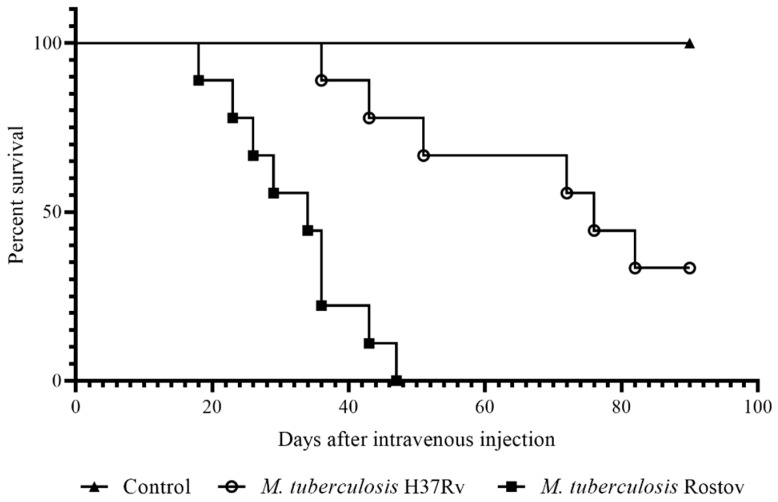
The Central Asia Outbreak (CAO) clade is a growing public health problem for Central Asian countries. Members of the clade belong to the narrow branch of the Beijing genotype and are characterized by multidrug resistance and increased transmissibility. The Rostov strain of isolated in Russia and attributed to the CAO clade based on PCR-assay and whole genome sequencing and the laboratory strain H37Rv were selected to evaluate the virulence on C57Bl/6 mice models by intravenous injection. All mice infected with the Rostov strain succumbed to death within a 48-day period, while more than half of the mice infected by the H37Rv strain survived within a 90-day period. Mice weight analysis revealed irreversible and severe depletion of animals infected with the Rostov strain compared to H37Rv. The histological investigation of lung and liver tissues of mice on the 30th day after injection of mycobacterial bacilli showed that the pattern of pathological changes generated by two strains were different. Moreover, bacterial load in the liver and lungs was higher for the Rostov strain infection. In conclusion, our data demonstrate that the drug-resistant Rostov strain exhibits a highly virulent phenotype which can be partly explained by the CAO-specific mutations.
中亚疫情(CAO)分支对中亚国家而言,正成为一个日益严重的公共卫生问题。该分支的成员属于北京基因型的一个狭窄分支,其特点是具有多重耐药性且传播性增强。选取了在俄罗斯分离出的、基于聚合酶链反应检测和全基因组测序归因于CAO分支的罗斯托夫菌株,以及实验室菌株H37Rv,通过静脉注射来评估它们对C57Bl/6小鼠模型的毒力。所有感染罗斯托夫菌株的小鼠在48天内死亡,而感染H37Rv菌株的小鼠超过半数在90天内存活。小鼠体重分析显示,与感染H37Rv菌株的小鼠相比,感染罗斯托夫菌株的小鼠出现了不可逆转的严重体重下降。对注射分枝杆菌后第30天的小鼠肺和肝组织进行组织学研究表明,两种菌株产生的病理变化模式不同。此外,罗斯托夫菌株感染时,肝脏和肺部的细菌载量更高。总之,我们的数据表明,耐药的罗斯托夫菌株表现出高毒力表型,这在一定程度上可由CAO特异性突变来解释。