Cicely Saunders Institute of Palliative Care, Policy and Rehabilitation, King's College London, London, UK.
Brighton General Hospital, Sussex Community NHS Foundation Trust, Brighton, UK.
Int J Chron Obstruct Pulmon Dis. 2020 Apr 20;15:841-855. doi: 10.2147/COPD.S238680. eCollection 2020.
People living with both chronic obstructive pulmonary disease (COPD) and frailty have high potential to benefit from exercise-based interventions, including pulmonary rehabilitation, but face challenges completing them. Research to understand ways to optimise exercise-based interventions in this group is lacking. We aimed to understand how exercise-based interventions might improve outcomes for people living with both COPD and frailty.
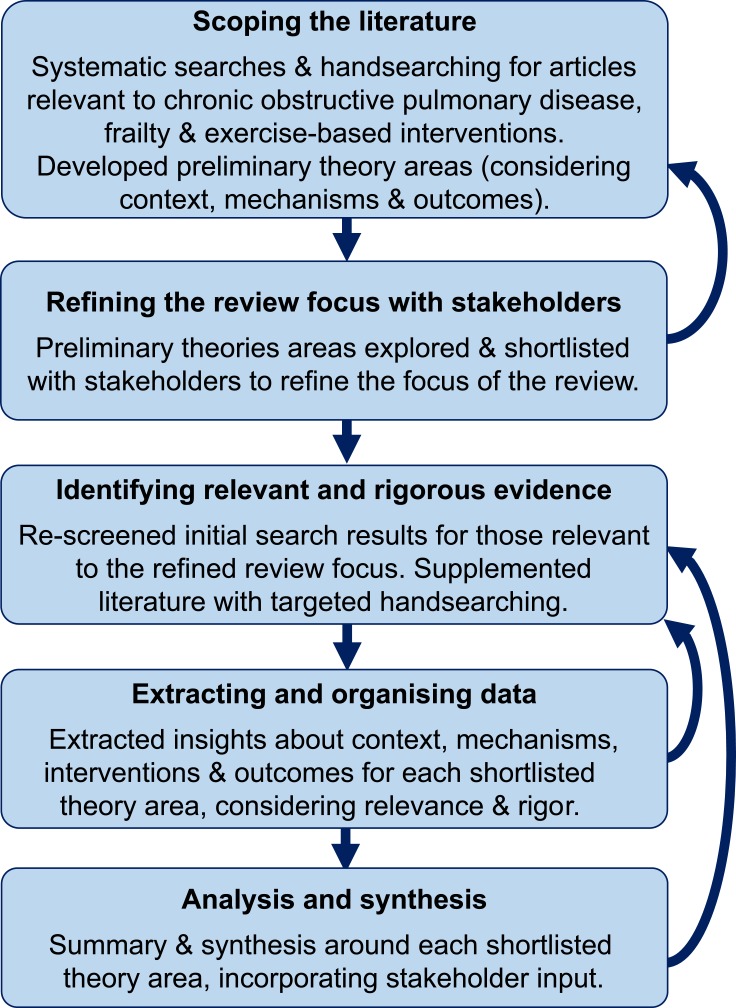
This realist review used database searches and handsearching until October 2019 to identify articles of relevance to exercise-based interventions for people living with COPD and frailty. A scoping search explored what is important about the context of living with COPD and frailty, and what mechanisms might be important in how exercise-based interventions result in their intended outcomes. Through discussion with stakeholders, the review scope was refined to areas deemed pertinent to improving care. We retained articles within this refined scope and identified additional articles through targeted handsearching. Data were extracted and synthesised in a narrative, prioritised by relevance and rigour.
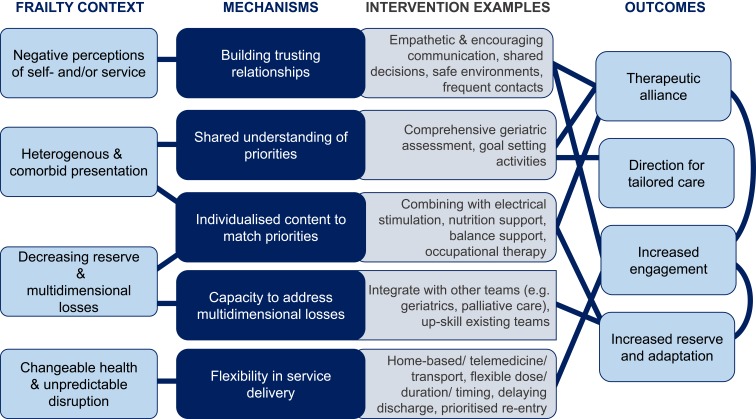
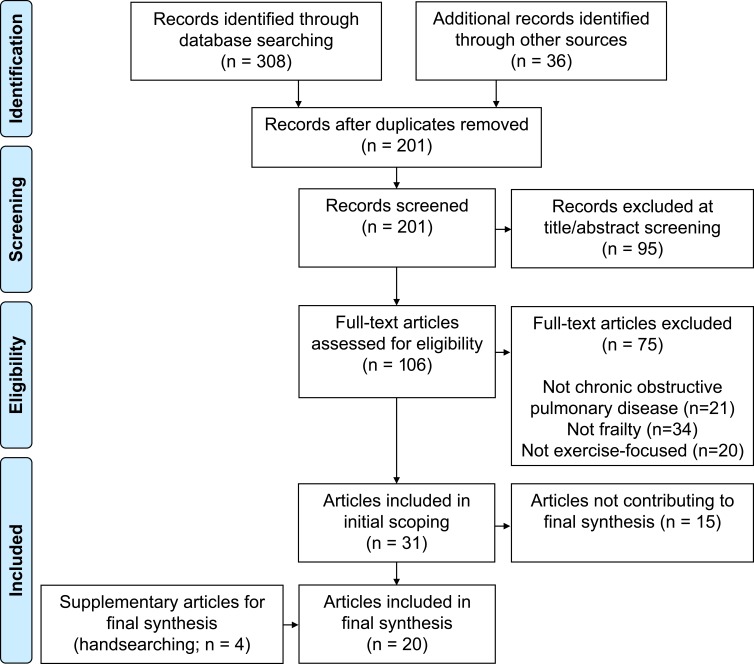
Of 344 records identified, 35 were included in the review and 20 informed the final synthesis. Important contextual factors to consider included: negative beliefs about themselves and exercise-based interventions; heterogenous presentation and comorbidities; decreased reserves and multidimensional loss; and experiencing unpredictable health and disruptions. In these circumstances, mechanisms that may help maximise outcomes from exercise-based interventions included: trusting relationships; creating a shared understanding of needs; having the capacity to address multidimensional concerns; being able to individualise approaches to needs and priorities; and flexible approaches to intervention delivery. Mixed-methods research and explicit theorising were often absent.
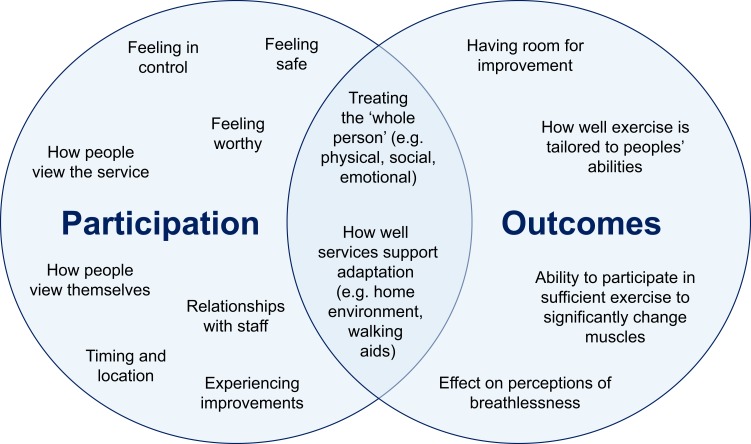
Building trusting relationships, understanding priorities, using individualised and multidisciplinary approaches, and flexible service delivery can improve the value of exercise-based interventions for people living with both COPD and frailty. Development and evaluation of new and adapted interventions should consider these principles.
患有慢性阻塞性肺疾病(COPD)和衰弱的人有很大的潜力从基于运动的干预措施中受益,包括肺康复,但他们在完成这些干预措施方面面临挑战。缺乏研究来了解如何优化这一人群的基于运动的干预措施。我们旨在了解基于运动的干预措施如何改善患有 COPD 和衰弱的人的预后。
本真实主义综述使用数据库搜索和手工搜索,截至 2019 年 10 月,以确定与 COPD 和衰弱患者的基于运动的干预措施相关的文章。范围搜索探索了与 COPD 和衰弱共存的环境的重要性,以及在基于运动的干预措施如何导致其预期结果方面,哪些机制可能很重要。通过与利益相关者的讨论,审查范围缩小到被认为对改善护理有帮助的领域。我们保留了该范围内的文章,并通过有针对性的手工搜索确定了其他文章。数据以叙述方式提取和综合,按相关性和严谨性进行排序。
在 344 条记录中,有 35 条被纳入综述,20 条为最终综合提供了信息。需要考虑的重要环境因素包括:对自己和基于运动的干预措施的负面看法;表现异质性和合并症;储备减少和多维损失;以及经历不可预测的健康和中断。在这种情况下,可能有助于最大限度地提高基于运动的干预措施效果的机制包括:建立信任关系;共同理解需求;有能力解决多维问题;能够根据需求和优先事项进行个体化方法;以及灵活的干预措施交付方式。混合方法研究和明确的理论化往往是缺失的。
建立信任关系、了解优先级、使用个体化和多学科方法以及灵活的服务交付可以提高基于运动的干预措施对患有 COPD 和衰弱的人的价值。新的和适应性干预措施的开发和评估应考虑这些原则。