Public Health, Department of Social Medicine, Osaka University Graduate School of Medicine, Osaka 5650871, Japan.
Department of Public Health, Hokkaido University Graduate School of Medicine, Sapporo 0608638, Japan.
Nutrients. 2020 May 2;12(5):1296. doi: 10.3390/nu12051296.
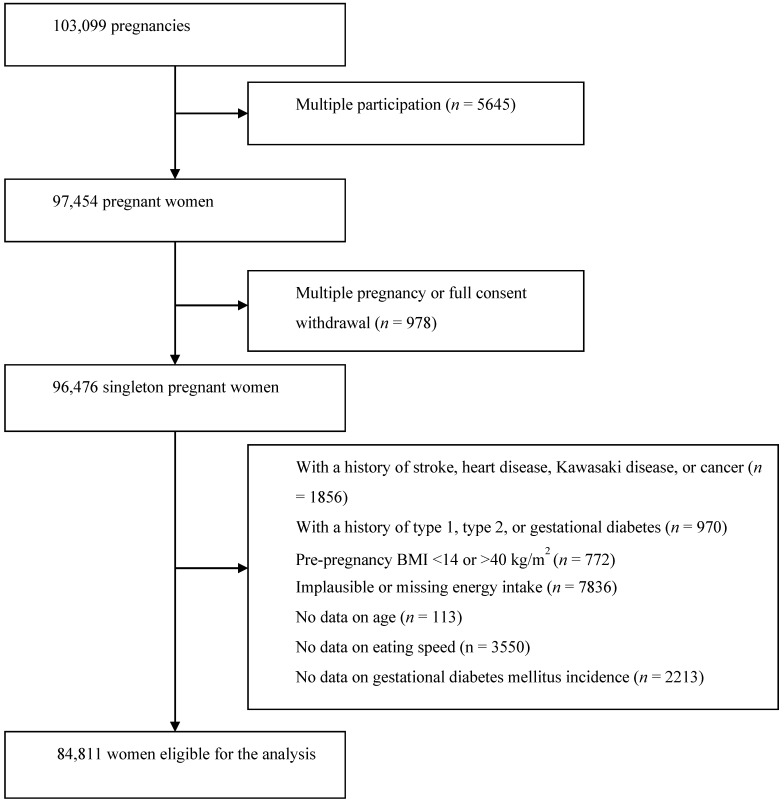
There is little evidence linking eating speed to gestational diabetes mellitus (GDM) incidence. We therefore aimed to evaluate the prospective association of eating speed with GDM incidence. Overall, 97,454 pregnant women were recruited between January 2011 and March 2014. Singleton pregnant women who did not have GDM, heart disease, stroke, cancer, type 1 diabetes, and/or type 2 diabetes at the time of study enrollment were eligible. Each woman was asked about her eating speed at that time via a questionnaire. Odds ratios of GDM in relation to eating speed were obtained using logistic regression. Among the 84,811 women eligible for analysis, 1902 cases of GDM were identified in medical records. Compared with women who reported slow eating speed, the age-adjusted odds ratios (95% confidence interval) of GDM for women who reported medium, relatively fast, or very fast eating speed were 1.03 (0.90, 1.18), 1.07 (0.94, 1.23), and 1.28 (1.05, 1.58), respectively. Adjustment for demographic, lifestyle-related, and dietary factors including dietary fat, dietary fiber, and energy intakes yielded similar results. The association was attenuated and no longer significant after further adjustment for pre-pregnancy body mass index. The mediation analysis showed that being overweight accounted for 64% of the excess risk of GDM associated with eating speed. In conclusion, women who reported very fast eating speed, compared with those reporting slow eating speed, were associated with an increased incidence of GDM, which may be largely mediated by increased body fat.
目前很少有证据表明进食速度与妊娠期糖尿病(GDM)的发生有关。因此,我们旨在评估进食速度与 GDM 发生的前瞻性关联。
总体而言,我们在 2011 年 1 月至 2014 年 3 月期间招募了 97454 名孕妇。研究入组时无 GDM、心脏病、中风、癌症、1 型糖尿病和/或 2 型糖尿病的单胎孕妇符合条件。每位女性都通过问卷被问及当时的进食速度。使用逻辑回归获得与进食速度相关的 GDM 比值比。在 84811 名符合分析条件的女性中,有 1902 例 GDM 在病历中被确诊。与进食速度较慢的女性相比,报告进食速度中等、相对较快或非常快的女性患 GDM 的年龄调整比值比(95%置信区间)分别为 1.03(0.90,1.18)、1.07(0.94,1.23)和 1.28(1.05,1.58)。调整人口统计学、生活方式相关和饮食因素,包括膳食脂肪、膳食纤维和能量摄入,得到了类似的结果。在进一步调整孕前体重指数后,该关联减弱且不再显著。中介分析表明,超重占与进食速度相关的 GDM 风险增加的 64%。
总之,与进食速度较慢的女性相比,报告进食速度非常快的女性发生 GDM 的风险增加,这可能在很大程度上是由体脂增加引起的。