APPNA Institute of Public Health Jinnah Sindh Medical University, Karachi, Sindh, Pakistan.
Public Health, APPNA Institute of Public Health Jinnah Sindh Medical University, Karachi, Pakistan.
BMJ Glob Health. 2020 Apr 15;5(4):e002112. doi: 10.1136/bmjgh-2019-002112. eCollection 2020.
To determine the magnitude and determinants of violence against healthcare workers (HCWs) and to identify the predominant types and causes of violence experienced by them.
A cross-sectional survey based on structured questionnaire adopted from previous surveys and qualitative data was conducted in 4 large cities and 12 districts in 3 provinces of Pakistan. The survey covered 8579 from all cadres of HCWs, including doctors, nurses, technicians, support staff, ambulance workers, vaccinators, lady health visitors, midwives and lady health workers (LHWs). The predictors of overall violence experienced, physical violence experienced and verbal violence experienced were separately analysed for tertiary care hospitals, secondary care hospitals, primary care hospitals and field-level HCWs. Logistic regression was used to compute adjusted ORs with 95% CIs for the association of different factors with the violence experienced.
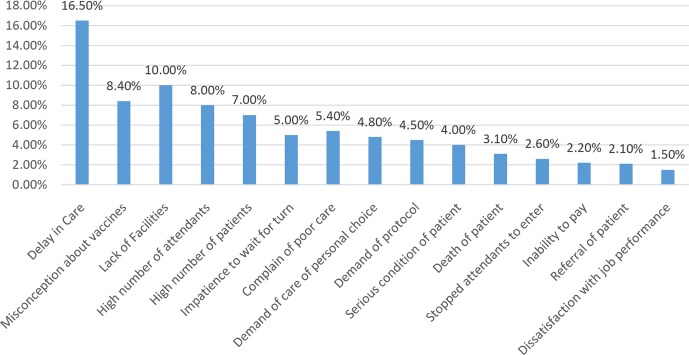
More than one-third (38.4%) reported having experienced any form of violence in the last 6 months. Verbal violence was the most commonly experienced form (33.9%), followed by physical violence (6.6%). The main reasons for physical violence were death of patients (17.6%), serious condition of patients (16.6%) and delay in care (13.4%). Among the different types of field HCWs, emergency vehicle operators were significantly more likely to experience verbal violence compared with LHWs (adjusted OR=1.97; 95% CI 1.31 to 2.94; p=0.001). Among hospital HCWs, those working in private hospitals were significantly less likely to experience physical violence (adjusted OR=0.52; 95% CI 0.38 to 0.71; p=0.001) and verbal violence (adjusted OR=0.57; 95% CI 0.48 to 0.68; p=0.001).
Violence against HCWs exists in various forms among all cadres and at different levels of care. The gaps in capacity, resources and policies are evident. Specific strategies need to be adopted for different types of HCWs to protect them against violence.*The study was conducted under the framework of ICRC's Healthcare in Danger Initiative for protection of healthcare against Violence.
确定针对医护人员(HCWs)的暴力行为的严重程度和决定因素,并确定他们所经历的主要类型和原因的暴力行为。
本研究基于从先前的调查和定性数据中采用的结构化问卷,在巴基斯坦的 3 个省的 4 个大城市和 12 个区进行了横断面调查。该调查涵盖了包括医生、护士、技术人员、支持人员、救护车工作人员、疫苗接种者、妇女保健访问者、助产士和妇女保健工作者(LHWs)在内的所有医护人员阶层的 8579 人。分别分析了三级保健医院、二级保健医院、一级保健医院和现场一级医护人员的整体经历暴力、经历身体暴力和经历言语暴力的预测因素。使用逻辑回归计算了不同因素与经历暴力之间的关联的调整后 OR(95%CI)。
超过三分之一(38.4%)的人报告在过去 6 个月内经历过任何形式的暴力。言语暴力是最常见的形式(33.9%),其次是身体暴力(6.6%)。身体暴力的主要原因是患者死亡(17.6%)、患者病情严重(16.6%)和护理延误(13.4%)。在不同类型的现场医护人员中,与 LHWs 相比,紧急车辆操作人员经历言语暴力的可能性显著更高(调整后的 OR=1.97;95%CI 1.31 至 2.94;p=0.001)。在医院医护人员中,在私立医院工作的人经历身体暴力(调整后的 OR=0.52;95%CI 0.38 至 0.71;p=0.001)和言语暴力(调整后的 OR=0.57;95%CI 0.48 至 0.68;p=0.001)的可能性明显较低。
各种形式的暴力行为都存在于各级医护人员中。能力、资源和政策方面的差距显而易见。需要针对不同类型的医护人员采取具体策略,以保护他们免受暴力侵害。*该研究是在 ICRC 的 Healthcare in Danger Initiative 框架下进行的,旨在保护医疗保健免受暴力侵害。