RAND Corporation, 4570 Fifth Avenue, Suite 600, Pittsburgh, PA, 15213, USA.
Robert Wood Johnson Foundation, Princeton, NJ, USA.
BMC Public Health. 2020 May 7;20(1):635. doi: 10.1186/s12889-020-08507-w.
Civic engagement, including voting, volunteering, and participating in civic organizations, is associated with better psychological, physical and behavioral health and well-being. In addition, civic engagement is increasingly viewed (e.g., in Robert Wood Johnson Foundation's Culture of Health action framework) as a potentially important driver for raising awareness of and addressing unhealthy conditions in communities. As such, it is important to understand the factors that may promote civic engagement, with a particular focus on the less-understood, health civic engagement, or civic engagement in health-related and health-specific activities. Using data from a nationally representative sample of adults in the United States (U.S.), we examined whether the extent to which individuals feel they belong in their community (i.e., perceived sense of community) and the value they placed on investing in community health were associated with individuals' health civic engagement.
Using data collected on 7187 nationally representative respondents from the 2018 National Survey of Health Attitudes, we examined associations between sense of community, valued investment in community health, and perceived barriers to taking action to invest in community health, with health civic engagement. We constructed continuous scales for each of these constructs and employed multiple linear regressions adjusting for multiple covariates including U.S. region and city size of residence, educational attainment, family income, race/ethnicity, household size, employment status, and years living in the community.
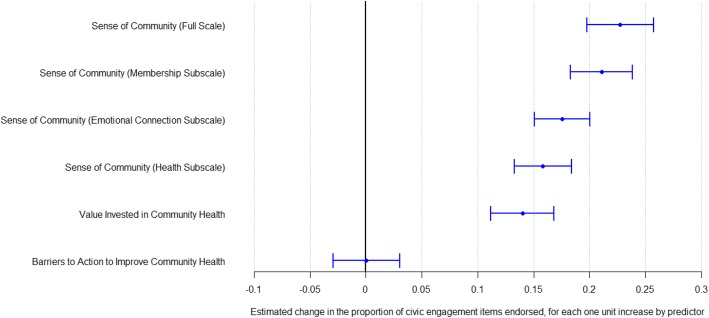
Participants who endorsed (i.e., responded with mostly or completely) all 16 sense of community scale items endorsed an average of 22.8% (95%CI: 19.8-25.7%) more of the health civic engagement scale items compared with respondents who did not endorse any of the sense of community items. Those who endorsed (responded that it was an important or top priority) all items capturing valued investment in community health endorsed 14.0% (95%CI: 11.2-16.8%) more of the health civic engagement items than those who did not endorse any valued investment in community health items.
Health civic engagement, including voting and volunteering to ultimately guide government decisions about health issues, may help improve conditions that influence health and well-being for all. Focusing on individuals' sense of community and highlighting investments in community health may concurrently be associated with increased health civic engagement and improved community and population health.
公民参与,包括投票、志愿服务和参与公民组织,与更好的心理、身体和行为健康和福祉有关。此外,公民参与越来越被视为(例如,在罗伯特伍德约翰逊基金会的健康文化行动框架中)是提高社区对不健康状况的认识和解决这些状况的一个潜在重要驱动因素。因此,了解可能促进公民参与的因素非常重要,特别是要关注不太被理解的健康公民参与,或与健康相关和特定于健康的活动中的公民参与。本研究使用来自美国全国代表性成年人样本的数据,考察了个人对自己所在社区的归属感(即感知社区感)以及他们对投资社区健康的重视程度与个人健康公民参与之间的关系。
使用 2018 年全国健康态度调查收集的 7187 名全国代表性受访者的数据,本研究考察了社区感、对社区健康投资的重视程度以及对投资社区健康的行动障碍感知与健康公民参与之间的关系。我们为这些结构中的每一个都构建了连续的量表,并采用多元线性回归,调整了美国地区和居住城市规模、教育程度、家庭收入、种族/民族、家庭规模、就业状况和在社区居住年限等多个协变量。
与不认同任何社区感项目的受访者相比,认同社区感量表中所有 16 个项目的参与者平均认同 22.8%(95%置信区间:19.8-25.7%)更多的健康公民参与项目。与不认同任何社区健康投资项目的受访者相比,认同所有捕捉到社区健康投资的重要性或优先性的项目的参与者,认同 14.0%(95%置信区间:11.2-16.8%)更多的健康公民参与项目。
健康公民参与,包括投票和自愿参与,最终指导政府关于健康问题的决策,可能有助于改善影响所有人健康和福祉的条件。关注个人的社区意识,强调对社区健康的投资,可能会同时与增加健康公民参与以及改善社区和人口健康相关。