Bevan Jones Rhys, Thapar Anita, Rice Frances, Mars Becky, Agha Sharifah Shameem, Smith Daniel, Merry Sally, Stallard Paul, Thapar Ajay K, Jones Ian, Simpson Sharon A
Division of Psychological Medicine and Clinical Neurosciences, Medical Research Council Centre for Neuropsychiatric Genetics and Genomics, Cardiff University, Cardiff, Wales, United Kingdom.
National Centre for Mental Health, Cardiff University, Cardiff, Wales, United Kingdom.
JMIR Ment Health. 2020 Jul 17;7(7):e14536. doi: 10.2196/14536.
Treatment and prevention guidelines highlight the key role of health information and evidence-based psychosocial interventions for adolescent depression. Digital health technologies and psychoeducational interventions have been recommended to help engage young people and to provide accurate health information, enhance self-management skills, and promote social support. However, few digital psychoeducational interventions for adolescent depression have been robustly developed and evaluated in line with research guidance.
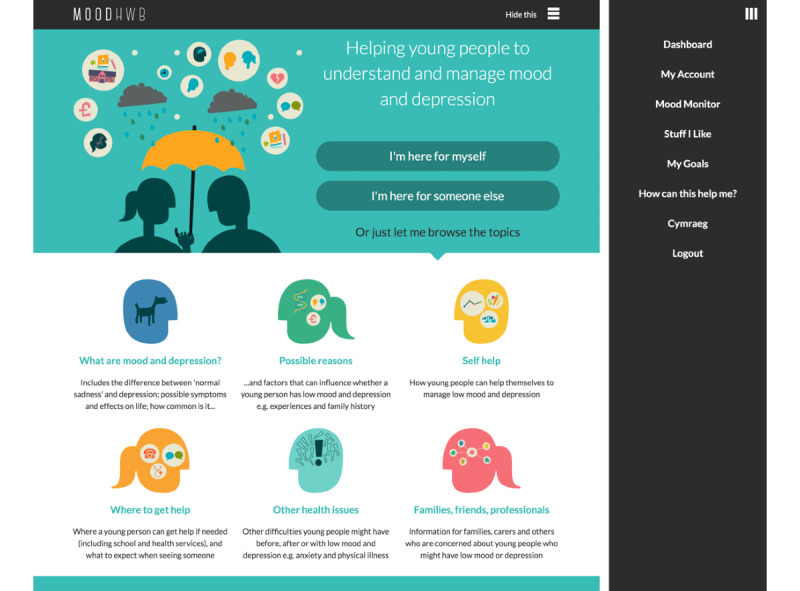
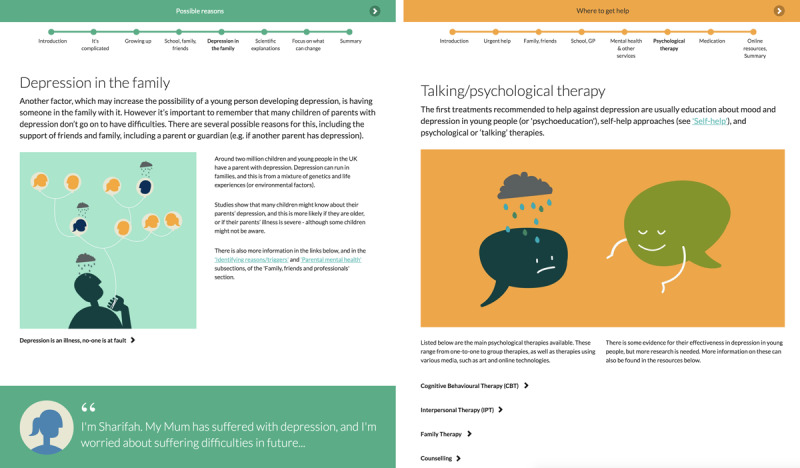
We aimed to evaluate the feasibility, acceptability, and potential impact of a theory-informed, co-designed digital intervention program, MoodHwb.
We used a mixed methods (quantitative and qualitative) approach to evaluate the program and the assessment process. Adolescents with or at elevated risk of depression and their parents and carers were recruited from mental health services, school counselors and nurses, and participants from a previous study. They completed a range of questionnaires before and after the program (related to the feasibility and acceptability of the program and evaluation process, and changes in mood, knowledge, attitudes, and behavior), and their Web usage was monitored. A subsample was also interviewed. A focus group was conducted with professionals from health, education, social, and youth services and charities. Interview and focus group transcripts were analyzed using thematic analysis with NVivo 10 (QSR International Pty Ltd).
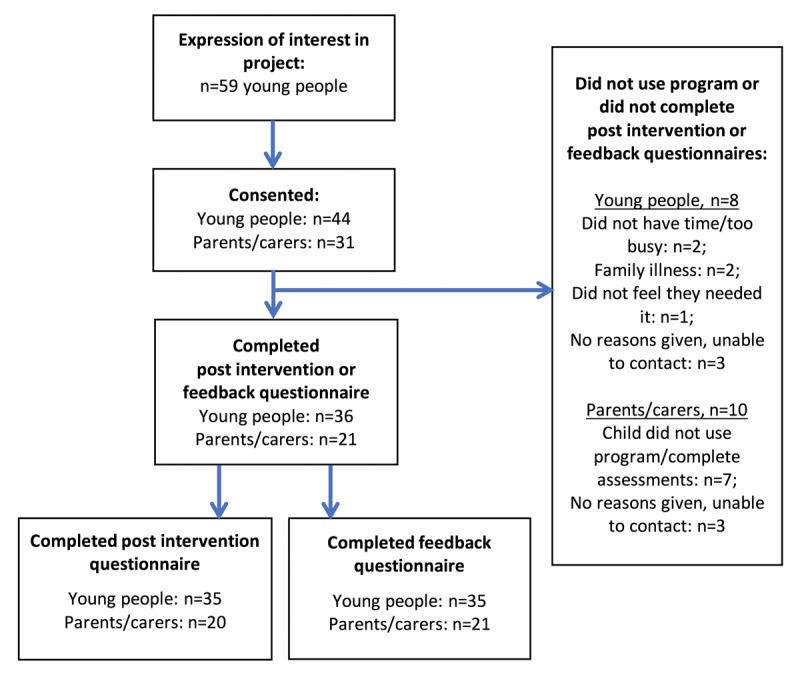
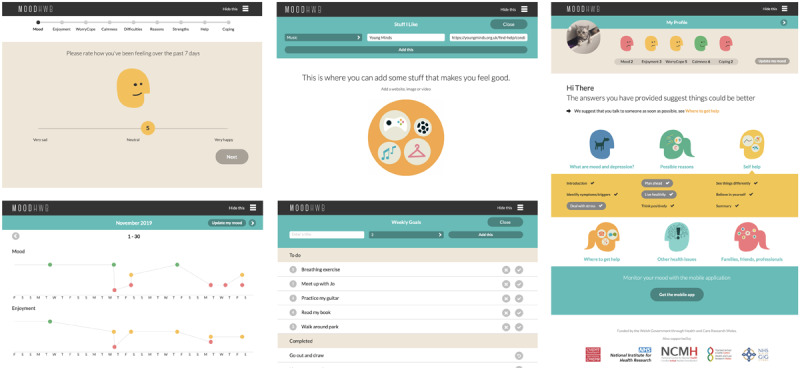
A total of 44 young people and 31 parents or carers were recruited, of which 36 (82%) young people and 21 (68%) parents or carers completed follow-up questionnaires. In all, 19 young people and 12 parents or carers were interviewed. Overall, 13 professionals from a range of disciplines participated in the focus group. The key themes from the interviews and groups related to the design features, sections and content, and integration and context of the program in the young person's life. Overall, the participants found the intervention engaging, clear, user-friendly, and comprehensive, and stated that it could be integrated into existing services. Young people found the "Self help" section and "Mood monitor" particularly helpful. The findings provided initial support for the intervention program theory, for example, depression literacy improved after using the intervention (difference in mean literacy score: 1.7, 95% CI 0.8 to 2.6; P<.001 for young people; 1.3, 95% CI 0.4 to 2.2; P=.006 for parents and carers).
Findings from this early stage evaluation suggest that MoodHwb and the assessment process were feasible and acceptable, and that the intervention has the potential to be helpful for young people, families and carers as an early intervention program in health, education, social, and youth services and charities. A randomized controlled trial is needed to further evaluate the digital program.
治疗与预防指南强调了健康信息及循证心理社会干预对青少年抑郁症的关键作用。数字健康技术和心理教育干预已被推荐用于帮助吸引年轻人、提供准确的健康信息、增强自我管理技能并促进社会支持。然而,很少有针对青少年抑郁症的数字心理教育干预措施依据研究指南得到充分开发和评估。
我们旨在评估一个基于理论、共同设计的数字干预项目MoodHwb的可行性、可接受性及潜在影响。
我们采用混合方法(定量和定性)来评估该项目及评估过程。从心理健康服务机构、学校辅导员和护士以及之前一项研究的参与者中招募有抑郁症或抑郁症风险升高的青少年及其父母和照料者。他们在项目前后完成了一系列问卷(与项目的可行性、可接受性及评估过程相关,以及情绪、知识、态度和行为的变化),并对其网络使用情况进行了监测。还对一个子样本进行了访谈。与来自健康、教育、社会、青年服务和慈善机构的专业人员进行了焦点小组讨论。使用NVivo 10(QSR国际私人有限公司)通过主题分析对访谈和焦点小组记录进行了分析。
共招募了44名年轻人和31名父母或照料者,其中36名(82%)年轻人和21名(68%)父母或照料者完成了随访问卷。总共对19名年轻人和12名父母或照料者进行了访谈。总体而言,来自一系列学科的13名专业人员参加了焦点小组讨论。访谈和小组讨论的关键主题涉及项目的设计特点、章节和内容以及在年轻人生活中的整合与背景。总体而言,参与者认为该干预措施引人入胜、清晰、用户友好且全面,并表示它可以融入现有服务。年轻人发现“自助”部分和“情绪监测器”特别有帮助。研究结果为干预项目理论提供了初步支持,例如,使用该干预措施后抑郁症知识有所提高(平均知识得分差异:年轻人为1.7,95%置信区间0.8至2.6;P<0.001;父母和照料者为1.3,95%置信区间0.4至2.2;P = 0.006)。
这一早期阶段评估的结果表明,MoodHwb和评估过程是可行且可接受的,并且该干预措施作为健康、教育、社会、青年服务和慈善机构的早期干预项目,有可能对年轻人、家庭和照料者有所帮助。需要进行一项随机对照试验来进一步评估该数字项目。