Cardiovascular Research Center, Lewis Katz School of Medicine, Temple University, Philadelphia, PA 19140, USA.
Department of Surgery, Lewis Katz School of Medicine, Temple University, Philadelphia, PA 19140, USA.
Cardiovasc Res. 2021 Feb 22;117(3):971-982. doi: 10.1093/cvr/cvaa133.
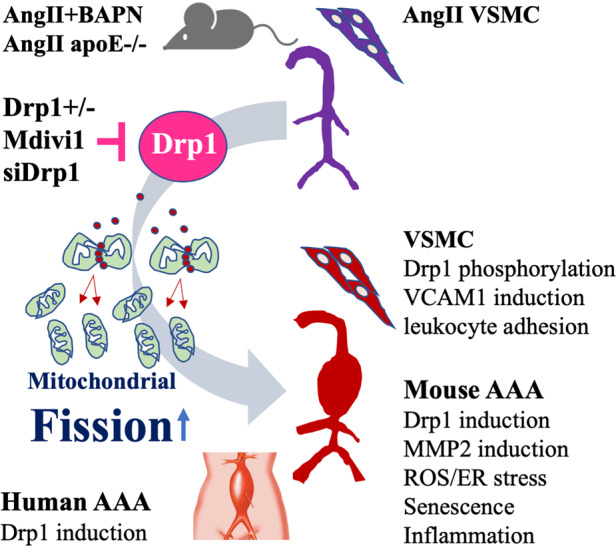
Angiotensin II (AngII) is a potential contributor to the development of abdominal aortic aneurysm (AAA). In aortic vascular smooth muscle cells (VSMCs), exposure to AngII induces mitochondrial fission via dynamin-related protein 1 (Drp1). However, pathophysiological relevance of mitochondrial morphology in AngII-associated AAA remains unexplored. Here, we tested the hypothesis that mitochondrial fission is involved in the development of AAA.
Immunohistochemistry was performed on human AAA samples and revealed enhanced expression of Drp1. In C57BL6 mice treated with AngII plus β-aminopropionitrile, AAA tissue also showed an increase in Drp1 expression. A mitochondrial fission inhibitor, mdivi1, attenuated AAA size, associated aortic pathology, Drp1 protein induction, and mitochondrial fission but not hypertension in these mice. Moreover, western-blot analysis showed that induction of matrix metalloproteinase-2, which precedes the development of AAA, was blocked by mdivi1. Mdivi1 also reduced the development of AAA in apolipoprotein E-deficient mice infused with AngII. As with mdivi1, Drp1+/- mice treated with AngII plus β-aminopropionitrile showed a decrease in AAA compared to control Drp1+/+ mice. In abdominal aortic VSMCs, AngII induced phosphorylation of Drp1 and mitochondrial fission, the latter of which was attenuated with Drp1 silencing as well as mdivi1. AngII also induced vascular cell adhesion molecule-1 expression and enhanced leucocyte adhesion and mitochondrial oxygen consumption in smooth muscle cells, which were attenuated with mdivi1.
These data indicate that Drp1 and mitochondrial fission play salient roles in AAA development, which likely involves mitochondrial dysfunction and inflammatory activation of VSMCs.
血管紧张素 II(AngII)可能是腹主动脉瘤(AAA)发展的一个促成因素。在主动脉血管平滑肌细胞(VSMCs)中,血管紧张素 II 通过与动力相关蛋白 1(Drp1)相互作用诱导线粒体裂变。然而,AngII 相关 AAA 中与线粒体形态相关的病理生理学相关性仍未得到探索。在这里,我们检验了线粒体裂变参与 AAA 发展的假设。
对人 AAA 样本进行免疫组织化学染色,结果显示 Drp1 表达增强。在接受 AngII 和β-氨基丙腈处理的 C57BL6 小鼠中,AAA 组织中 Drp1 的表达也增加。线粒体裂变抑制剂 mdivi1 减弱了这些小鼠的 AAA 大小、相关的主动脉病理学、Drp1 蛋白诱导和线粒体裂变,但对高血压没有影响。此外,Western blot 分析显示,mdivi1 阻断了 MMP-2 的诱导,MMP-2 的诱导先于 AAA 的发生。mdivi1 还减少了 AngII 输注的载脂蛋白 E 缺陷型小鼠的 AAA 发生。与 mdivi1 一样,接受 AngII 和β-氨基丙腈处理的 Drp1+/- 小鼠的 AAA 发生率较 Drp1+/+ 对照小鼠降低。在腹主动脉 VSMCs 中,AngII 诱导 Drp1 磷酸化和线粒体裂变,后者可通过 Drp1 沉默和 mdivi1 减弱。AngII 还诱导血管细胞黏附分子-1 的表达,并增强平滑肌细胞中的白细胞黏附和线粒体耗氧量,mdivi1 可减弱这些效应。
这些数据表明,Drp1 和线粒体裂变在 AAA 的发展中起着重要作用,这可能涉及线粒体功能障碍和 VSMCs 的炎症激活。