Department of Health and Environmental Sciences, Kyoto University Graduate School of Medicine, Kyoto, 606-8501, Japan.
Yufune Healthcare Center, Kawauchi Village Office, Fukushima, 979-1202, Japan.
Environ Health Prev Med. 2020 May 8;25(1):13. doi: 10.1186/s12199-020-00852-x.
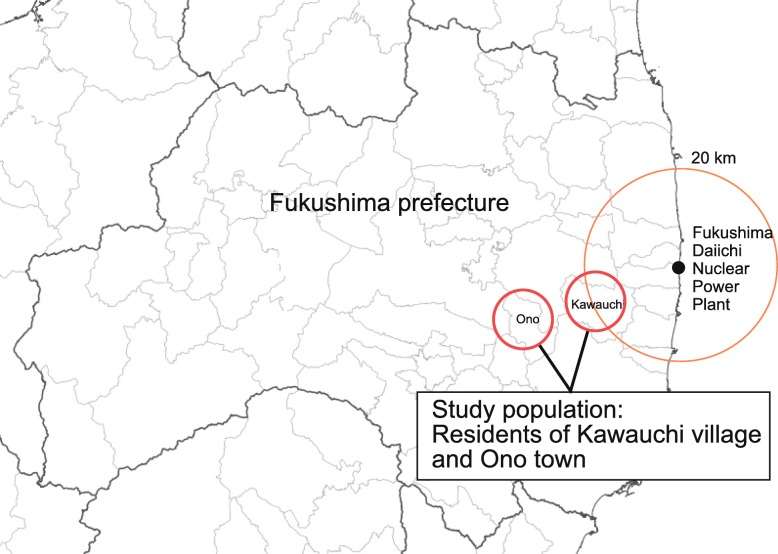
After the Fukushima Daiichi nuclear power plant disaster in 2011, residents of Kawauchi village who experienced evacuation had a high risk of suffering from diabetes and metabolic syndrome compared with non-evacuees. In addition to evacuation, lifestyle characteristics can be important factors influencing the development and prognosis of diabetes or glucose tolerance. The current study aimed to evaluate the effects of evacuation (i.e., lifestyle changes) on the incidence of diabetes among the non-diabetic residents of Kawauchi village.
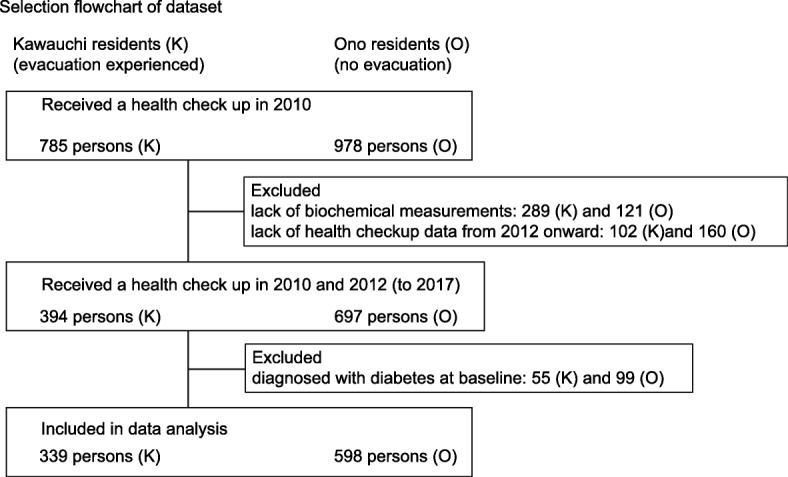
Design is retrospective cohort study. Annual health examination data of residents of Kawauchi village and control area (Ono town) in Fukushima prefecture from 2008 to 2017, as available from the Japanese National Health Insurance system. Participants were classified into three groups: "Diabetes (DM)" (FBG ≥ 126 mg/dL or HbA1c ≥ 6.5% or hospital visit for DM or usage of diabetic medication), "Borderline DM" (126 mg/dL > FBG ≥ 110 mg/dL or 6.5% > HbA1c ≥ 6.0%, and without hospital visit, and without diabetic medication), and "Normoglycemic" (FBG < 110 mg/dL and HbA1c < 6.0%, and without hospital visit, and without diabetic medication). New onset of diabetes was evaluated and the events or missing data were occurred at health checkup. For this survival analysis, 339 residents in Kawauchi and 598 residents in Ono were included. Average follow-up periods after 2010 were 3.9 years in Kawauchi village and 3.6 years in Ono town.
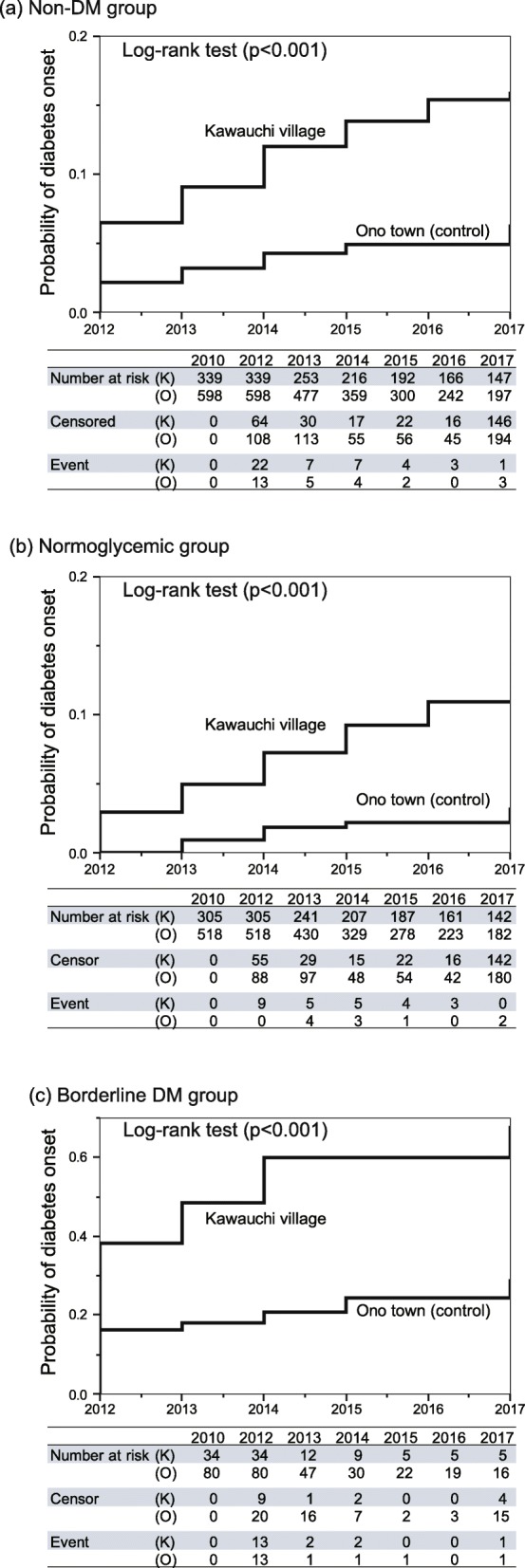
Compared with the normoglycemic group, incidence of DM was much greater in the borderline DM group, where DM occurred among 38.2% of the group in 2012 and increased to over 60% cumulatively through 2017 in Kawauchi village. DM had a prevalence of 16.3% in 2012, and below 30% in 2017 in borderline DM group of Ono town. Cox proportional hazard regression analysis was applied to non-DM groups at both study sites separately to evaluate the effects of lifestyle changes at each site. While BMI, BMI change, and the lack of regular exercise (HR = 1.29, 1.72, and 5.04, respectively) showed significant associations with the onset of diabetes in Ono town, only BMI and late-night dinner (HR = 1.21 and 4.86, respectively) showed significant associations with diabetes onset in Kawauchi village.
The current results confirmed that diabetes incidence was increased 6 years after the Daiichi nuclear power plant disaster in Kawauchi. We also found changes in lifestyle habits, suggesting that diabetes prevention with promotion of healthy lifestyle behaviors is an urgent priority.
2011 年福岛第一核电站灾难后,经历疏散的川内村居民患糖尿病和代谢综合征的风险高于未疏散居民。除了疏散,生活方式特征可能是影响糖尿病或葡萄糖耐量发展和预后的重要因素。本研究旨在评估疏散(即生活方式改变)对川内村非糖尿病居民糖尿病发病率的影响。
设计为回顾性队列研究。使用日本国民健康保险系统提供的 2008 年至 2017 年福岛县川内村和对照区(小野镇)居民的年度健康检查数据。参与者分为三组:“糖尿病(DM)”(FBG≥126mg/dL 或 HbA1c≥6.5%或因 DM 就诊或使用糖尿病药物)、“边缘型 DM”(126mg/dL>FBG≥110mg/dL 或 6.5%>HbA1c≥6.0%,且无就诊和无糖尿病药物)和“血糖正常”(FBG<110mg/dL 和 HbA1c<6.0%,且无就诊和无糖尿病药物)。评估新发糖尿病,并在体检时发生事件或缺失数据。对于这项生存分析,川内村有 339 名居民,小野镇有 598 名居民。2010 年后的平均随访时间分别为川内村 3.9 年和小野镇 3.6 年。
与血糖正常组相比,边缘型 DM 组的 DM 发病率要高得多,2012 年该组 DM 发生率为 38.2%,到 2017 年累计超过 60%。2012 年 DM 的患病率为 16.3%,2017 年在小野镇的边缘型 DM 组低于 30%。分别对两个研究地点的非 DM 组应用 Cox 比例风险回归分析,以评估每个地点生活方式改变的影响。虽然 BMI、BMI 变化和缺乏规律运动(HR=1.29、1.72 和 5.04)在小野镇与糖尿病发病显著相关,但只有 BMI 和晚餐过晚(HR=1.21 和 4.86)在川内村与糖尿病发病显著相关。
目前的结果证实,在福岛第一核电站灾难发生 6 年后,川内村的糖尿病发病率有所上升。我们还发现生活方式习惯的改变,这表明促进健康的生活方式行为是预防糖尿病的当务之急。