Department of Medical Evaluation and Epidemiology, Nantes University Hospital, Hôpital Saint-Jacques, 85 rue Saint-Jacques, 44093, Nantes cedex, France.
UMR INSERM 1246 SPHERE MethodS in Patient-centered outcomes and HEalth ResEarch, Universités de Nantes et Tours, Institut de recherche en Santé 2, Nantes, France.
BMC Health Serv Res. 2020 May 8;20(1):391. doi: 10.1186/s12913-020-05271-w.
The present challenge for patient involvement is the improvement of healthcare efficiency through a deeper consideration of the patient experience. In hospitals, numerous interventions promoting patient involvement are informally implemented by healthcare workers (HCWs). The first aim of this study was to conduct an overview of hospital HCWs' experiences of the involvement of patients or their representatives. This overview included the involvement of patients in the domains of healthcare provision and support for other patients, healthcare quality and safety improvement, training and research. The second aim was to describe the challenges and conditions for the development of participative interventions by HCWs.
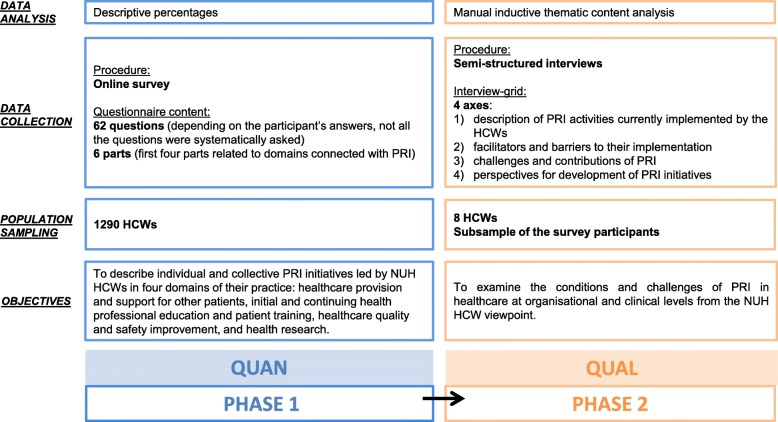
We conducted a mixed-methods sequential study at Nantes University Hospital from September 2017 to May 2018. To achieve the first aim, we performed a descriptive analysis of quantitative data collected via a questionnaire survey of 1290 HCWs. To achieve the second aim, we conducted a thematic analysis of qualitative data collected via eight semi-structured interviews with HCWs who reported involving patients or their representatives (family and patient association members) in healthcare.
Among the 213 survey participants (16.5%), 133 reported a total of 424 participative interventions, mostly in the domains of care quality and safety (37%) and care provision and support (29%). The analysis of the qualitative data evidenced three types of factors determining the implementation of such interventions: the profiles of patients and their representatives, the beliefs and attitudes of HCWs, and organisational factors. While leadership from patients and HCWs was a central element in the development of patient involvement interventions, organisations' capacities to foster a sustainable partnership culture appeared to be the next challenge to promote the patient-as-partner model in health systems. Our results also highlighted numerous benefits of patient and representative involvement for patients and HCWs.
The numerous initiatives reported show that patients and patient representatives participate alongside HCWs in hospitals. It is essential to take into account the facilitating and hindering factors of patient involvement in hospital HCWs' practices for the further development of current initiatives. Additional studies, especially from the point of view of patients, are needed to complement our findings.
目前患者参与面临的挑战是通过更深入地考虑患者体验来提高医疗保健效率。在医院中,医疗保健工作者(HCWs)非正式地实施了许多促进患者参与的干预措施。本研究的首要目的是对医院 HCWs 参与患者或其代表的医疗保健提供和支持、医疗质量和安全改进、培训和研究等领域的经验进行概述。第二个目的是描述 HCWs 开展参与性干预措施的挑战和条件。
我们于 2017 年 9 月至 2018 年 5 月在南特大学医院进行了一项混合方法顺序研究。为实现第一个目的,我们对通过对 1290 名 HCWs 进行问卷调查收集的定量数据进行了描述性分析。为实现第二个目的,我们对 8 名报告参与患者或其代表(家属和患者协会成员)的 HCWs 进行了半结构化访谈收集的定性数据进行了主题分析。
在 213 名调查参与者(16.5%)中,有 133 人共报告了 424 项参与性干预措施,主要集中在医疗质量和安全(37%)和医疗保健提供和支持(29%)领域。对定性数据的分析表明,有三种类型的因素决定了这些干预措施的实施:患者及其代表的特征、HCWs 的信仰和态度以及组织因素。虽然患者和 HCWs 的领导力是发展患者参与式干预措施的核心要素,但组织促进可持续伙伴关系文化的能力似乎是在卫生系统中推广患者作为合作伙伴模式的下一个挑战。我们的研究结果还强调了患者和代表参与对患者和 HCWs 的诸多益处。
报告的众多举措表明,患者及其代表与 HCWs 一起参与医院的工作。为了进一步发展当前的举措,必须考虑患者参与医院 HCWs 实践的促进和阻碍因素。需要进行更多研究,特别是从患者的角度出发,以补充我们的研究结果。