Pastor-Vicedo Juan Carlos, Prieto-Ayuso Alejandro, Contreras-Jordán Onofre Ricardo, Clemente Filipe Manuel, Nikolaidis Pantelis Theo, Rosemann Thomas Johannes, Knechtle Beat
Department of Didactics of Musical, Plastic and Physical Education, Faculty of Education, University of Castilla-La Mancha, Albacete, Spain.
Department of Didactics of Musical, Plastic and Physical Education, Faculty of Education, University of Castilla-La Mancha, Cuenca, Spain.
Front Psychol. 2020 Apr 22;11:600. doi: 10.3389/fpsyg.2020.00600. eCollection 2020.
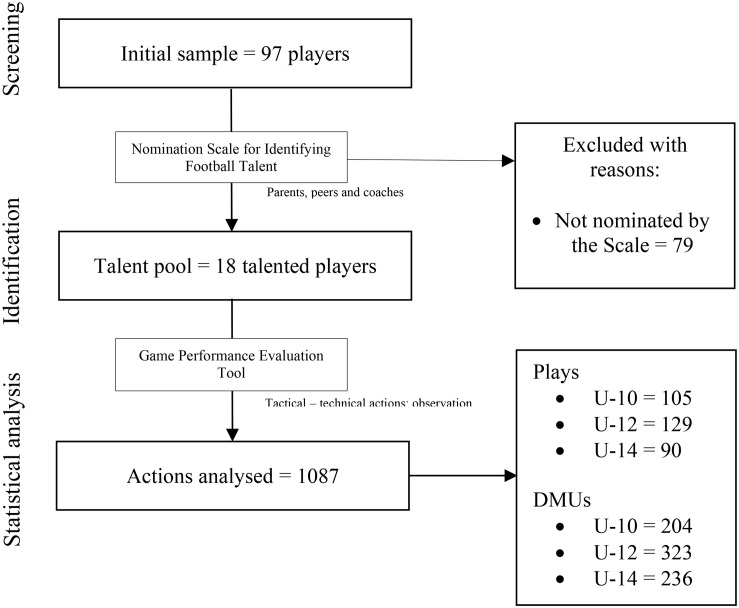
There are multiple factors that have been studied for talent identification (TI) with regard to sport performance, such as physical and physiological parameters; psychological, social, and contextual parameters; and technical-tactical parameters. However, despite the importance of these indicators for reaching the elite, new trends seem to assure that one of the key elements in a young player is decision making (DM). Thus, in the last decades, research DM in young players has increased. Nevertheless, very little has been done in relation with DM and talented players. The purpose of this study was to analyze and compare the effectiveness, number, and duration of DM units (DMUs) of three groups of talented young players in U-10, U-12, and U-14 levels. Ninety-seven youth players participated in the study. A total of 1,087 actions were analyzed. The Nomination Scale for Identifying Football Talent was utilized to screen the talent pool ( = 18), and the Game Performance Evaluation Tool was used for analyzing the 1,087 actions completed. The results showed that the effectiveness has to be more than 80% for children to be considered talented. Moreover, a greater effectiveness of DMUs was shown in older age groups. The game speed also increased with age. It was revealed that U-12 did not follow the progression in the decisional demands in the formative stages. It is highlighted, therefore, the necessity of reviewing the organizational aspects in the U-12 age group, related mainly to the size of the pitch and the number of players, because it does not follow the same progression in regard to decisional demands. Future studies should follow this study with the U-16, U-18, and U-23 age groups, with the purpose of knowing the effectiveness, duration, and number of DMUs in older age groups. Furthermore, policy makers and teachers/coaches from both educational and soccer context must take these results into account, with the purpose of adjusting the teaching and learning process of talented children in sport.
为了识别与运动表现相关的人才,人们研究了多个因素,如身体和生理参数、心理、社会和环境参数以及技术战术参数。然而,尽管这些指标对于成为精英很重要,但新的趋势似乎表明,年轻球员的关键要素之一是决策能力(DM)。因此,在过去几十年里,对年轻球员决策能力的研究有所增加。然而,关于决策能力与有天赋球员的研究却很少。本研究的目的是分析和比较三组10岁、12岁和14岁有天赋的年轻球员的决策单元(DMU)的有效性、数量和持续时间。97名青少年球员参与了这项研究。共分析了1087次动作。使用足球人才识别提名量表筛选人才库(=18),并使用比赛表现评估工具分析完成的1087次动作。结果表明,儿童要被视为有天赋,其决策有效性必须超过80%。此外,年龄较大的年龄组决策单元的有效性更高。比赛速度也随着年龄的增长而提高。结果显示,12岁组在成长阶段没有遵循决策需求的发展趋势。因此,强调了审查12岁年龄组组织方面的必要性,这主要与场地大小和球员数量有关,因为在决策需求方面它没有遵循相同的发展趋势。未来的研究应以16岁、18岁和23岁年龄组为对象,以了解年龄较大年龄组决策单元的有效性、持续时间和数量。此外,教育和足球领域的政策制定者以及教师/教练必须考虑这些结果,以便调整有天赋儿童在体育方面的教学和学习过程。