Singhealth Infectious Diseases Residency, Singapore.
Department of Infectious Diseases, Singapore General Hospital, Singapore.
Infect Control Hosp Epidemiol. 2020 Jul;41(7):765-771. doi: 10.1017/ice.2020.219. Epub 2020 May 11.
Staff surveillance is crucial during the containment phase of a pandemic to help reduce potential healthcare-associated transmission and sustain good staff morale. During an outbreak of SARS-COV-2 with community transmission, our institution used an integrated strategy for early detection and containment of COVID-19 cases among healthcare workers (HCWs).
Our strategy comprised 3 key components: (1) enforcing reporting of HCWs with acute respiratory illness (ARI) to our institution's staff clinic for monitoring; (2) conducting ongoing syndromic surveillance to obtain early warning of potential clusters of COVID-19; and (3) outbreak investigation and management.
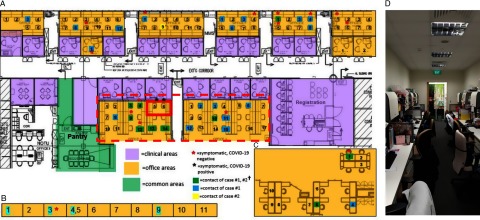
Over a 16-week surveillance period, we detected 14 cases of COVID-19 among HCWs with ARI symptoms. Two of the cases were linked epidemiologically and thus constituted a COVID-19 cluster with intrahospital HCW-HCW transmission; we also detected 1 family cluster and 2 clusters among HCWs who shared accommodation. No transmission to HCWs or patients was detected after containment measures were instituted. Early detection minimized the number of HCWs requiring quarantine, hence preserving continuity of service during an ongoing pandemic.
An integrated surveillance strategy, outbreak management, and encouraging individual responsibility were successful in early detection of clusters of COVID-19 among HCWs. With ongoing local transmission, vigilance must be maintained for intrahospital spread in nonclinical areas where social mingling of HCWs occurs. Because most individuals with COVID-19 have mild symptoms, addressing presenteeism is crucial to minimize potential staff and patient exposure.
在大流行的遏制阶段,员工监测对于帮助减少潜在的医疗保健相关传播并维持良好的员工士气至关重要。在 SARS-CoV-2 社区传播爆发期间,我们机构采用了一种综合策略,用于早期发现和控制医护人员(HCW)中的 COVID-19 病例。
我们的策略包括 3 个关键组成部分:(1)强制报告有急性呼吸道疾病(ARI)的 HCW 到我们机构的员工诊所进行监测;(2)进行持续的综合征监测,以获得 COVID-19 潜在聚集的早期预警;(3)爆发调查和管理。
在 16 周的监测期间,我们在有 ARI 症状的 HCW 中发现了 14 例 COVID-19 病例。其中 2 例病例在流行病学上有联系,因此构成了一个 COVID-19 聚集,有院内 HCW-HCW 传播;我们还检测到 1 个家庭聚集和 2 个共享住宿的 HCW 聚集。在采取控制措施后,没有发现向 HCW 或患者的传播。早期发现使需要隔离的 HCW 数量最少,从而在持续的大流行期间保持了服务的连续性。
综合监测策略、爆发管理和鼓励个人责任成功地早期发现了 HCW 中的 COVID-19 聚集。随着当地传播的持续,必须警惕非临床区域(HCW 社交混合发生的区域)发生院内传播。由于大多数 COVID-19 患者症状较轻,解决出勤问题对于最大限度地减少潜在的员工和患者暴露至关重要。