Medigen, Inc., 8420 Gas House Pike, Suite S, Frederick, MD 21701, USA.
Viruses. 2020 May 8;12(5):518. doi: 10.3390/v12050518.
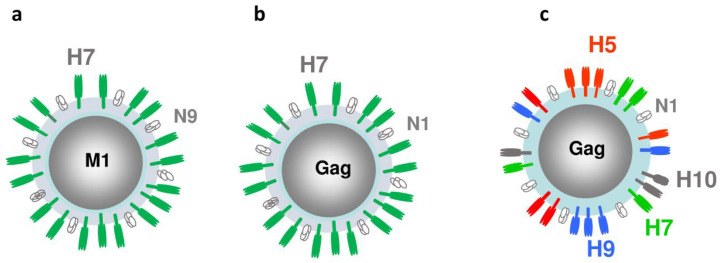
In the midst of the ongoing COVID-19 coronavirus pandemic, influenza virus remains a major threat to public health due to its potential to cause epidemics and pandemics with significant human mortality. Cases of H7N9 human infections emerged in eastern China in 2013 and immediately raised pandemic concerns as historically, pandemics were caused by the introduction of new subtypes into immunologically naïve human populations. Highly pathogenic H7N9 cases with severe disease were reported recently, indicating the continuing public health threat and the need for a prophylactic vaccine. Here we review the development of recombinant influenza virus-like particles (VLPs) as vaccines against H7N9 virus. Several approaches to vaccine development are reviewed including the expression of VLPs in mammalian, plant and insect cell expression systems. Although considerable progress has been achieved, including demonstration of safety and immunogenicity of H7N9 VLPs in the human clinical trials, the remaining challenges need to be addressed. These challenges include improvements to the manufacturing processes, as well as enhancements to immunogenicity in order to elicit protective immunity to multiple variants and subtypes of influenza virus.
在持续的 COVID-19 冠状病毒大流行中,流感病毒仍然是对公众健康的主要威胁,因为它有可能导致具有重大人类死亡率的流行和大流行。2013 年,中国东部出现了 H7N9 型人类感染病例,这立即引起了大流行的担忧,因为历史上,大流行是由新亚型引入免疫幼稚的人类群体引起的。最近报告了高致病性 H7N9 病例,病情严重,这表明持续存在公共卫生威胁,需要预防性疫苗。在这里,我们回顾了重组流感病毒样颗粒 (VLPs) 作为 H7N9 病毒疫苗的开发。综述了几种疫苗开发方法,包括在哺乳动物、植物和昆虫细胞表达系统中表达 VLPs。尽管已经取得了相当大的进展,包括在人体临床试验中证明了 H7N9 VLPs 的安全性和免疫原性,但仍需要解决剩余的挑战。这些挑战包括改进制造工艺,以及提高免疫原性,以诱导对多种流感病毒变体和亚型的保护性免疫。