Division of Epidemiology and Biostatistics, School of Public Health, University of California, Berkeley, CA, 94720, USA.
Biophysics Graduate Group, University of California, Berkeley, CA, 94720, USA.
BMC Biol. 2020 May 12;18(1):50. doi: 10.1186/s12915-020-0759-9.
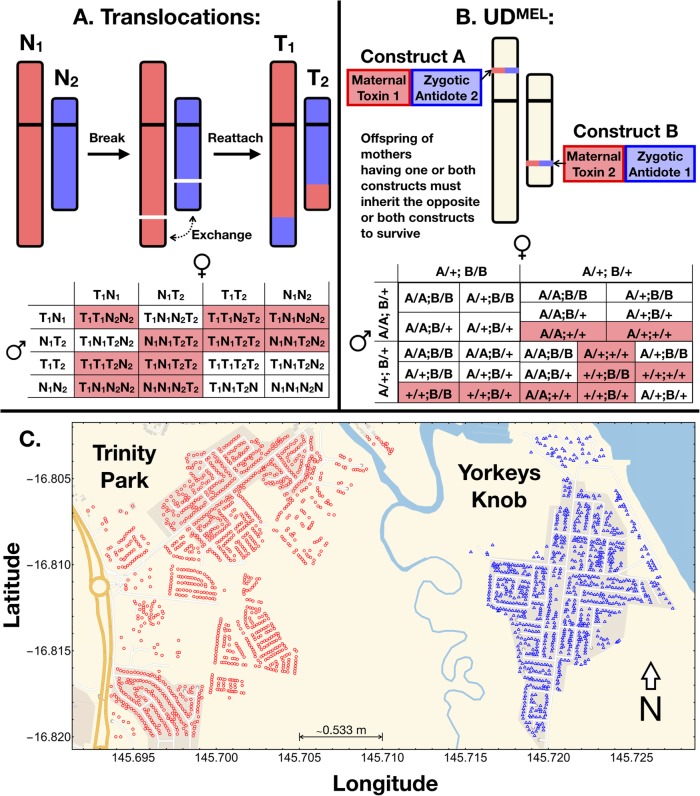
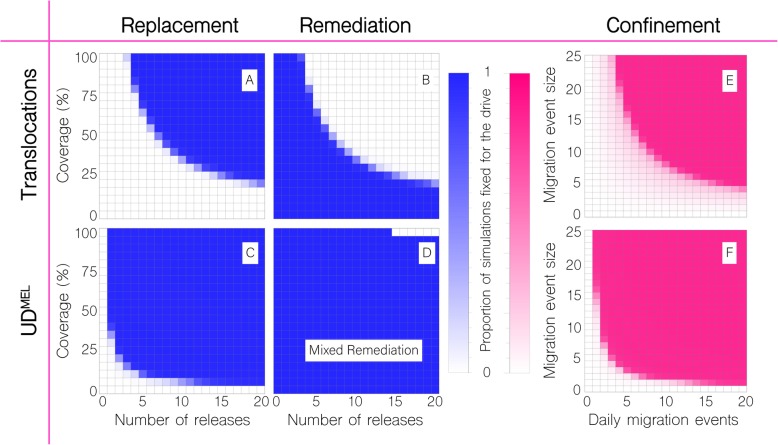
The discovery of CRISPR-based gene editing and its application to homing-based gene drive systems has been greeted with excitement, for its potential to control mosquito-borne diseases on a wide scale, and concern, for the invasiveness and potential irreversibility of a release. Gene drive systems that display threshold-dependent behavior could potentially be used during the trial phase of this technology, or when localized control is otherwise desired, as simple models predict them to spread into partially isolated populations in a confineable manner, and to be reversible through releases of wild-type organisms. Here, we model hypothetical releases of two recently engineered threshold-dependent gene drive systems-reciprocal chromosomal translocations and a form of toxin-antidote-based underdominance known as UD-to explore their ability to be confined and remediated.
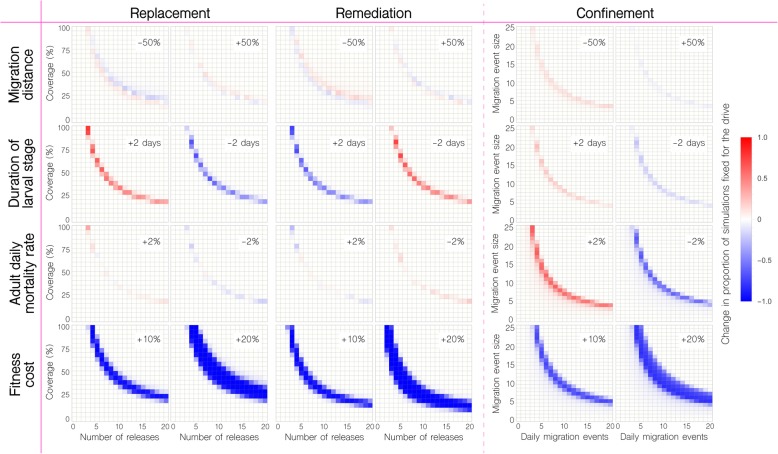
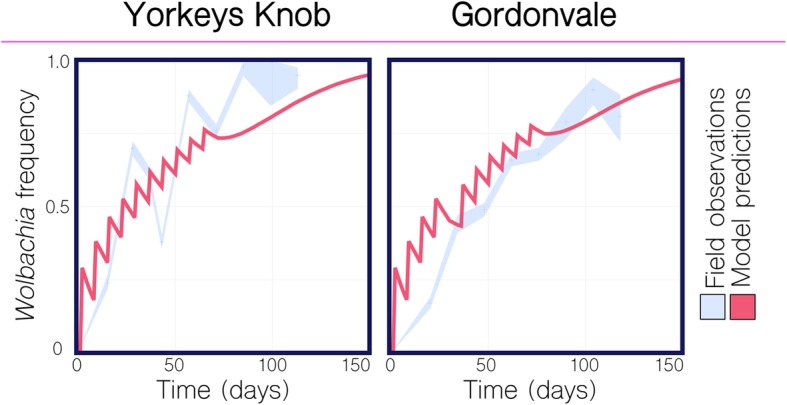
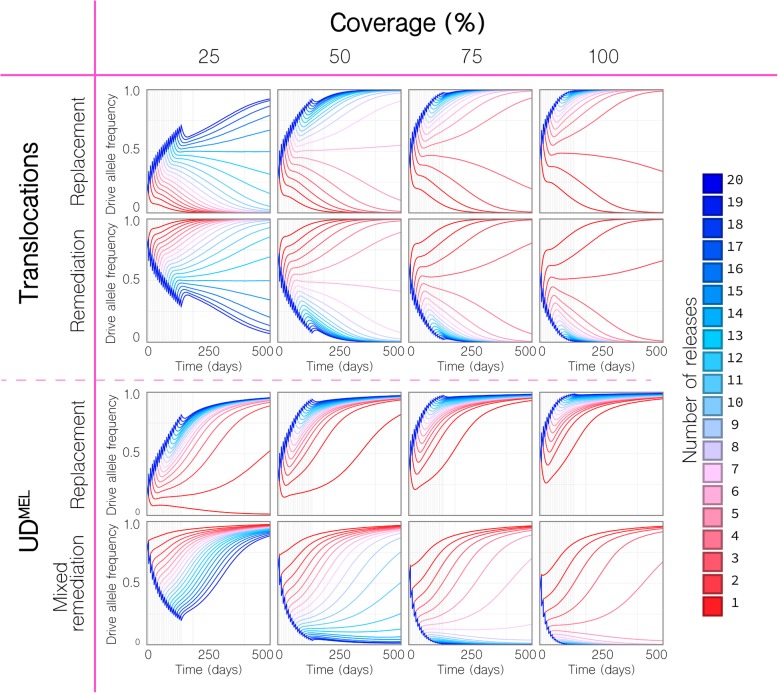
We simulate releases of Aedes aegypti, the mosquito vector of dengue, Zika, and other arboviruses, in Yorkeys Knob, a suburb of Cairns, Australia, where previous biological control interventions have been undertaken on this species. We monitor spread to the neighboring suburb of Trinity Park to assess confinement. Results suggest that translocations could be introduced on a suburban scale, and remediated through releases of non-disease-transmitting male mosquitoes with release sizes on the scale of what has been previously implemented. UD requires fewer releases to introduce, but more releases to remediate, including of females capable of disease transmission. Both systems are expected to be confineable to the release site; however, spillover of translocations into neighboring populations is less likely.
Our analysis supports the use of translocations as a threshold-dependent drive system capable of spreading disease-refractory genes into Ae. aegypti populations in a confineable and reversible manner. It also highlights increased release requirements when incorporating life history and population structure into models. As the technology nears implementation, further ecological work will be essential to enhance model predictions in preparation for field trials.
基于 CRISPR 的基因编辑技术的发现及其在同源基因驱动系统中的应用令人兴奋,因为它有可能大规模控制蚊媒疾病,但也令人担忧,因为这种技术具有入侵性和潜在的不可逆性。显示阈值依赖性行为的基因驱动系统在该技术的试验阶段或需要局部控制时可能会被使用,因为简单的模型预测它们可以以可控制的方式传播到部分隔离的种群中,并通过释放野生型生物来逆转。在这里,我们模拟了两种最近设计的阈值依赖型基因驱动系统——相互染色体易位和一种称为 UD 的基于毒素-解毒剂的下位优势的假设释放,以探索它们被限制和修复的能力。
我们模拟了登革热、寨卡病毒和其他虫媒病毒的蚊媒埃及伊蚊在澳大利亚凯恩斯郊区约克角的释放情况,此前曾在该物种上进行过生物控制干预。我们监测传播到邻近的三一公园郊区,以评估限制情况。结果表明,易位可以在郊区范围内引入,并通过释放非传播疾病的雄性蚊子来修复,释放规模与之前实施的规模相当。UD 引入所需的释放次数较少,但修复所需的释放次数较多,包括能够传播疾病的雌性蚊子。这两种系统都有望被限制在释放地点;然而,易位向邻近种群溢出的可能性较小。
我们的分析支持使用易位作为一种阈值依赖型驱动系统,能够以可限制和可逆转的方式将抗疾病基因传播到埃及伊蚊种群中。它还强调了在将生活史和种群结构纳入模型时增加释放要求的必要性。随着该技术的临近实施,进一步的生态工作将是必不可少的,以提高模型预测,为现场试验做准备。