The Pirbright Institute, Pirbright, Woking, Surrey, U.K.
Department of Zoology, University of Oxford, Oxford, U.K.
Biochem Soc Trans. 2018 Oct 19;46(5):1203-1212. doi: 10.1042/BST20180076. Epub 2018 Sep 6.
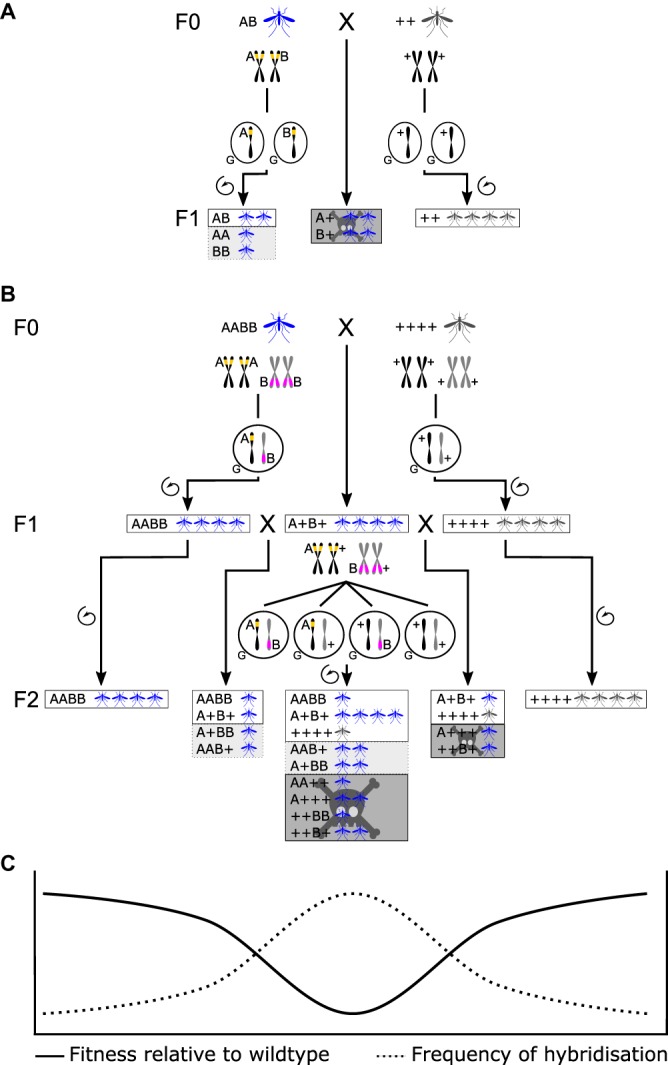
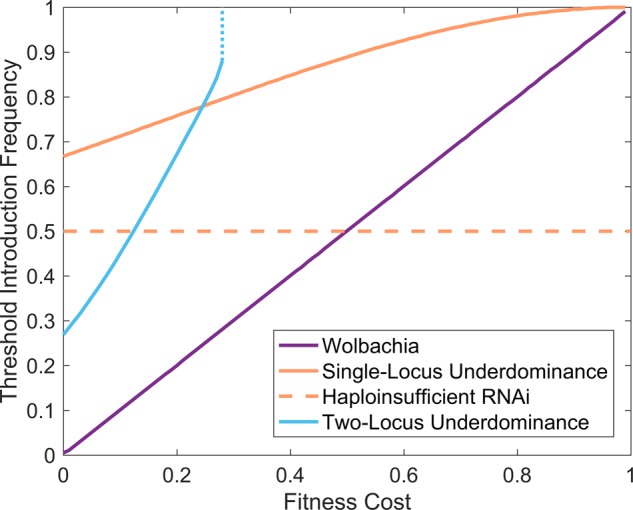
Mosquito-borne diseases, such as malaria, dengue and chikungunya, cause morbidity and mortality around the world. Recent advances in gene drives have produced control methods that could theoretically modify all populations of a disease vector, from a single release, making whole species less able to transmit pathogens. This ability has caused both excitement, at the prospect of global eradication of mosquito-borne diseases, and concern around safeguards. Drive mechanisms that require individuals to be released at high frequency before genes will spread can therefore be desirable as they are potentially localised and reversible. These include underdominance-based strategies and use of the reproductive parasite Here, we review recent advances in practical applications and mathematical analyses of these threshold-dependent gene drives with a focus on implementation in , highlighting their mechanisms and the role of fitness costs on introduction frequencies. Drawing on the parallels between these systems offers useful insights into practical, controlled application of localised drives, and allows us to assess the requirements needed for gene drive reversal.
蚊媒疾病(如疟疾、登革热和基孔肯雅热)在全球范围内造成发病率和死亡率。基因驱动技术的最新进展已经产生了控制方法,理论上可以从单次释放中改变疾病载体的所有种群,使整个物种更难传播病原体。这种能力既令人兴奋,因为有望在全球范围内消灭蚊媒疾病,也令人担忧保障措施。因此,在基因传播之前需要以高频率释放个体的驱动机制是可取的,因为它们具有潜在的本地化和可逆性。其中包括基于劣势的策略和利用生殖寄生虫。在这里,我们回顾了这些基于阈值的基因驱动在实际应用和数学分析方面的最新进展,重点是在 中的实施,强调了它们的机制和适应性成本在引入频率上的作用。借鉴这些系统之间的相似之处,为本地化驱动的实际、受控应用提供了有用的见解,并使我们能够评估基因驱动反转所需的条件。