Wimmer Lena, Bellingrath Silja, von Stockhausen Lisa
Department of Psychology, University of Duisburg-Essen, Essen, Germany.
School of Psychology, University of Kent, Canterbury, United Kingdom.
Front Psychol. 2020 Apr 29;11:719. doi: 10.3389/fpsyg.2020.00719. eCollection 2020.
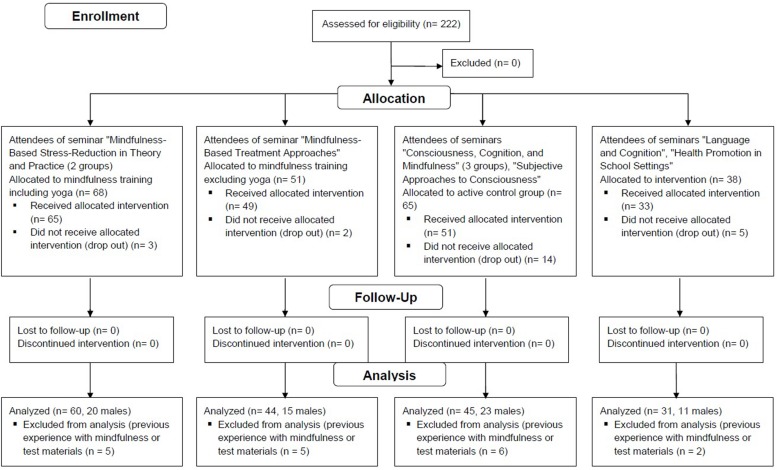
The present study examined the effects of mindfulness training on attention regulation in university students and whether the potential benefits of implementation are influenced by the yoga component of mindfulness-based interventions (MBIs) and/or by MBI homework practice. In a non-randomized trial with pre- and post-assessments, = 180 university students were allocated to either mindfulness training (experimental groups), awareness activities (active control group), or no training (passive control group). Mindfulness was taught through two MBIs, one including yoga and the other excluding yoga. Attention regulation was operationalized via behavioral indicators, namely sustained attention, cognitive flexibility, cognitive inhibition, and data-driven information processing. With the exception of speed in a cognitive flexibility task, the results indicated no systematic or differential advantage arising from mindfulness training, with or without yoga, regarding the aspects of attention regulation. There was no consistent influence of homework quantity or quality. The implications for mindfulness training in academic contexts are discussed.
本研究考察了正念训练对大学生注意力调节的影响,以及实施正念训练的潜在益处是否受基于正念的干预措施(MBIs)中的瑜伽成分和/或MBIs家庭作业练习的影响。在一项有前后评估的非随机试验中,180名大学生被分配到正念训练组(实验组)、意识活动组(积极对照组)或无训练组(消极对照组)。通过两种MBIs教授正念,一种包含瑜伽,另一种不包含瑜伽。注意力调节通过行为指标进行操作化,即持续注意力、认知灵活性、认知抑制和数据驱动的信息处理。除了认知灵活性任务中的速度外,结果表明,无论有无瑜伽,正念训练在注意力调节方面均未产生系统性或差异性优势。家庭作业的数量或质量没有一致的影响。文中讨论了在学术环境中进行正念训练的意义。