Department of Electrical Engineering and Computer Science, The University of Michigan, Ann Arbor, MI, 48109, USA.
Nat Commun. 2020 May 15;11(1):2439. doi: 10.1038/s41467-020-16261-1.
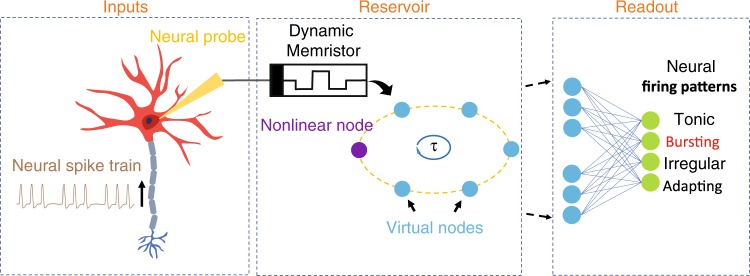
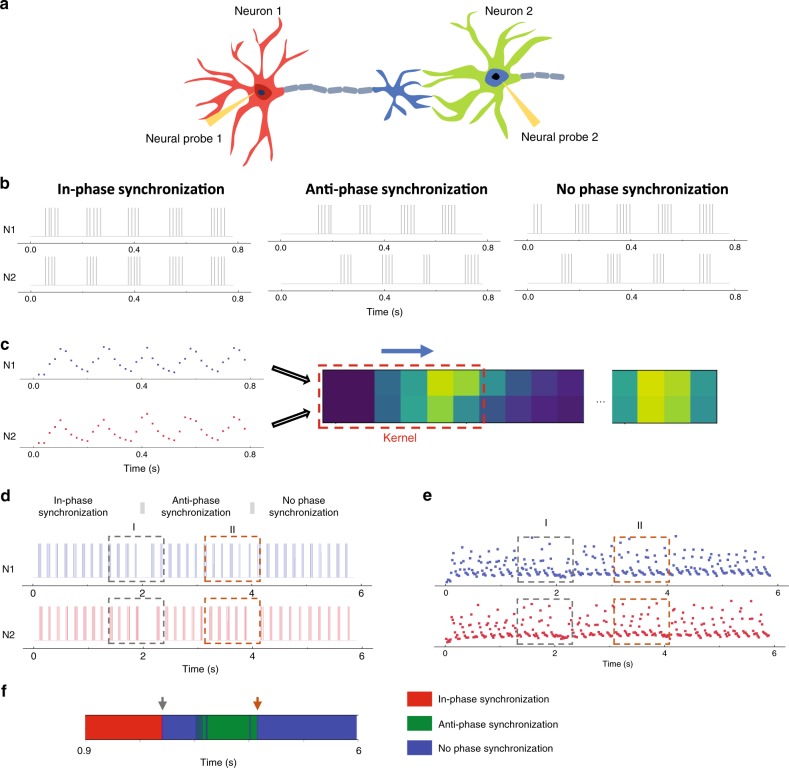
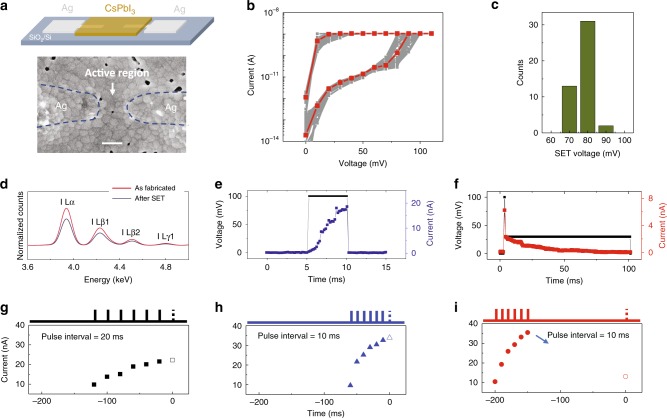
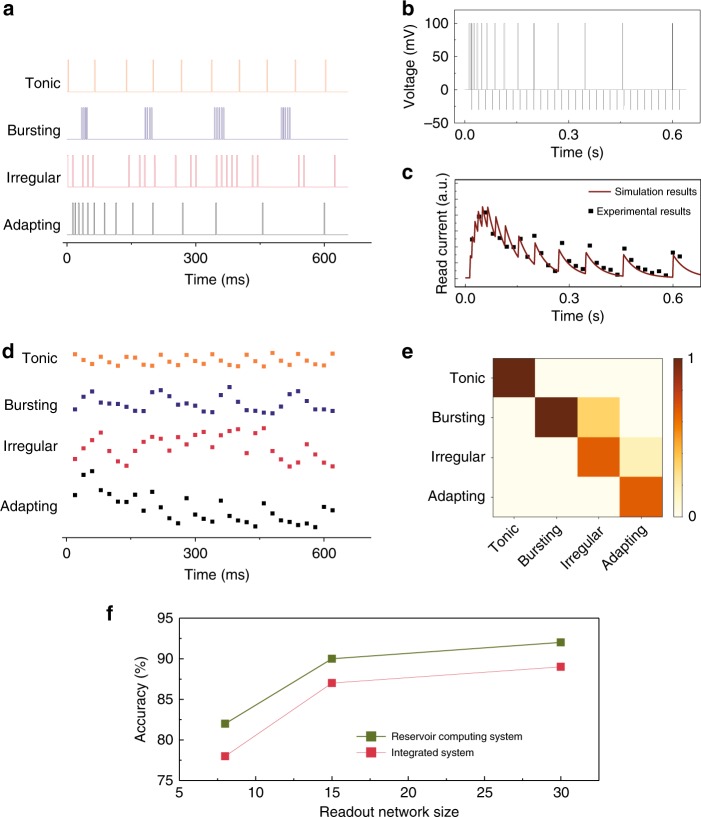
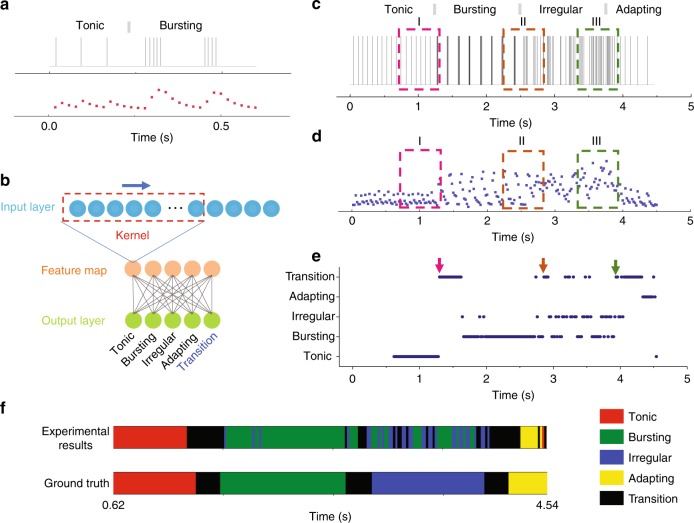
The ability to efficiently analyze the activities of biological neural networks can significantly promote our understanding of neural communications and functionalities. However, conventional neural signal analysis approaches need to transmit and store large amounts of raw recording data, followed by extensive processing offline, posing significant challenges to the hardware and preventing real-time analysis and feedback. Here, we demonstrate a memristor-based reservoir computing (RC) system that can potentially analyze neural signals in real-time. We show that the perovskite halide-based memristor can be directly driven by emulated neural spikes, where the memristor state reflects temporal features in the neural spike train. The RC system is successfully used to recognize neural firing patterns, monitor the transition of the firing patterns, and identify neural synchronization states among different neurons. Advanced neuroelectronic systems with such memristor networks can enable efficient neural signal analysis with high spatiotemporal precision, and possibly closed-loop feedback control.
高效分析生物神经网络的活动可以显著促进我们对神经通讯和功能的理解。然而,传统的神经信号分析方法需要传输和存储大量原始记录数据,然后进行离线的广泛处理,这对硬件提出了巨大挑战,并且阻止了实时分析和反馈。在这里,我们展示了一个基于忆阻器的储层计算 (RC) 系统,该系统有可能实时分析神经信号。我们表明,基于钙钛矿卤化物的忆阻器可以直接由模拟神经尖峰驱动,其中忆阻器的状态反映了神经尖峰序列中的时间特征。RC 系统成功地用于识别神经发射模式,监测发射模式的转变,并识别不同神经元之间的神经同步状态。具有这种忆阻器网络的先进神经电子系统可以实现具有高时空精度的高效神经信号分析,并可能实现闭环反馈控制。