Department of Internal Medicine and cardiology unit, Nobel Medical College Teaching Hospital, Biratnagar, Nepal.
Department of Internal Medicine, Nobel Medical College Teaching Hospital, Biratnagar, Nepal.
JNMA J Nepal Med Assoc. 2020 Apr 30;58(224):204-208. doi: 10.31729/jnma.4765.
Dyslipidemia is one of the major risk factors for acute coronary syndrome. Dyslipidemia with an increase in total cholesterol, low-density lipoprotein cholesterol, triglycerides and decrease in high-density lipoprotein cholesterol is one of the major risk factors for the acute coronary syndrome and alone account for more than 50% of population attributable risk. This study was conducted to find out the prevalence of dyslipidemia.
This descriptive cross-sectional study was conducted in 105 patients admitted at the tertiary care center with a diagnosis of acute coronary syndrome from July 2018 to March 2019 after approval from the institutional review committee (Ref no. 205/2018). Fasting serum lipid profile was obtained within 24 hours of hospitalization with the convenient sampling method. Data were analyzed with the help of the Statistical Package for Social Sciences version 20. Point estimation at 95% Confidence interval was calculated along with frequency and proportion for binary data.
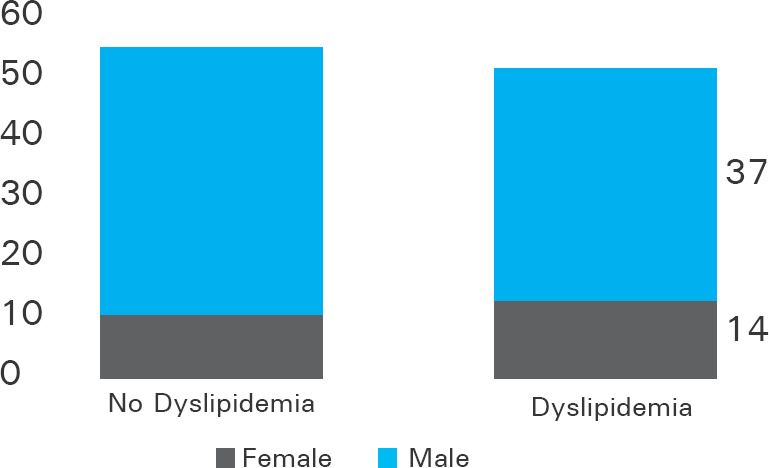
Out of 105 people, dyslipidemia was present in 51 (48.6%). The mean age of the participants was 59.19±12.69 years. The majority 81 (77.1%) were male. The mean total cholesterol, triglycerides, low-density lipoprotein cholesterol, and high-density lipoprotein cholesterol were 183.43±35.9 mg/dl, 140.59±46.83 mg/dl, 109.9±26.38 mg/dl and 41.17±4.78 mg/dl respectively. High total cholesterol and triglyceride were found in 34 (32.4%) each, low high-density lipoprotein in 31 (29.5%) and high low-density lipoprotein in 22 (21%).
Dyslipidemia is a significant risk factor in patients with acute coronary syndrome and commonly associated with other risk factors. Careful attention to its management may help to reduce further events.
血脂异常是急性冠状动脉综合征的主要危险因素之一。总胆固醇、低密度脂蛋白胆固醇、甘油三酯升高和高密度脂蛋白胆固醇降低的血脂异常是急性冠状动脉综合征的主要危险因素之一,其单独导致的人群归因风险超过 50%。本研究旨在探讨血脂异常的患病率。
本研究为描述性横断面研究,于 2018 年 7 月至 2019 年 3 月在获得机构审查委员会批准后(批准号:205/2018),在三级护理中心对 105 例急性冠状动脉综合征患者进行调查。采用便利抽样法在入院后 24 小时内抽取空腹血清脂质谱。采用统计软件包 20 版进行数据分析。采用点估计 95%置信区间,并对二项数据进行频率和比例分析。
105 例患者中,血脂异常 51 例(48.6%)。参与者的平均年龄为 59.19±12.69 岁。大多数(81 例,77.1%)为男性。平均总胆固醇、甘油三酯、低密度脂蛋白胆固醇和高密度脂蛋白胆固醇分别为 183.43±35.9mg/dl、140.59±46.83mg/dl、109.9±26.38mg/dl 和 41.17±4.78mg/dl。高总胆固醇和甘油三酯分别为 34 例(32.4%),低高密度脂蛋白胆固醇 31 例(29.5%),高低密度脂蛋白胆固醇 22 例(21%)。
血脂异常是急性冠状动脉综合征患者的一个重要危险因素,常与其他危险因素相关。对其进行严格管理可能有助于减少进一步的发病。