Woodford Joanne, Norbäck Kajsa, Hagström Josefin, Grönqvist Helena, Parker Adwoa, Arundel Catherine, von Essen Louise
Department of Women's and Children's Health, Uppsala University Psychosocial Care Programme (U-CARE), Uppsala University, Sweden.
Department of Health Sciences, Faculty of Sciences, York Trials Unit, University of York, United Kingdom.
Contemp Clin Trials Commun. 2020 Apr 24;18:100572. doi: 10.1016/j.conctc.2020.100572. eCollection 2020 Jun.
Recruitment into clinical trials is a common challenge experienced by healthcare researchers. Currently, there is little evidence regarding strategies to improve recruitment into clinical trials. However, preliminary research suggests the personalisation of study invitation letters may increase recruitment rates. As such, there is a need to investigate the effectiveness of personalisation strategies on trial recruitment rates. This study within a trial (SWAT) will investigate the effect of personalised versus non-personalised study invitation letters on recruitment rates into the host trial ENGAGE, a feasibility study of an internet-administered, guided, Cognitive-Behavioural Therapy (CBT) based self-help intervention for parents of children previously treated for cancer.
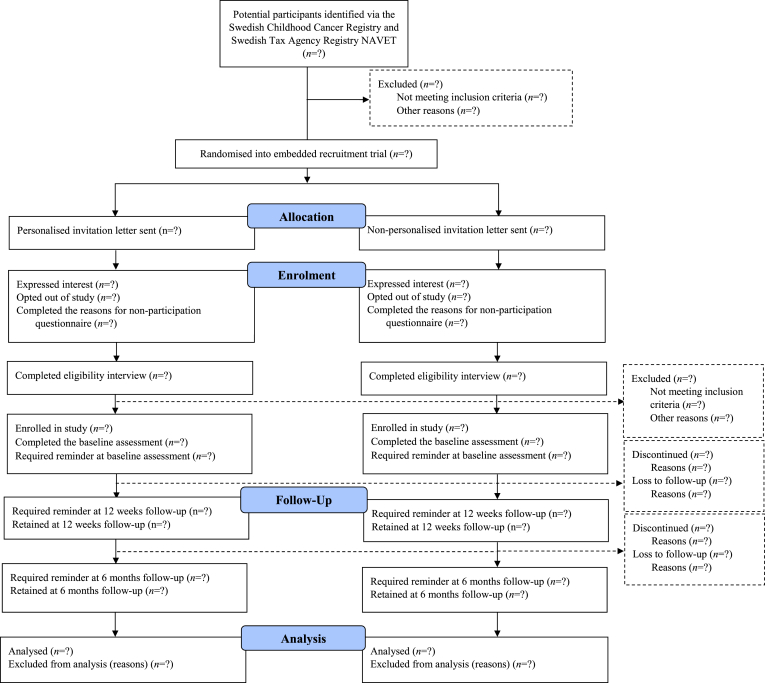
An embedded randomised controlled trial (RCT) will investigate the effectiveness of a personalised study invitation letter including the potential participant's name and address compared with a standard, non-personalised letter without name or address, on participant recruitment rates into the ENGAGE study. The primary outcome is differences in the proportion of participants recruited, examined using logistic regression. Results will be reported as adjusted odds ratios with 95% confidence intervals.
Even moderate effects of the personalisation of study invitation letters on recruitment rates could be of significant value by shortening study length, saving resources, and providing a faster answer to the clinical question posed by the study. This protocol can be used as a template for other researchers who wish to contribute to the evidence base for trial decision-making, by embedding a similar SWAT into their trial.
ISRCTN 57233429; ISRCTN 18404129; SWAT 112, Northern Ireland Hub for Trials Methodology Research SWAT repository (2018 OCT 1 1231).
招募患者参加临床试验是医疗保健研究人员普遍面临的挑战。目前,关于提高临床试验招募成功率的策略,几乎没有相关证据。然而,初步研究表明,研究邀请信的个性化处理可能会提高招募率。因此,有必要研究个性化策略对试验招募率的有效性。本试验中的试验(SWAT)将研究个性化与非个性化研究邀请信对纳入主要试验ENGAGE的招募率的影响,ENGAGE是一项针对曾患癌症儿童的父母进行的基于互联网管理、有指导的认知行为疗法(CBT)自助干预的可行性研究。
一项嵌入式随机对照试验(RCT)将研究一封包含潜在参与者姓名和地址的个性化研究邀请信与一封不包含姓名或地址的标准非个性化信件相比,对ENGAGE研究参与者招募率的有效性。主要结局是招募参与者比例的差异,采用逻辑回归进行分析。结果将报告为调整后的比值比及95%置信区间。
即使研究邀请信的个性化处理对招募率的影响适中,也可能具有重要价值,可缩短研究时长、节省资源,并更快地回答研究所提出的临床问题。本方案可作为其他研究人员的模板,他们希望通过在自己的试验中嵌入类似的SWAT,为试验决策的证据基础做出贡献。
ISRCTN 57233429;ISRCTN 18404129;SWAT 112,北爱尔兰试验方法研究中心SWAT存储库(2018年10月1日1231)。