Department of Pharmaceutical Chemistry, Smriti College of Pharmaceutical Education, Madhya Pradesh, India.
Department of Pharmaceutical Chemistry, Matoshri Institute of Pharmacy, Maharashtra, India.
Biomed J. 2020 Aug;43(4):363-367. doi: 10.1016/j.bj.2020.05.002. Epub 2020 May 18.
The present study demonstrates the potential of flavanoid narcissoside against the novel corona virus (COVID-19) complications using molecular docking studies.
The computation molecular docking screening was performed using Molegro Virtual Docker software (MVD) with grid resolution of 30 Å. Protein of COVID 19 virus was taken from protein data bank.
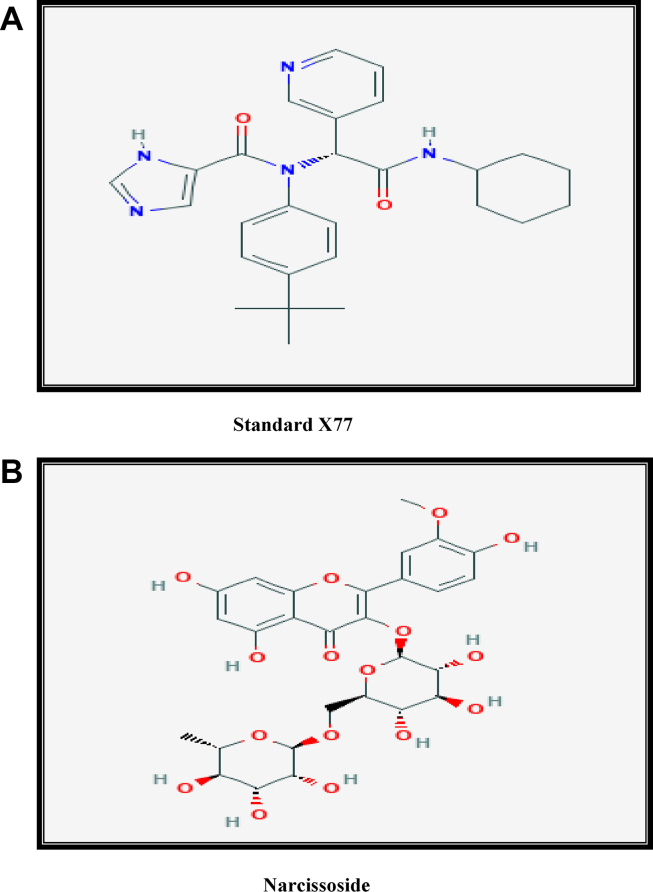
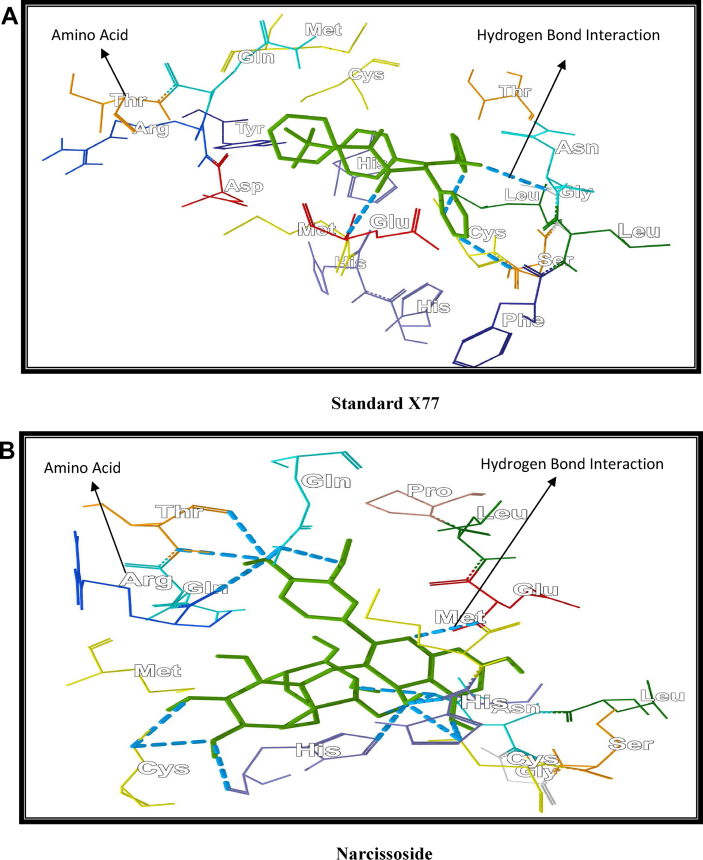
The standard inhibitor X77 (N-(4-tert-butylphenyl)-N-[(1R)-2-(cyclohexylamino)-2-oxo-1-(pyridin-3-yl)ethyl]-1H-imidazole-4-carboxamide) identified from the protein inhibitor complex 6W63 from protein data bank was docked with COVID 19 protein 6W63 which showed MolDock score of -156.913, rerank Sore -121.296 and H Bond -5.7369, while the flavanoid narcissoside had showed MolDock score -180.739, Rerank Sore -137.092 and H Bond -18.6771. The narcissoside showed potent inhibitory effect which is greater than standard X77. The result showed that narcissoside have high affinity towards 6W63 as it showed thirteen hydrogen bonds with nine amino acids (Arg 188, Glu 166, His 164, Cys 145 (2 bonds), Asn 14 (2 bonds), Cys 44 (2 bonds), His 41 (2 bonds), Gln 192, Thr 190) while showed four hydrogen bonds with amino acids (Gly 143, Cys 145, Glu 166, Ser 144).
From computation approach it was concluded that narcissoside is a potent inhibitor of viral COVID 19 protein 6W63. The narcissoside have high affinity and inhibition potential than standard inhibitor X77 (N-(4-tert-butylphenyl)-N-[(1R)-2-(cyclohexylamino)-2-oxo-1-(pyridin-3-yl)ethyl]-1H-imidazole-4-carboxamide). The narcissoside predicted as more potent inhibitor which can be further optimize, pharmacologically and clinically evaluated for the treatment of novel coronavirus COVID-19.
本研究通过分子对接研究证明了黄烷苷水仙苷预防新型冠状病毒(COVID-19)并发症的潜力。
使用 Molegro Virtual Docker 软件(MVD)进行计算分子对接筛选,网格分辨率为 30Å。COVID-19 病毒的蛋白质取自蛋白质数据库。
从蛋白质数据库中的蛋白质抑制剂复合物 6W63 中鉴定出的标准抑制剂 X77(N-(4-叔丁基苯基)-N-[(1R)-2-(环己基氨基)-2-氧代-1-(吡啶-3-基)乙基]-1H-咪唑-4-甲酰胺)与 COVID-19 蛋白 6W63 对接,其 MolDock 评分为-156.913,重新排名得分-121.296,氢键-5.7369,而黄烷苷水仙苷的 MolDock 评分为-180.739,重新排名得分-137.092,氢键-18.6771。水仙苷表现出比标准 X77 更强的抑制作用。结果表明,水仙苷与 6W63 具有高亲和力,因为它与 9 个氨基酸(Arg 188、Glu 166、His 164、Cys 145(2 个键)、Asn 14(2 个键)、Cys 44(2 个键)、His 41(2 个键)、Gln 192、Thr 190)形成 13 个氢键,而与氨基酸(Gly 143、Cys 145、Glu 166、Ser 144)形成 4 个氢键。
从计算方法得出的结论是,水仙苷是一种有效的 COVID-19 病毒 6W63 蛋白抑制剂。水仙苷具有比标准抑制剂 X77(N-(4-叔丁基苯基)-N-[(1R)-2-(环己基氨基)-2-氧代-1-(吡啶-3-基)乙基]-1H-咪唑-4-甲酰胺)更高的亲和力和抑制潜力。水仙苷预测为更有效的抑制剂,可进一步优化,并进行药理学和临床评估,以治疗新型冠状病毒 COVID-19。