Wensley Cynthia, Botti Mari, McKillop Ann, Merry Alan F
School of Nursing, Faculty of Medical and Health Sciences, The University of Auckland, Auckland, New Zealand
Centre for Quality and Patient Safety Research - Epworth HealthCare Partnership, School of Nursing and Midwifery, Deakin University, Burwood, Victoria, Australia.
BMJ Open. 2020 May 18;10(5):e033336. doi: 10.1136/bmjopen-2019-033336.
To develop a multidimensional framework representing patients' perspectives on comfort to guide practice and quality initiatives aimed at improving patients' experiences of care.
Two-stage qualitative descriptive study design. Findings from a previously published synthesis of 62 studies (stage 1) informed data collection and analysis of 25 semistructured interviews (stage 2) exploring patients' perspectives of comfort in an acute care setting.
Cardiac surgical unit in New Zealand.
Culturally diverse patients in hospital undergoing heart surgery.
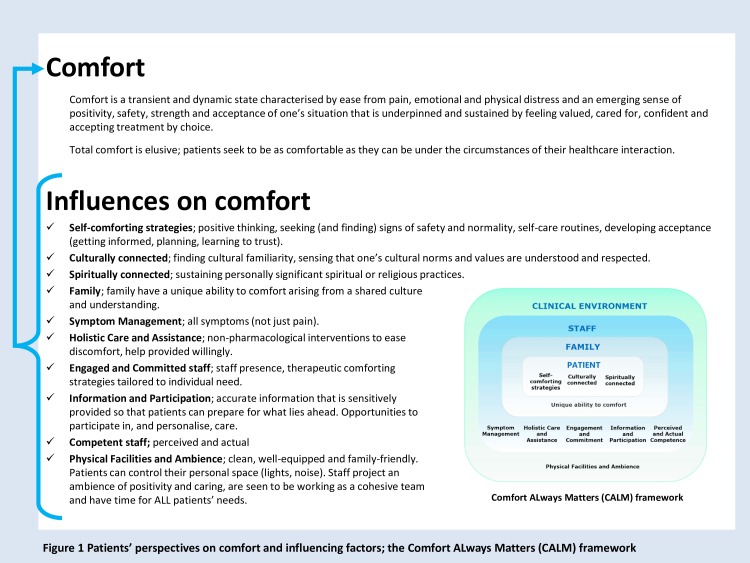
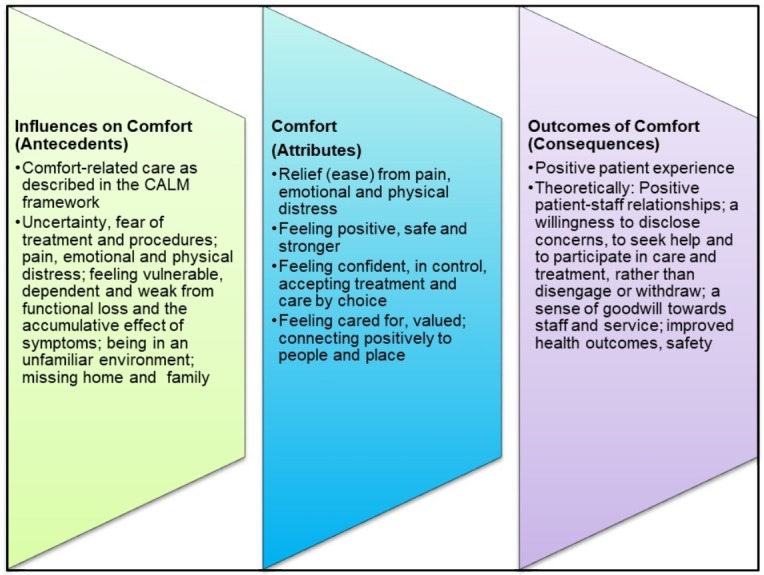
A definition of comfort. The Comfort ALways Matters (CALM) framework describing factors influencing comfort.
Comfort is transient and multidimensional and, as defined by patients, incorporates more than the absence of pain. Factors influencing comfort were synthesised into 10 themes within four inter-related layers: patients' personal (often private) strategies; the unique role of family; staff actions and behaviours; and factors within the clinical environment.
These findings provide new insights into what comfort means to patients, the care required to promote their comfort and the reasons for which doing so is important. We have developed a definition of comfort and the CALM framework, which can be used by healthcare leaders and clinicians to guide practice and quality initiatives aimed at maximising comfort and minimising distress. These findings appear applicable to a range of inpatient populations. A focus on comfort by individuals is crucial, but leadership will be essential for driving the changes needed to reduce unwarranted variability in care that affects comfort.
构建一个多维框架,以呈现患者对舒适度的看法,从而指导旨在改善患者护理体验的实践和质量改进举措。
两阶段定性描述性研究设计。先前发表的对62项研究的综合分析结果(第一阶段)为25次半结构化访谈(第二阶段)的数据收集和分析提供了信息,此次访谈探讨了患者在急性护理环境中的舒适度看法。
新西兰的心脏外科病房。
在医院接受心脏手术的具有文化多样性的患者。
舒适度的定义。描述影响舒适度因素的“舒适至关重要(CALM)”框架。
舒适度是短暂且多维的,患者所定义的舒适度不仅仅是没有疼痛。影响舒适度的因素被综合为四个相互关联层面中的10个主题:患者的个人(通常是私密的)策略;家庭的独特作用;医护人员的行动和行为;以及临床环境中的因素。
这些发现为舒适度对患者意味着什么、促进患者舒适所需的护理以及这样做的重要原因提供了新的见解。我们已经制定了舒适度的定义和CALM框架,医疗保健领导者和临床医生可利用它们来指导旨在最大限度提高舒适度和最小化痛苦的实践和质量改进举措。这些发现似乎适用于一系列住院患者群体。个人对舒适度的关注至关重要,但领导力对于推动减少影响舒适度的不必要护理差异所需的变革至关重要。