Fazia Teresa, Nova Andrea, Gentilini Davide, Beecham Ashley, Piras Marialuisa, Saddi Valeria, Ticca Anna, Bitti Pierpaolo, McCauley Jacob L, Berzuini Carlo, Bernardinelli Luisa
Department of Brain and Behavioural Sciences, University of Pavia, Pavia, Italy.
Bioinformatics and Statistical Genomics Unit, Istituto Auxologico Italiano IRCCS, Milan, Italy.
Front Bioeng Biotechnol. 2020 May 5;8:397. doi: 10.3389/fbioe.2020.00397. eCollection 2020.
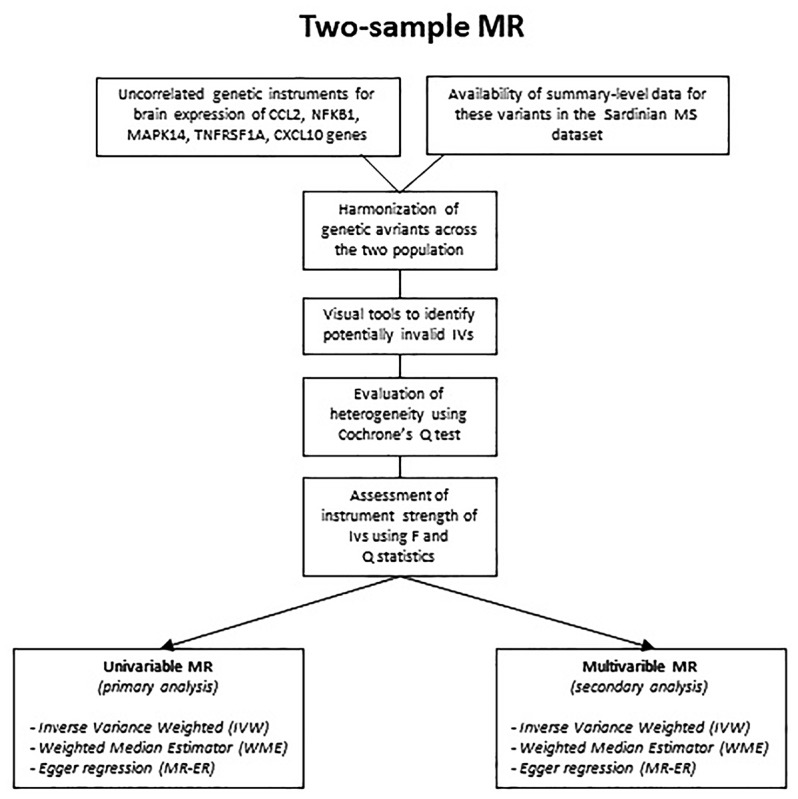
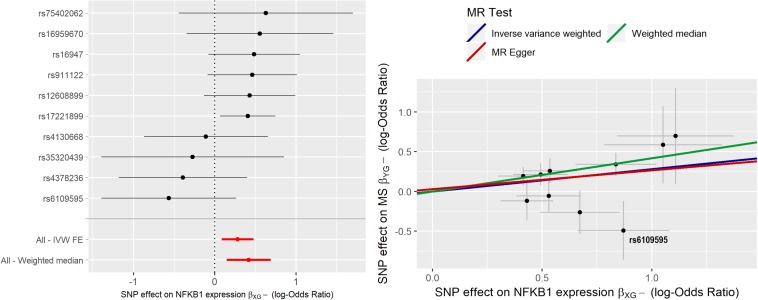
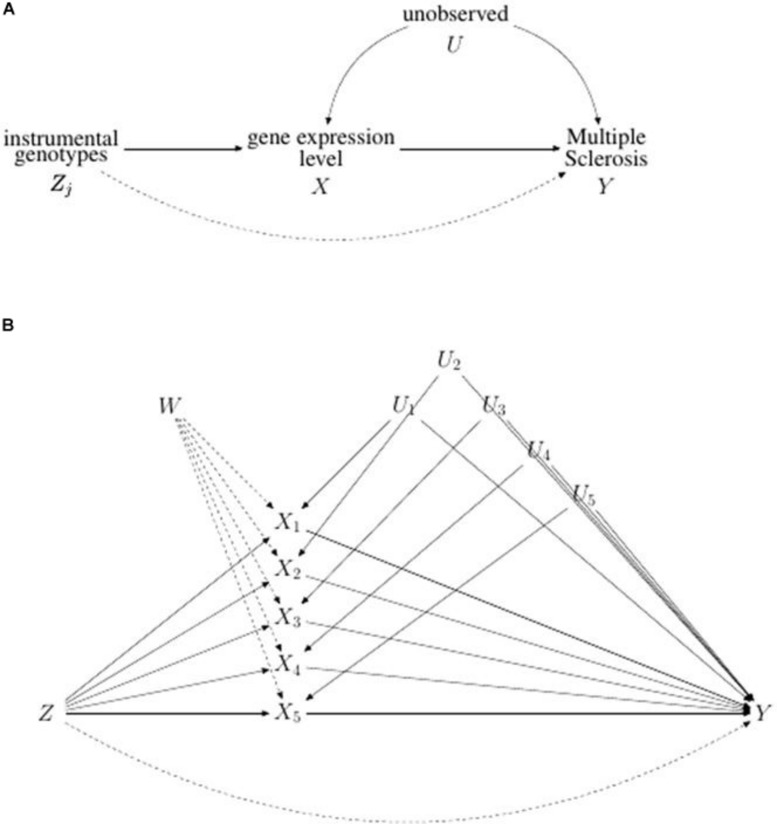
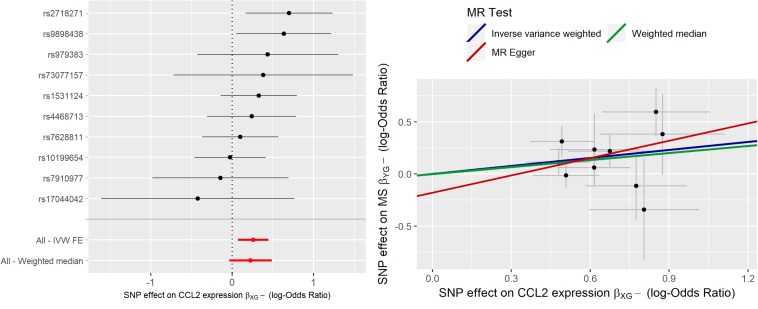
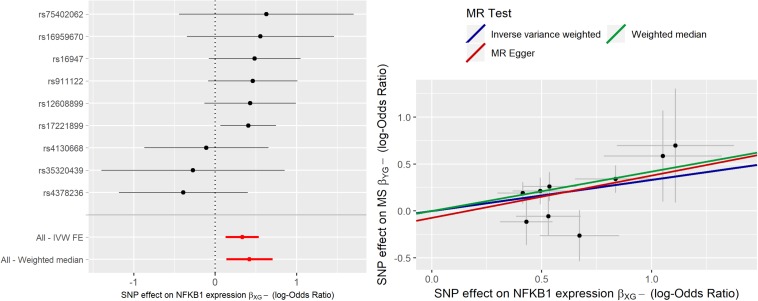
Multiple Sclerosis (MS) exhibits considerable heterogeneity in phenotypic expression, course, prognosis and response to therapy. This suggests this disease involves multiple, as yet poorly understood, causal mechanisms. In this work we assessed the possible causal link between gene expression level of five selected genes related to the pro-inflammatory NF-κB signaling pathway (i.e., , , , , ) in ten different brain tissues (i.e., cerebellum, frontal cortex, hippocampus, medulla, occipital cortex, putamen, substantia nigra, thalamus, temporal cortex and intralobular white matter) and MS. We adopted a two-stage Mendelian Randomization (MR) approach for the estimation of the causal effects of interest, based on summary-level data from 20 multiplex Sardinian families and data provided by the United Kingdom Brain Expression Consortium (UKBEC). Through Radial-MR and Cochrane's Q statistics we identified and removed genetic variants which are most likely to be invalid instruments. To estimate the total causal effect, univariable MR was carried out separately for each gene and brain region. We used Inverse-Variance Weighted estimator (IVW) as main analysis and MR-Egger Regression estimator (MR-ER) and Weighted Median Estimator (WME) as sensitivity analysis. As these genes belong to the same pathway and thus they can be closely related, we also estimated their direct causal effects by applying IVW and MR-ER within a multivariable MR (MVMR) approach using set of genetic instruments specific and common (composite) to each multiple exposures represented by the expression of the candidate genes. Univariate MR analysis showed a significant positive total causal effect for and respectively in medulla and cerebellum. MVMR showed a direct positive causal effect for and , and a direct negative causal effect for in cerebellum; while in medulla we observed a direct positive causal effect for . Since in general we observed a different magnitude for the gene specific causal effect we hypothesize that in cerebellum and medulla the effect of each gene expression is direct but also mediated by the others. These results confirm the importance of the involvement of NF-κB signaling pathway in brain tissue for the development of the disease and improve our understanding in the pathogenesis of MS.
多发性硬化症(MS)在表型表达、病程、预后及对治疗的反应方面表现出显著的异质性。这表明该疾病涉及多种尚未完全了解的致病机制。在这项研究中,我们评估了与促炎性核因子κB信号通路相关的五个选定基因(即 、 、 、 、 )在十种不同脑组织(即小脑、额叶皮质、海马体、延髓、枕叶皮质、壳核、黑质、丘脑、颞叶皮质和小叶内白质)中的基因表达水平与MS之间可能存在的因果联系。我们采用两阶段孟德尔随机化(MR)方法来估计感兴趣的因果效应,该方法基于来自20个撒丁岛多重家庭的汇总数据以及英国大脑表达联盟(UKBEC)提供的数据。通过径向MR和Cochrane's Q统计量,我们识别并去除了最有可能无效的基因变异。为了估计总因果效应,我们对每个基因和脑区分别进行了单变量MR分析。我们使用逆方差加权估计器(IVW)作为主要分析方法,并使用MR-Egger回归估计器(MR-ER)和加权中位数估计器(WME)作为敏感性分析方法。由于这些基因属于同一信号通路,因此它们可能密切相关,我们还通过在多变量MR(MVMR)方法中应用IVW和MR-ER来估计它们的直接因果效应,该方法使用特定于每个候选基因表达所代表的多个暴露的一组基因工具以及共同(复合)基因工具。单变量MR分析显示, 分别在延髓和小脑中具有显著的正向总因果效应。MVMR显示, 在小脑中具有直接的正向因果效应, 在小脑中具有直接的负向因果效应;而在延髓中,我们观察到 具有直接的正向因果效应。由于总体上我们观察到基因特异性因果效应的大小不同,因此我们推测在小脑和延髓中,每个基因表达的效应是直接的,但也由其他基因介导。这些结果证实了核因子κB信号通路在脑组织中参与疾病发展的重要性,并增进了我们对MS发病机制的理解。