Department of Radiation Oncology, University of Iowa, Iowa City, IA, USA.
Department of Radiology, University of Iowa, Iowa City, IA, USA.
J Appl Clin Med Phys. 2020 Jul;21(7):160-172. doi: 10.1002/acm2.12902. Epub 2020 May 20.
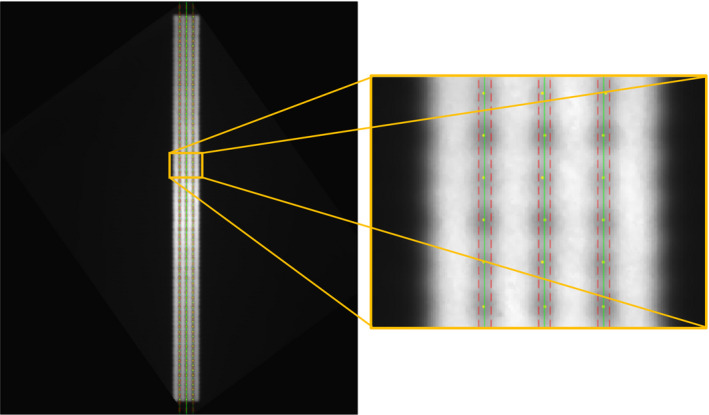
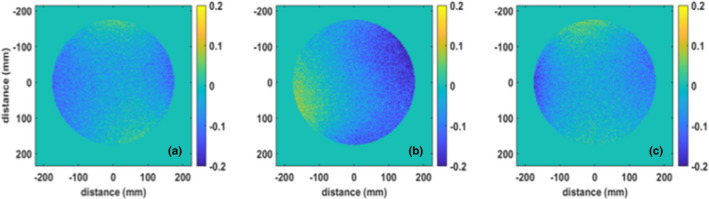
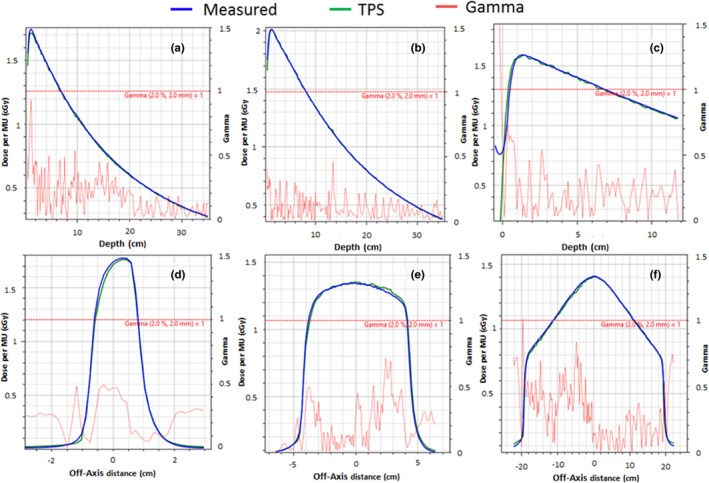
MR image-guided radiotherapy has the potential to improve patient care, but integration of an MRI scanner with a linear accelerator adds complexity to the commissioning process. This work describes a single institution experience of commissioning an Elekta Unity MR-linac, including mechanical testing, MRI scanner commissioning, and dosimetric validation. Mechanical testing included multileaf collimator (MLC) positional accuracy, measurement of radiation isocenter diameter, and MR-to-MV coincidence. Key MRI tests included magnetic field homogeneity, geometric accuracy, image quality, and the accuracy of navigator-triggered imaging for motion management. Dosimetric validation consisted of comparison between measured and calculated PDDs and profiles, IMRT measurements, and end-to-end testing. Multileaf collimator positional accuracy was within 1.0 mm, the measured radiation isocenter walkout was 0.20 mm, and the coincidence between MR and MV isocenter was 1.06 mm, which is accounted for in the treatment planning system (TPS). For a 350-mm-diameter spherical volume, the peak-to-peak deviation of the magnetic field homogeneity was 4.44 ppm and the geometric distortion was 0.8 mm. All image quality metrics were within ACR recommendations. Navigator-triggered images showed a maximum deviation of 0.42, 0.75, and 3.0 mm in the target centroid location compared to the stationary target for a 20 mm motion at 10, 15, and 20 breaths per minute, respectively. TPS-calculated PDDs and profiles showed excellent agreement with measurement. The gamma passing rate for IMRT plans was 98.4 ± 1.1% (3%/ 2 mm) and end-to-end testing of adapted plans showed agreement within 0.4% between ion-chamber measurement and TPS calculation. All credentialing criteria were satisfied in an independent end-to-end test using an IROC MRgRT phantom.
磁共振引导放疗有可能改善患者的护理水平,但将磁共振扫描仪与线性加速器集成会增加调试过程的复杂性。本工作描述了一家机构在调试 Elekta Unity MR-直线加速器方面的经验,包括机械测试、磁共振扫描仪调试和剂量验证。机械测试包括多叶准直器(MLC)位置精度、辐射等中心直径的测量以及磁共振与兆伏(MV)等中心的符合度。关键磁共振测试包括磁场均匀性、几何精度、图像质量以及用于运动管理的导航触发成像的准确性。剂量验证包括测量与计算的 PDD 和轮廓、调强放疗(IMRT)测量以及端对端测试之间的比较。多叶准直器位置精度在 1.0 毫米以内,测量的辐射等中心偏差为 0.20 毫米,磁共振和兆伏等中心的符合度为 1.06 毫米,这在治疗计划系统(TPS)中得到了考虑。对于 350 毫米直径的球形容积,磁场均匀性的峰峰值偏差为 4.44 ppm,几何变形为 0.8 毫米。所有图像质量指标均符合 ACR 建议。导航触发图像显示,在 10、15 和 20 次/分钟呼吸频率下,目标中心位置相对于静止目标的最大偏差分别为 0.42、0.75 和 3.0 毫米,目标在 20 毫米运动时。TPS 计算的 PDD 和轮廓与测量值具有极好的一致性。调强放疗计划的伽玛通过率为 98.4±1.1%(3%/2 毫米),自适应计划的端对端测试结果显示,离子室测量值与 TPS 计算值之间的一致性在 0.4%以内。在使用 IROC MRgRT 体模进行的独立端对端测试中,所有认证标准均得到满足。