Kang Yuqi, Vijay Siddharth, Gujral Taranjit S
Division of Human Biology, Fred Hutchinson Cancer Center, Seattle, WA, USA.
Department of Pharmacology, University of Washington, Seattle, WA, USA.
iScience. 2022 Apr 9;25(5):104228. doi: 10.1016/j.isci.2022.104228. eCollection 2022 May 20.
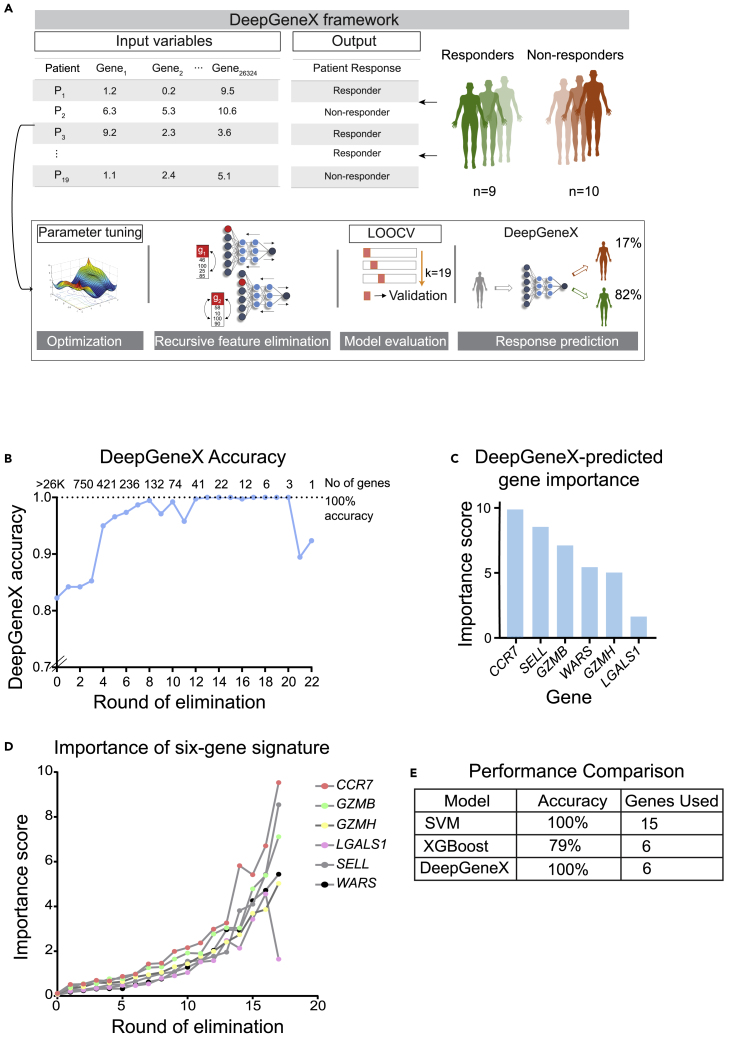
Immunotherapy has shown significant promise as a treatment for cancer, such as lung cancer and melanoma. However, only 10%-30% of the patients respond to treatment with immune checkpoint blockers (ICBs), underscoring the need for biomarkers to predict response to immunotherapy. Here, we developed DeepGeneX, a computational framework that uses advanced deep neural network modeling and feature elimination to reduce single-cell RNA-seq data on ∼26,000 genes to six of the most important genes (, , , , , and ), that accurately predict response to immunotherapy. We also discovered that the high LGALS1 and WARS-expressing macrophage population represent a biomarker for ICB therapy nonresponders, suggesting that these macrophages may be a target for improving ICB response. Taken together, DeepGeneX enables biomarker discovery and provides an understanding of the molecular basis for the model's predictions.
免疫疗法已显示出作为癌症(如肺癌和黑色素瘤)治疗方法的巨大前景。然而,只有10%-30%的患者对免疫检查点阻断剂(ICB)治疗有反应,这凸显了需要生物标志物来预测免疫疗法反应的必要性。在此,我们开发了DeepGeneX,这是一个计算框架,它使用先进的深度神经网络建模和特征消除,将约26000个基因的单细胞RNA测序数据减少到六个最重要的基因(、、、、和),这些基因能准确预测对免疫疗法的反应。我们还发现,高表达LGALS1和WARS的巨噬细胞群体是ICB治疗无反应者的生物标志物,这表明这些巨噬细胞可能是改善ICB反应的靶点。综上所述,DeepGeneX能够发现生物标志物,并提供对该模型预测的分子基础的理解。