Division of Pharmacology, School of Korean Medicine, Pusan National University, Yangsan 50612, Korea.
Research Institute for Korean Medicine, Pusan National University, Yangsan 50612, Korea.
Mar Drugs. 2020 May 19;18(5):266. doi: 10.3390/md18050266.
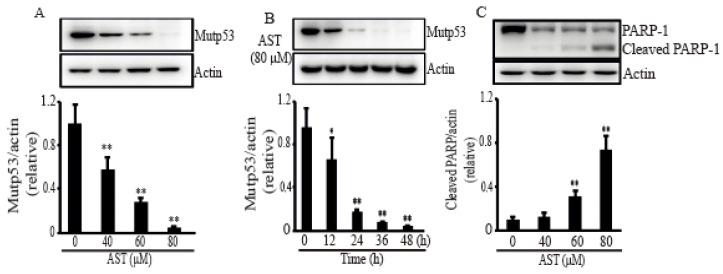
Astaxanthin (AST) is related to apoptosis but the details of the mechanism of how AST makes apoptosis is not clear. The present study investigated apoptotic effects of AST to SKBR3, a breast cancer cell line in detail. Cell viability assay showed cellular proliferation and morphological changes of the cells were observed under AST treatment. FACS analysis indicated that AST blocked cell cycle progression at G0/G1, suppressed proliferation dose-dependently, and induced apoptosis of the cells. The apoptosis of the cells by AST was further demonstrated through the decreased expression level of mutp53 and cleaved a PARP-1 fragment, respectively. In addition, AST induced the intrinsic apoptosis of the cells by activation of Bax/Bcl2, cleaved caspase-3, and cleaved caspase-9 as well as the phosphorylation of ERK1/2, JNK, and p38. Furthermore, AST decreased production of intracellular reactive oxygen species as well as modulated expressions of superoxide dismutases and Pontin, an anti-apoptotic factor. Co-immunoprecipitation assay revealed AST reduced interaction between Pontin and mutant p53. Taken together, these studies proved that AST regulates the expression of apoptotic molecules to induce intrinsic apoptosis of the cells, suggesting AST therapy might provide an alternative for improving the efficacies of other anti-cancer therapies for breast cancer.
虾青素(AST)与细胞凋亡有关,但 AST 如何诱导细胞凋亡的机制尚不清楚。本研究详细研究了 AST 对 SKBR3(一种乳腺癌细胞系)的凋亡作用。细胞活力测定显示 AST 处理后细胞增殖和形态发生变化。FACS 分析表明,AST 阻断细胞周期在 G0/G1 期进展,呈剂量依赖性抑制增殖,并诱导细胞凋亡。AST 诱导细胞凋亡进一步通过降低 mutp53 和裂解 PARP-1 片段的表达水平来证明。此外,AST 通过激活 Bax/Bcl2、裂解 caspase-3 和裂解 caspase-9 以及 ERK1/2、JNK 和 p38 的磷酸化诱导细胞内源性凋亡。此外,AST 减少了细胞内活性氧的产生,并调节了超氧化物歧化酶和 Pontin(一种抗凋亡因子)的表达。共免疫沉淀试验表明 AST 减少了 Pontin 和突变型 p53 之间的相互作用。总之,这些研究证明 AST 通过调节凋亡分子的表达来诱导细胞内源性凋亡,提示 AST 治疗可能为提高乳腺癌其他抗癌疗法的疗效提供一种替代方法。