Fachbereich Physik, Universität Konstanz, Konstanz, D-78464, Germany.
Nat Commun. 2020 May 21;11(1):2547. doi: 10.1038/s41467-020-16161-4.
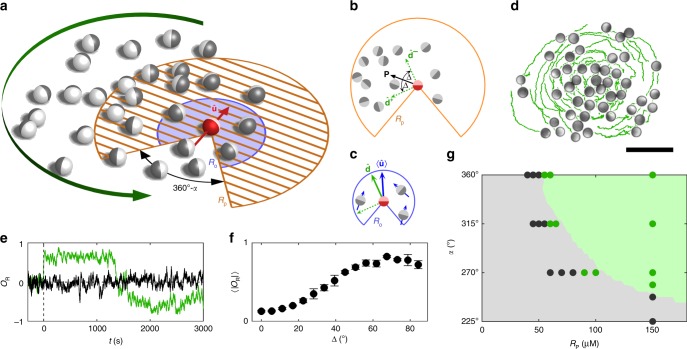
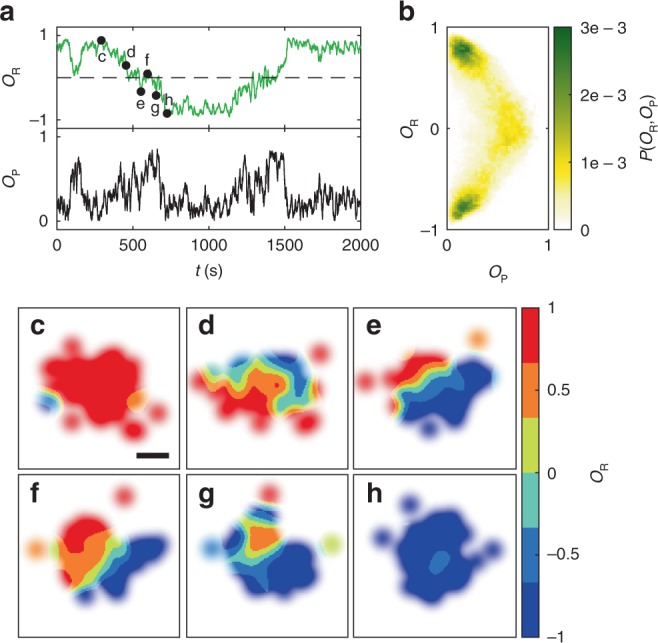
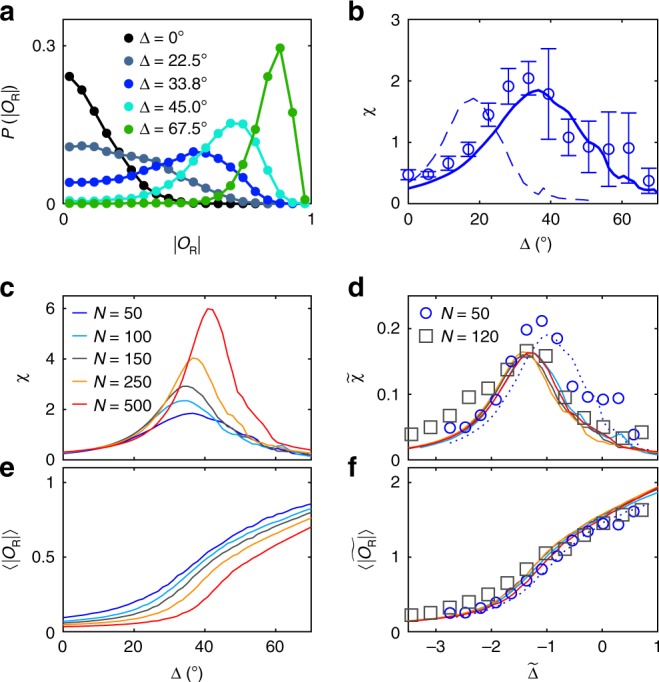
Many animal species organise into disordered swarms, polarised flocks or swirls to protect from predators or optimise foraging. Previous studies suggest that such collective states are related to a critical point, which could explain their balance between robustness to noise and high responsiveness regarding external perturbations. Here we provide experimental evidence for this idea by investigating the stability of swirls formed by light-responsive active colloids which adjust their individual motion to positions and orientations of neighbours. Because their behaviour can be precisely tuned, controlled changes between different collective states can be achieved. During the transition between stable swirls and swarms we observe a maximum of the group's susceptibility indicating the vicinity of a critical point. Our results support the idea of system-independent organisation principles of collective states and provide useful strategies for the realisation of responsive yet stable ensembles in microrobotic systems.
许多动物物种通过形成无序的蜂群、极化的羊群或漩涡来保护自己免受捕食者的侵害,或者优化觅食。先前的研究表明,这种集体状态与临界点有关,这可以解释它们在噪声鲁棒性和对外界干扰的高响应性之间的平衡。通过研究对光响应的活性胶体形成的漩涡的稳定性,我们提供了这一观点的实验证据,这些胶体可以根据邻居的位置和方向调整自身的运动。因为它们的行为可以被精确地调整,所以可以实现不同集体状态之间的可控变化。在稳定的漩涡和蜂群之间的转变过程中,我们观察到了群体敏感性的最大值,表明临界点就在附近。我们的结果支持了集体状态的系统独立组织原则的观点,并为在微机器人系统中实现响应性但稳定的集合体提供了有用的策略。