Tan Steven J, Chang Alice C, Anderson Sarah M, Miller Cayla M, Prahl Louis S, Odde David J, Dunn Alexander R
Department of Chemical Engineering, Stanford University, Stanford, CA 94305, USA.
Department of Biomedical Engineering and Physical Sciences-Oncology Center, University of Minnesota, Minneapolis, MN 55455, USA.
Sci Adv. 2020 May 15;6(20):eaax0317. doi: 10.1126/sciadv.aax0317. eCollection 2020 May.
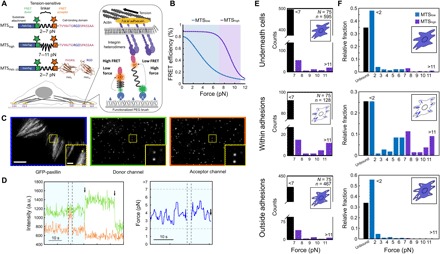
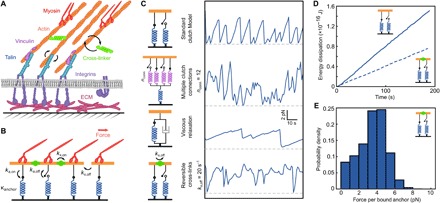
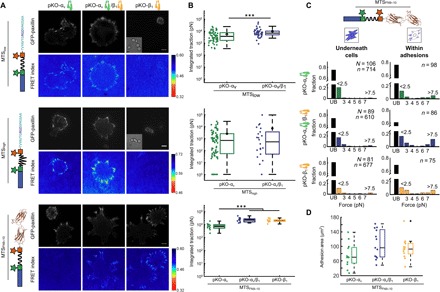
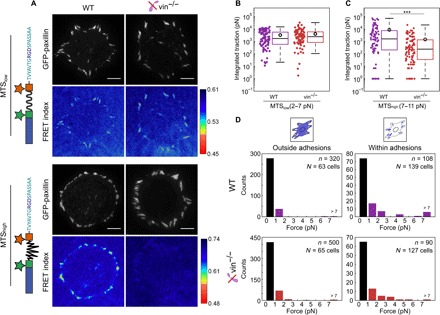
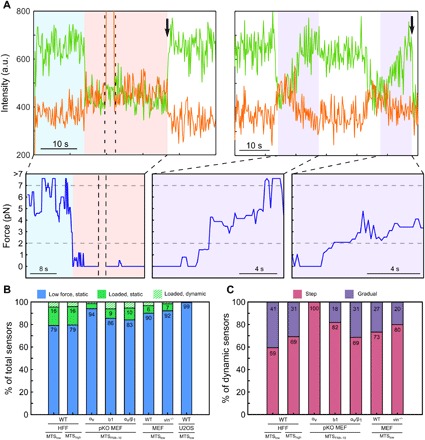
Integrin-based adhesion complexes link the cytoskeleton to the extracellular matrix (ECM) and are central to the construction of multicellular animal tissues. How biological function emerges from the tens to thousands of proteins present within a single adhesion complex remains unclear. We used fluorescent molecular tension sensors to visualize force transmission by individual integrins in living cells. These measurements revealed an underlying functional modularity in which integrin class controlled adhesion size and ECM ligand specificity, while the number and type of connections between integrins and F-actin determined the force per individual integrin. In addition, we found that most integrins existed in a state of near-mechanical equilibrium, a result not predicted by existing models of cytoskeletal force transduction. A revised model that includes reversible cross-links within the F-actin network can account for this result and suggests one means by which cellular mechanical homeostasis can arise at the molecular level.
基于整合素的黏附复合体将细胞骨架与细胞外基质(ECM)相连,对多细胞动物组织的构建至关重要。单个黏附复合体内存在的数十种至数千种蛋白质如何产生生物学功能仍不清楚。我们使用荧光分子张力传感器来可视化活细胞中单个整合素的力传递。这些测量揭示了一种潜在的功能模块性,其中整合素类别控制黏附大小和ECM配体特异性,而整合素与F-肌动蛋白之间连接的数量和类型决定了每个整合素的力。此外,我们发现大多数整合素处于接近力学平衡的状态,这一结果是现有细胞骨架力转导模型所未预测到的。一个包含F-肌动蛋白网络内可逆交联的修订模型可以解释这一结果,并提出了一种在分子水平上产生细胞力学稳态的方式。