• 文献检索
  • 文档翻译
  • 深度研究
  • 学术资讯
  • Suppr Zotero 插件Zotero 插件
  • 邀请有礼
  • 套餐&价格
  • 历史记录
应用&插件
Suppr Zotero 插件Zotero 插件浏览器插件Mac 客户端Windows 客户端微信小程序
定价
高级版会员购买积分包购买API积分包
服务
文献检索文档翻译深度研究API 文档MCP 服务
关于我们
关于 Suppr公司介绍联系我们用户协议隐私条款
关注我们

Suppr 超能文献

核心技术专利:CN118964589B侵权必究
粤ICP备2023148730 号-1Suppr @ 2026

文献检索

告别复杂PubMed语法,用中文像聊天一样搜索,搜遍4000万医学文献。AI智能推荐,让科研检索更轻松。

立即免费搜索

文件翻译

保留排版,准确专业,支持PDF/Word/PPT等文件格式,支持 12+语言互译。

免费翻译文档

深度研究

AI帮你快速写综述,25分钟生成高质量综述,智能提取关键信息,辅助科研写作。

立即免费体验

瑞典人群中气味强度估计与新冠病毒病患病率预测之间的关系

Relationship between odor intensity estimates and COVID-19 prevalence prediction in a Swedish population.

作者信息

Iravani Behzad, Arshamian Artin, Ravia Aharon, Mishor Eva, Snitz Kobi, Shushan Sagit, Roth Yehudah, Perl Ofer, Honigstein Danielle, Weissgross Reut, Karagach Shiri, Ernst Gernot, Okamoto Masako, Mainen Zachary, Monteleone Erminio, Dinnella Caterina, Spinelli Sara, Mariño-Sánchez Franklin, Ferdenzi Camille, Smeets Monique, Touhara Kazushige, Bensafi Moustafa, Hummel Thomas, Sobel Noam, Lundström Johan N

机构信息

Department of Clinical Neuroscience, Karolinska Institutet, Stockholm, Sweden.

Department of Psychology, Stockholm University, Stockholm, Sweden.

出版信息

Chem Senses. 2020 May 22. doi: 10.1093/chemse/bjaa034.

DOI:10.1093/chemse/bjaa034
PMID:32441744
原文链接:https://pmc.ncbi.nlm.nih.gov/articles/PMC7314115/
Abstract

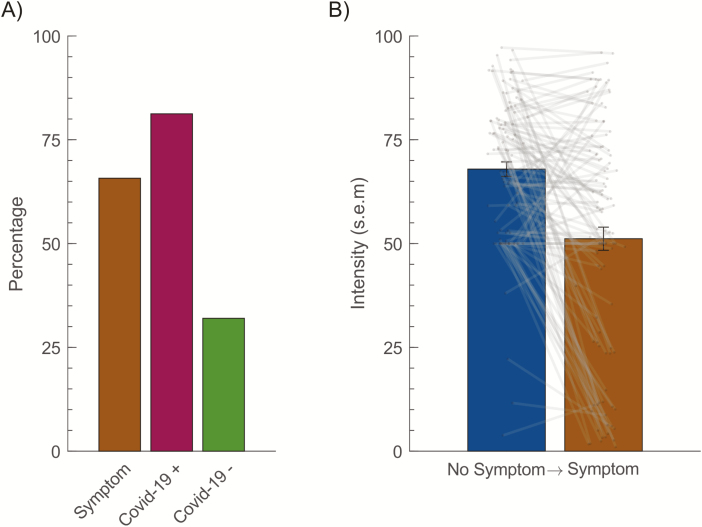
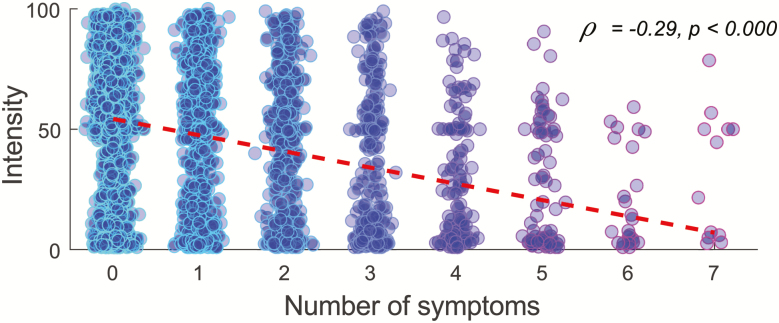
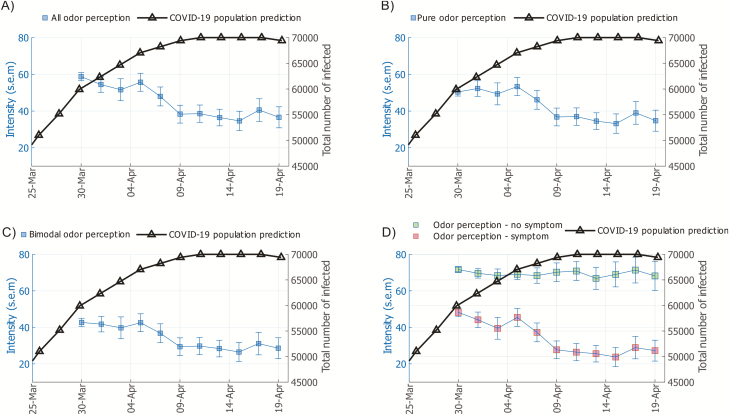
In response to the COVID-19 pandemic, countries have implemented various strategies to reduce and slow the spread of the disease in the general population. For countries that have implemented restrictions on its population in a step-wise manner, monitoring of COVID-19 prevalence is of importance to guide decision on when to impose new, or when to abolish old, restrictions. We are here determining whether measures of odor intensity in a large sample can serve as one such measure. Online measures of how intense common household odors are perceived and symptoms of COVID-19 were collected from 2440 Swedes. Average odor intensity ratings were then compared to predicted COVID-19 population prevalence over time in the Swedish population and were found to closely track each other (r=-0.83). Moreover, we found that there was a large difference in rated intensity between individuals with and without COVID-19 symptoms and number of symptoms was related to odor intensity ratings. Finally, we found that individuals progressing from reporting no symptoms to subsequently reporting COVID-19 symptoms demonstrated a large drop in olfactory performance. These data suggest that measures of odor intensity, if obtained in a large and representative sample, can be used as an indicator of COVID-19 disease in the general population. Importantly, this simple measure could easily be implemented in countries without widespread access to COVID-19 testing or implemented as a fast early response before wide-spread testing can be facilitated.

摘要

为应对新冠疫情,各国已实施各种策略以减少并减缓该疾病在普通人群中的传播。对于逐步对其民众实施限制措施的国家而言,监测新冠病毒流行情况对于指导何时实施新的限制措施或何时取消旧的限制措施的决策至关重要。我们在此确定在大量样本中测量气味强度的方法是否可作为这样一种措施。我们从2440名瑞典人那里收集了关于常见家庭气味的感知强度的在线测量数据以及新冠病毒症状数据。然后将平均气味强度评分与瑞典人群中随时间推移预测的新冠病毒流行率进行比较,发现二者密切相关(r = -0.83)。此外,我们发现有新冠病毒症状和没有新冠病毒症状的个体在气味强度评分上存在很大差异,且症状数量与气味强度评分相关。最后,我们发现从报告无症状到随后报告有新冠病毒症状的个体,其嗅觉表现大幅下降。这些数据表明,如果在一个大型且具有代表性的样本中获取气味强度测量数据,那么它可作为普通人群中新冠病毒感染情况的一个指标。重要的是,在没有广泛开展新冠病毒检测的国家,这种简单的测量方法可以很容易地实施,或者在能够促进广泛检测之前作为一种快速的早期应对措施来实施。
https://cdn.ncbi.nlm.nih.gov/pmc/blobs/aab5/7314115/4b493268f3ae/bjaa034f0003.jpg
https://cdn.ncbi.nlm.nih.gov/pmc/blobs/aab5/7314115/8a477377c225/bjaa034f0001.jpg
https://cdn.ncbi.nlm.nih.gov/pmc/blobs/aab5/7314115/b81aed929250/bjaa034f0002.jpg
https://cdn.ncbi.nlm.nih.gov/pmc/blobs/aab5/7314115/4b493268f3ae/bjaa034f0003.jpg
https://cdn.ncbi.nlm.nih.gov/pmc/blobs/aab5/7314115/8a477377c225/bjaa034f0001.jpg
https://cdn.ncbi.nlm.nih.gov/pmc/blobs/aab5/7314115/b81aed929250/bjaa034f0002.jpg
https://cdn.ncbi.nlm.nih.gov/pmc/blobs/aab5/7314115/4b493268f3ae/bjaa034f0003.jpg

相似文献

1
Relationship between odor intensity estimates and COVID-19 prevalence prediction in a Swedish population.瑞典人群中气味强度估计与新冠病毒病患病率预测之间的关系
Chem Senses. 2020 May 22. doi: 10.1093/chemse/bjaa034.
2
Loss of olfactory sensitivity is an early and reliable marker for COVID-19.嗅觉灵敏度丧失是 COVID-19 的早期且可靠的标志物。
Chem Senses. 2022 Jan 1;47. doi: 10.1093/chemse/bjac022.
3
Effectiveness and cost-effectiveness of four different strategies for SARS-CoV-2 surveillance in the general population (CoV-Surv Study): a structured summary of a study protocol for a cluster-randomised, two-factorial controlled trial.在普通人群中进行 SARS-CoV-2 监测的四种不同策略的有效性和成本效益(CoV-Surv 研究):一项关于集群随机、双因素对照试验的研究方案的结构化总结。
Trials. 2021 Jan 8;22(1):39. doi: 10.1186/s13063-020-04982-z.
4
An olfactory self-test effectively screens for COVID-19.嗅觉自我检测可有效筛查新冠病毒。
Commun Med (Lond). 2022 Apr 5;2:34. doi: 10.1038/s43856-022-00095-7. eCollection 2022.
5
Travel-related control measures to contain the COVID-19 pandemic: a rapid review.旅行相关的控制措施以遏制 COVID-19 大流行:快速综述。
Cochrane Database Syst Rev. 2020 Oct 5;10:CD013717. doi: 10.1002/14651858.CD013717.
6
International travel-related control measures to contain the COVID-19 pandemic: a rapid review.国际旅行相关防控措施以遏制 COVID-19 大流行:快速综述。
Cochrane Database Syst Rev. 2021 Mar 25;3(3):CD013717. doi: 10.1002/14651858.CD013717.pub2.
7
Objective Sensory Testing Methods Reveal a Higher Prevalence of Olfactory Loss in COVID-19-Positive Patients Compared to Subjective Methods: A Systematic Review and Meta-Analysis.目的:与主观方法相比,客观感觉测试方法显示 COVID-19 阳性患者的嗅觉丧失发生率更高:系统评价和荟萃分析。
Chem Senses. 2020 Dec 5;45(9):865-874. doi: 10.1093/chemse/bjaa064.
8
Signs and symptoms to determine if a patient presenting in primary care or hospital outpatient settings has COVID-19.在基层医疗机构或医院门诊环境中,如果患者出现以下症状和体征,可判断其是否患有 COVID-19。
Cochrane Database Syst Rev. 2022 May 20;5(5):CD013665. doi: 10.1002/14651858.CD013665.pub3.
9
Erratum: High-Throughput Identification of Resistance to Pseudomonas syringae pv. Tomato in Tomato using Seedling Flood Assay.勘误:利用幼苗浸没法高通量鉴定番茄对丁香假单胞菌 pv.番茄的抗性。
J Vis Exp. 2023 Oct 18(200). doi: 10.3791/6576.
10
Low odor awareness predicts reduced olfactory abilities in women with depressive symptoms, but not with anxiety symptoms.低气味意识预示着有抑郁症状的女性嗅觉能力下降,但没有焦虑症状的女性则不然。
J Affect Disord. 2023 Oct 1;338:171-179. doi: 10.1016/j.jad.2023.06.009. Epub 2023 Jun 7.

引用本文的文献

1
Integrating the patient's voice into the research agenda for treatment of chemosensory disorders.将患者的声音纳入治疗化疗感觉障碍的研究议程中。
Chem Senses. 2024 Jan 1;49. doi: 10.1093/chemse/bjae020.
2
Using SCENTinel® to predict SARS-CoV-2 infection: insights from a community sample during dominance of Delta and Omicron variants.使用SCENTinel®预测新型冠状病毒2型感染:来自德尔塔和奥密克戎变异株主导时期社区样本的见解
Front Public Health. 2024 Apr 10;12:1322797. doi: 10.3389/fpubh.2024.1322797. eCollection 2024.
3
Transient loss and recovery of oral chemesthesis, taste and smell with COVID-19: A small case-control series.

本文引用的文献

1
MRI Evaluation of the Olfactory Clefts in Patients with SARS-CoV-2 Infection Revealed an Unexpected Mechanism for Olfactory Function Loss.对感染新型冠状病毒(SARS-CoV-2)患者的嗅裂进行磁共振成像(MRI)评估揭示了嗅觉功能丧失的一种意外机制。
Acad Radiol. 2020 Aug;27(8):1191. doi: 10.1016/j.acra.2020.05.013. Epub 2020 May 16.
2
Corona Viruses and the Chemical Senses: Past, Present, and Future.冠状病毒与化学感官:过去、现在与未来
Chem Senses. 2020 May 14. doi: 10.1093/chemse/bjaa031.
3
Real-time tracking of self-reported symptoms to predict potential COVID-19.
新冠病毒感染后口腔化学感觉、味觉和嗅觉的短暂丧失和恢复:一项小型病例对照研究系列。
Physiol Behav. 2023 Nov 1;271:114331. doi: 10.1016/j.physbeh.2023.114331. Epub 2023 Aug 16.
4
A quick test to objectify smell and taste dysfunction at home: a proof of concept for the validation of the chemosensory perception test.一种在家中客观化嗅觉和味觉障碍的快速测试:用于验证化学感觉感知测试的概念验证。
Chem Senses. 2023 Jan 1;48. doi: 10.1093/chemse/bjad033.
5
Covid-19 affects taste independent of taste-smell confusions: results from a combined chemosensory home test and online survey from a large global cohort.Covid-19 对味觉的影响独立于味觉-嗅觉混淆:来自大型全球队列的联合化学感觉家庭测试和在线调查的结果。
Chem Senses. 2023 Jan 1;48. doi: 10.1093/chemse/bjad020.
6
Transient loss and recovery of oral chemesthesis, taste and smell with COVID-19: a small case-control series.新冠病毒感染导致口腔化学感觉、味觉和嗅觉的短暂丧失及恢复:一项小型病例对照研究系列
medRxiv. 2023 Mar 29:2023.03.27.23287763. doi: 10.1101/2023.03.27.23287763.
7
Covid-19 affects taste independently of smell: results from a combined chemosensory home test and online survey from a global cohort (N=10,953).新冠病毒肺炎独立于嗅觉影响味觉:一项联合化学感觉家庭测试及来自全球队列(N = 10,953)在线调查的结果
medRxiv. 2023 Jan 18:2023.01.16.23284630. doi: 10.1101/2023.01.16.23284630.
8
Loss of olfactory sensitivity is an early and reliable marker for COVID-19.嗅觉灵敏度丧失是 COVID-19 的早期且可靠的标志物。
Chem Senses. 2022 Jan 1;47. doi: 10.1093/chemse/bjac022.
9
Results from psychophysical tests of smell and taste during the course of SARS-CoV-2 infection: a review.新型冠状病毒感染过程中嗅觉和味觉的心理物理学测试结果:一项综述
Acta Otorhinolaryngol Ital. 2022 Apr;42(Suppl. 1):S20-S35. doi: 10.14639/0392-100X-suppl.1-42-2022-03.
10
An olfactory self-test effectively screens for COVID-19.嗅觉自我检测可有效筛查新冠病毒。
Commun Med (Lond). 2022 Apr 5;2:34. doi: 10.1038/s43856-022-00095-7. eCollection 2022.
实时跟踪自我报告的症状以预测潜在的 COVID-19。
Nat Med. 2020 Jul;26(7):1037-1040. doi: 10.1038/s41591-020-0916-2. Epub 2020 May 11.
4
SARS-CoV-2 entry factors are highly expressed in nasal epithelial cells together with innate immune genes.严重急性呼吸综合征冠状病毒2(SARS-CoV-2)进入因子与固有免疫基因一起在鼻上皮细胞中高表达。
Nat Med. 2020 May;26(5):681-687. doi: 10.1038/s41591-020-0868-6. Epub 2020 Apr 23.
5
Smell dysfunction: a biomarker for COVID-19.嗅觉功能障碍:COVID-19 的生物标志物。
Int Forum Allergy Rhinol. 2020 Aug;10(8):944-950. doi: 10.1002/alr.22587. Epub 2020 Jun 18.
6
Use of Google Trends to investigate loss-of-smell-related searches during the COVID-19 outbreak.利用谷歌趋势调查 COVID-19 爆发期间与嗅觉丧失相关的搜索。
Int Forum Allergy Rhinol. 2020 Jul;10(7):839-847. doi: 10.1002/alr.22580. Epub 2020 Jun 15.
7
Neurologic Manifestations of Hospitalized Patients With Coronavirus Disease 2019 in Wuhan, China.中国武汉住院的 2019 年冠状病毒病患者的神经系统表现。
JAMA Neurol. 2020 Jun 1;77(6):683-690. doi: 10.1001/jamaneurol.2020.1127.
8
Isolated sudden onset anosmia in COVID-19 infection. A novel syndrome?COVID-19 感染中的孤立性突发性嗅觉丧失。一种新综合征?
Rhinology. 2020 Jun 1;58(3):299-301. doi: 10.4193/Rhin20.114.
9
SARS-CoV-2 Cell Entry Depends on ACE2 and TMPRSS2 and Is Blocked by a Clinically Proven Protease Inhibitor.严重急性呼吸综合征冠状病毒 2 型(SARS-CoV-2)进入细胞依赖于 ACE2 和 TMPRSS2,可被一种临床验证的蛋白酶抑制剂所阻断。
Cell. 2020 Apr 16;181(2):271-280.e8. doi: 10.1016/j.cell.2020.02.052. Epub 2020 Mar 5.
10
The neuroinvasive potential of SARS-CoV2 may play a role in the respiratory failure of COVID-19 patients.SARS-CoV2 的神经侵袭性可能在 COVID-19 患者的呼吸衰竭中起作用。
J Med Virol. 2020 Jun;92(6):552-555. doi: 10.1002/jmv.25728. Epub 2020 Mar 11.