Magiri Royford Bundi, Lai Ken John, Mutwiri George Kiremu, Wilson Heather Lynne
Vaccinology & Immunotherapeutic Program, School of Public Health, University of Saskatchewan, Saskatoon, SK S7N 2Z4, Canada.
Vaccine & Infectious Disease Organization-International Vaccine Centre (VIDO-InterVac), University of Saskatchewan, 120 Veterinary Road, Saskatoon, SK S7N 5E3, Canada.
Vaccines (Basel). 2020 May 18;8(2):235. doi: 10.3390/vaccines8020235.
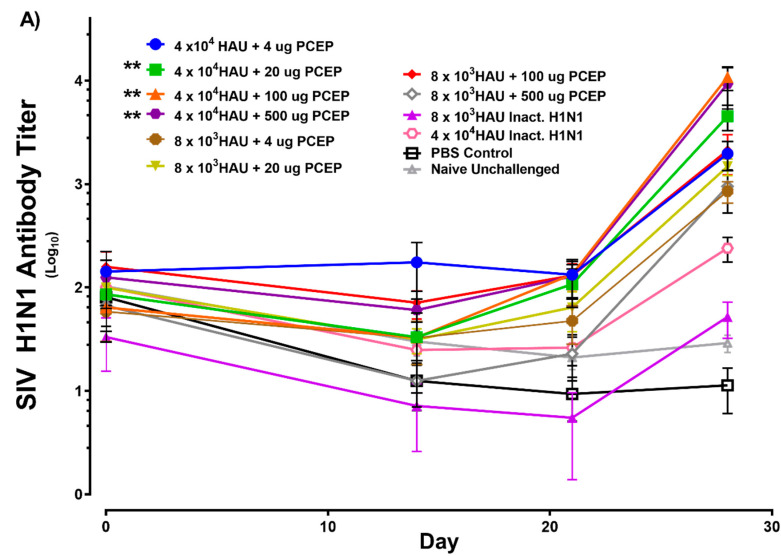
Vaccination is the most efficient method of protection against influenza infections. However, the rapidly mutating viruses and development of new strains make it necessary to develop new influenza vaccines annually. Hence, vaccines that stimulate cross-protection against multiple influenza subtypes are highly sought. Recent evidence suggests that adjuvants such as PCEP that promote Th1-type T cell and Th2-type T cell immune responses and broad-spectrum immune responses may confer cross-protection against heterologous influenza strains. In this study, we evaluated whether the immunogenic and protective potential of PCEP-adjuvanted inactivated swine influenza virus H1N1 vaccine can protect pigs immunized against live H3N2 virus. Piglets were vaccinated via the intradermal route with PCEP-adjuvanted inactivated swine influenza virus (SIV) H1N1 vaccine, boosted at day 21 with the same vaccines then challenged with infectious SIV H3N2 virus at day 35 via the tracheobronchial route. The pigs showed significant anti-H1N1 SIV specific antibody titres and H1N1 SIV neutralizing antibody titres, and these serum titres remained after the challenge with the H3N2 virus. In contrast, vaccination with anti-H1N1 SIV did not trigger anti-H3N2 SIV antibody titres or neutralizing antibody titres and these titres remained low until pigs were challenged with H3N2 SIV. At necropsy (six days after challenge), we collected prescapular lymph nodes and tracheobronchial draining the vaccination sites and challenge site, respectively. ELISPOTs from lymph node cells restimulated ex vivo with inactivated SIV H1N1 showed significant production of IFN-γ in the tracheobronchial cells, but not the prescapular lymph nodes. In contrast, lymph node cells restimulated ex vivo with inactivated SIV H1N1 showed significantly higher IL-13 and IL-17A in the prescapular lymph nodes draining the vaccination sites relative to unchallenged animals. Lung lesion scores show that intradermal vaccination with H1N1 SIV plus PCEP did not prevent lesions when the animals were challenged with H3N2. These results confirm previous findings that PCEP is effective as a vaccine adjuvant in that it induces strong immune responses and protects against homologous swine influenza H1N1 virus, but the experimental H1N1 vaccine failed to cross-protect against heterologous H3N2 virus.
接种疫苗是预防流感感染最有效的方法。然而,病毒的快速变异和新毒株的出现使得每年都有必要研发新的流感疫苗。因此,能够刺激针对多种流感亚型产生交叉保护作用的疫苗备受青睐。最近的证据表明,诸如PCEP之类的佐剂可促进Th1型T细胞和Th2型T细胞免疫反应以及广谱免疫反应,可能赋予针对异源流感毒株的交叉保护作用。在本研究中,我们评估了PCEP佐剂灭活猪流感病毒H1N1疫苗的免疫原性和保护潜力是否能保护接种疫苗的猪抵抗活的H3N2病毒。仔猪通过皮内途径接种PCEP佐剂灭活猪流感病毒(SIV)H1N1疫苗,在第21天用相同疫苗加强免疫,然后在第35天通过气管支气管途径用传染性SIV H3N2病毒进行攻毒。这些猪表现出显著的抗H1N1 SIV特异性抗体滴度和H1N1 SIV中和抗体滴度,并且在用H3N2病毒攻毒后这些血清滴度依然存在。相比之下,接种抗H1N1 SIV疫苗并未引发抗H3N2 SIV抗体滴度或中和抗体滴度,并且在猪用H3N2 SIV攻毒之前这些滴度一直很低。在尸检时(攻毒后6天),我们分别收集了肩胛前淋巴结以及引流接种部位和攻毒部位的气管支气管淋巴结。用灭活SIV H1N1体外再次刺激淋巴结细胞后进行的ELISPOT分析显示,气管支气管细胞中显著产生了IFN-γ,但肩胛前淋巴结中未产生。相比之下,相对于未攻毒动物,用灭活SIV H1N1体外再次刺激接种部位引流的肩胛前淋巴结中的淋巴结细胞后,IL-13和IL-17A显著升高。肺部病变评分显示,当动物用H3N2攻毒时,皮内接种H1N1 SIV加PCEP并不能预防病变。这些结果证实了先前的发现,即PCEP作为疫苗佐剂是有效的,因为它能诱导强烈的免疫反应并保护抵抗同源猪流感H1N1病毒,但实验性H1N1疫苗未能对异源H3N2病毒产生交叉保护作用。