Department of Health Promotion Sciences, Maternal and Infant Care, Internal Medicine and Medical Specialties "G. D'Alessandro", University of Palermo, Piazza delle Cliniche, 2, 90127, Palermo, Italy.
Ital J Pediatr. 2020 May 24;46(1):73. doi: 10.1186/s13052-020-00838-z.
The rate of twinning continues to increase due to the combined effect of a rise in parental age and increased use of assisted reproductive technology. The risk of congenital anomalies in twins is higher than in singletons, but it is less well reported in relation to growth patterns. We focused to the auxological outcome of twin pregnancies when one or both of twins are affected by one or more malformations.
We conducted a retrospective observational study reviewing the clinical charts of twins admitted in the period between January 2003 and December 2018 at the University Hospital of Palermo. The associations between malformations and anthropometric variables at birth were analyzed by comparison within each twin pair and regarding each variable as ordered difference between the two twins.
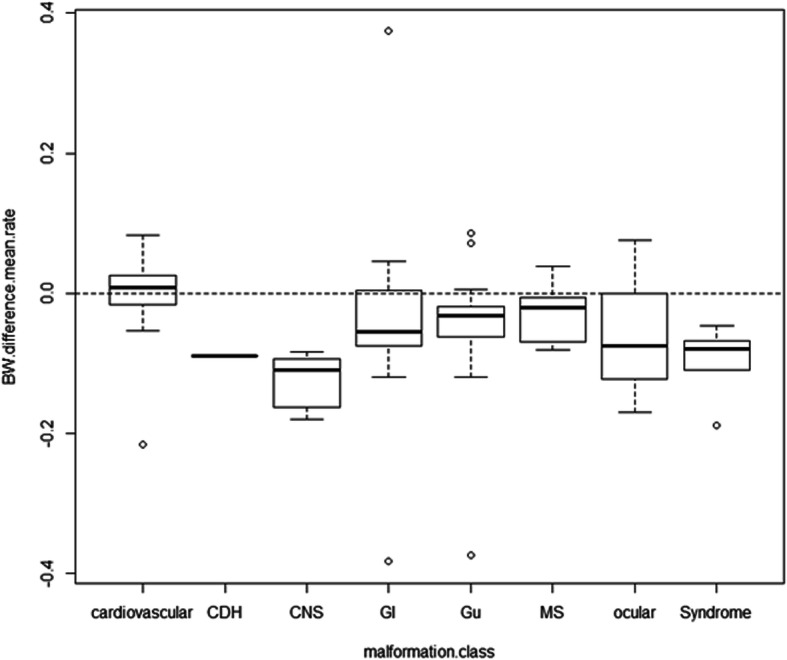
We studied data of 488 neonates (52% females) from 244 pregnancies. The rate of major congenital anomalies was 11%, affecting significantly the smaller twin (p = .00018; Odds ratio 3.21; 95% CI 1.65 6.59). Malformation class distribution was as following: genitourinary (24%), gastrointestinal (20%), cardiovascular (18.5%), musculoskeletal (11%), central nervous system (9%), syndromic (9%), ocular (5.5%) and diaphragmatic hernia (2%). The most predictive value, the Birthweight (BW) difference mean ratio in malformed versus not malformed neonates (- 0.31 vs 0.02; p = .0016) was distributed equally lower than zero in all malformed twins, except for those with congenital heart defects (p = .0000083). Microcephaly (head circumference < 2 standard deviation, SD) was present in 3% of symmetrically smaller twin, and severe microcephaly (< 3 SD) was present in 0.6%. We found that an intertwin BW discordance of 18% or greater identified 50% of neonates with microcephaly, but only 11% of malformed twins.
In case of one twin with a BW < 10th centile, a concomitant intertwin BW discordance ≥18% could reveal an increased risk for microcephaly but not for malformation. Lower values of BW, Ponderal index, Body mass index but above all negative value of BW difference mean ratio are associated with malformations in twin pairs.
由于父母年龄的增长和辅助生殖技术的使用增加,双胞胎的出生率持续上升。双胞胎的先天畸形风险高于单胎,但与生长模式相关的报道较少。我们专注于当一对双胞胎或两者都受到一种或多种畸形影响时,双胞胎妊娠的人体测量学结局。
我们进行了一项回顾性观察研究,回顾了 2003 年 1 月至 2018 年 12 月期间在巴勒莫大学医院住院的双胞胎的临床病历。通过比较每对双胞胎内的畸形和出生时的人体测量学变量,分析了畸形与出生时的人体测量学变量之间的关联,并将每个变量视为双胞胎之间的有序差异。
我们研究了来自 244 例妊娠的 488 例新生儿(52%为女性)的数据。主要先天畸形的发生率为 11%,显著影响较小的双胞胎(p=0.00018;优势比 3.21;95%置信区间 1.65-6.59)。畸形分类分布如下:泌尿生殖系统(24%)、胃肠道(20%)、心血管系统(18.5%)、肌肉骨骼系统(11%)、中枢神经系统(9%)、综合征(9%)、眼(5.5%)和膈疝(2%)。最具预测价值的是畸形儿与非畸形儿的出生体重(BW)差值均值比(-0.31 对 0.02;p=0.0016)在所有畸形儿中均低于零,除先天性心脏病儿(p=0.0000083)外。3%的对称小胎出现小头畸形(头围<2 个标准差,SD),严重小头畸形(<3 SD)的发生率为 0.6%。我们发现,双胞胎之间 BW 差异≥18%可识别 50%的小头畸形新生儿,但仅识别 11%的畸形儿。
如果一个胎儿的 BW<第 10 百分位,同时双胞胎之间的 BW 差异≥18%,可能会增加小头畸形的风险,但不能增加畸形的风险。BW、体重指数、体质指数的较低值,但特别是 BW 差值均值的负值,与双胞胎中畸形有关。