Département de Phytologie, Faculty of Agriculture and Food Sciences, Centre de Recherche en Innovation des Végétaux (CRIV), Université Laval , Québec, Québec, Canada.
RNA Biol. 2020 Sep;17(9):1252-1260. doi: 10.1080/15476286.2020.1763024. Epub 2020 May 23.
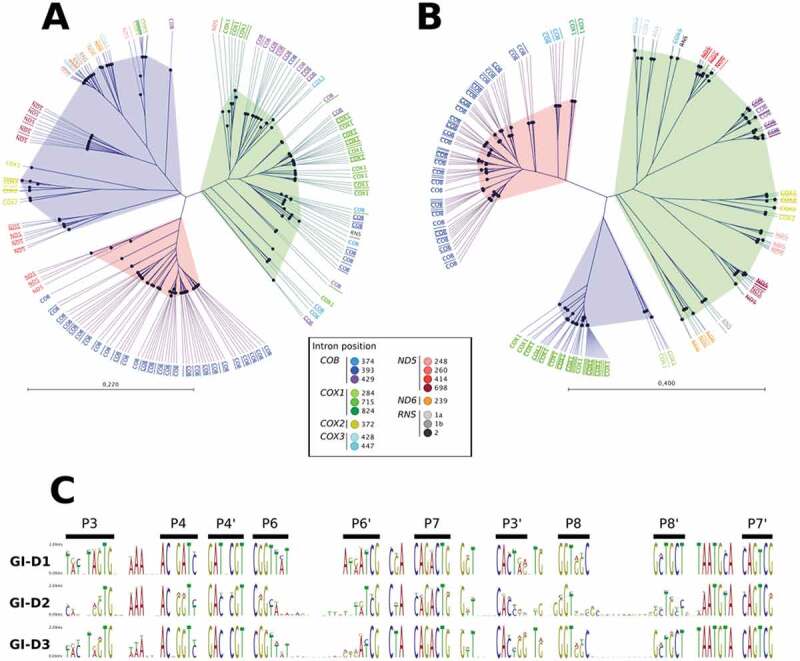
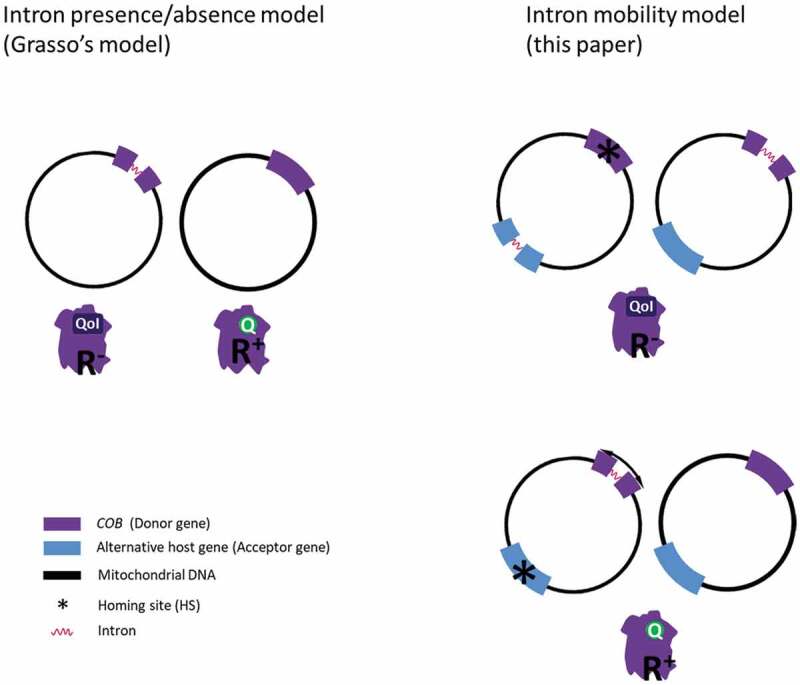
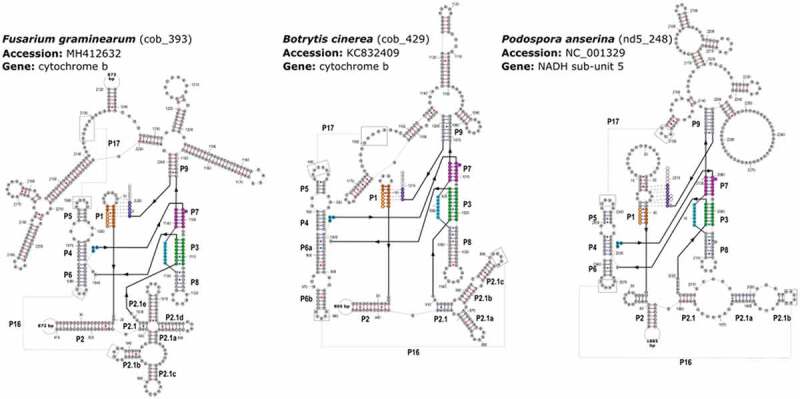
Group I catalytic introns are widespread in bacterial, archaeal, viral, organellar, and some eukaryotic genomes, where they are reported to provide regulatory functions. The group I introns are currently divided into five types (A-E), which are themselves distributed into several subtypes, with the exception of group I type D intron (GI-D). GI-D introns belong to the rarest group with only 17 described to date, including only one with a putative role reported in fungi, where it would interfere with an adaptive response in the cytochrome b (COB) gene to quinone outside inhibitor (QoI) fungicide resistance. Using homology search methods taking into account both conserved sequences and RNA secondary structures, we analysed the mitochondrial genomes or COB genes of 169 fungal species, including some frequently under QoI selection pressure. These analyses have led to the identification of 216 novel GI-D introns, and the definition of three distinct subtypes, one of which being linked with a functional activity. We have further uncovered a homing site for this GI-D intron type, which helps refine the accepted model of quinone outside inhibitor resistance, whereby mobility of the intron across fungal mitochondrial genomes, would influence a fungus ability to develop resistance to QoIs.
I 类催化内含子广泛存在于细菌、古菌、病毒、细胞器和一些真核生物基因组中,据报道它们具有调节功能。I 类内含子目前分为 5 种类型(A-E),它们本身又分为几个亚型,除了 I 类 D 型内含子(GI-D)。GI-D 内含子属于最罕见的一类,目前仅描述了 17 种,其中只有一种在真菌中具有假定的作用,它会干扰细胞色素 b(COB)基因对醌外抑制剂(QoI)杀菌剂抗性的适应性反应。我们使用同源搜索方法,同时考虑保守序列和 RNA 二级结构,分析了 169 种真菌物种的线粒体基因组或 COB 基因,其中一些经常受到 QoI 的选择压力。这些分析导致了 216 个新的 GI-D 内含子的鉴定,并定义了三个不同的亚型,其中一个与功能活性有关。我们进一步发现了这种 GI-D 内含子类型的归巢位点,这有助于完善醌外抑制剂抗性的公认模型,即内含子在真菌线粒体基因组中的移动性会影响真菌产生对 QoI 抗性的能力。