Department of Surgery, National Hospital Organization, Tsuruga Medical Center, 33-1, Sakuragaoka, Tsuruga, Fukui, 914-0195, Japan.
First Department of Surgery, Faculty of Medicine, University of Fukui, 23-3, Matsuoka Shimoaizuki, Eiheiji-cho, Yoshida-gun, Fukui, 910-1193, Japan.
World J Surg Oncol. 2020 May 25;18(1):105. doi: 10.1186/s12957-020-01879-8.
Sarcomatoid carcinoma of the pancreas (SCP) tends to have similar or even worse prognosis than that of conventional pancreatic ductal adenocarcinoma. The clinical and pathological features of SCP remain poorly characterized owing to its rarity.
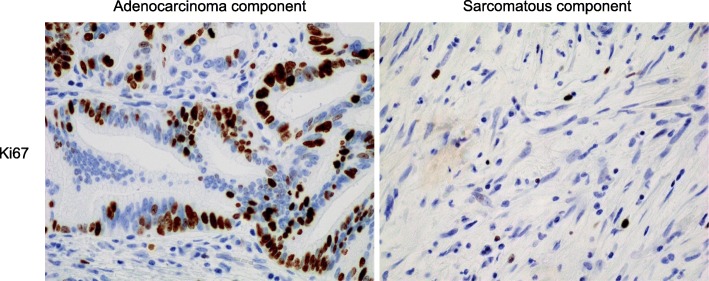
A 58-year-old man was admitted to our hospital with the chief complaints of upper abdominal pain and weight loss. Abdominal contrast computed tomography revealed a 5-cm low-density mass in the pancreatic body. Magnetic resonance cholangiopancreatography revealed an obstruction of the main pancreatic duct and a dilation of the distal main pancreatic duct. Based on the clinicoradiological findings, pancreatic body cancer was suspected, and the distal pancreatectomy was performed. A pathological examination revealed that the tumor was composed of an area of invasive ductal adenocarcinoma and an area of sarcomatous spindle-shaped cells; the latter component predominated. The spindle cells were immunohistochemically positive for both cytokeratin and vimentin, and thus, a pathological diagnosis of SCP was made. In addition, immunohistochemical analysis suggested the sarcomatous component might be derived from the adenocarcinoma component via the process of epithelial-mesenchymal transition. After the operation, the patient received 6 months of chemotherapy with gemcitabine. At 10 years after the operation, the patient is alive with no recurrence.
The current case study presented a SCP patient with long-term survival after the operation. It was worth noting that the sarcomatous component of the tumor pathologically showed lower MIB-1 labeling index compared with those in previously reported SCP cases, which might account for the long-term survival of the patient.
胰腺肉瘤样癌(SCP)的预后往往与传统的胰腺导管腺癌相似,甚至更差。由于其罕见性,SCP 的临床和病理特征仍未得到很好的描述。
一名 58 岁男性因上腹痛和体重减轻为主诉入院。腹部对比增强 CT 显示胰体部有一个 5cm 的低密度肿块。磁共振胆胰管成像显示主胰管阻塞和远端主胰管扩张。根据临床和影像学检查结果,怀疑为胰体癌,并进行了胰体尾切除术。病理检查显示肿瘤由浸润性导管腺癌区和肉瘤样梭形细胞区组成;后者占主导地位。梭形细胞免疫组化阳性表达细胞角蛋白和波形蛋白,因此病理诊断为 SCP。此外,免疫组化分析提示肉瘤成分可能通过上皮-间充质转化过程来源于腺癌成分。术后,患者接受了 6 个月的吉西他滨化疗。术后 10 年,患者无复发,存活。
本病例研究报道了一例 SCP 患者术后长期生存。值得注意的是,肿瘤的肉瘤成分在病理上显示出比先前报道的 SCP 病例更低的 MIB-1 标记指数,这可能是患者长期生存的原因。