Bacterial Toxins, Institut Pasteur, 75015 Paris, France.
Toxins (Basel). 2020 May 21;12(5):338. doi: 10.3390/toxins12050338.
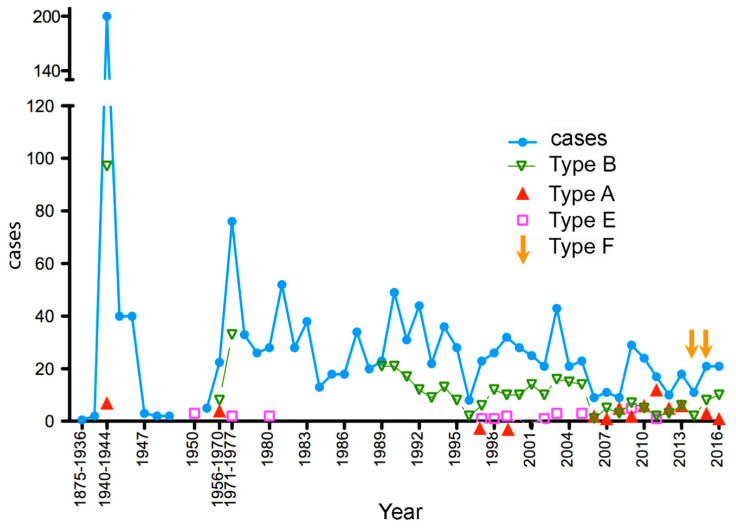
Botulism is a rare but severe disease which is characterized by paralysis and inhibition of secretions. Only a few cases had been reported at the end of the 19th century in France. The disease was frequent during the second world war, and then the incidence decreased progressively. However, human botulism is still present in France with 10-25 cases every year. Food-borne botulism was the main form of botulism in France, whereas infant botulism (17 cases between 2004 and 2016) was rare, and wound and inhalational botulism were exceptional. Type B was the prevalent botulism type and was mainly due to consumption of home-made or small-scale preparations of cured ham and to a lesser extent other pork meat products. In the recent period (2000-2016), a wider diversity of botulism types from various food origin including industrial foods was reported. Severe cases of type A and F botulism as well as type E botulism were more frequent. Albeit rare, the severity of botulism justifies its continued surveillance and recommendations to food industry and consumers regarding food hygiene and preservation practices.
肉毒中毒是一种罕见但严重的疾病,其特征为瘫痪和分泌物抑制。19 世纪末,法国仅报告了几例此类病例。第二次世界大战期间,这种疾病频繁发生,此后发病率逐渐下降。然而,法国仍存在人类肉毒中毒,每年有 10-25 例病例。食源性肉毒中毒是法国肉毒中毒的主要形式,而婴儿肉毒中毒(2004 年至 2016 年期间有 17 例)则很少见,伤口和吸入性肉毒中毒则很罕见。B 型是主要的肉毒中毒类型,主要是由于食用自制或小规模制作的熏火腿,以及在较小程度上食用其他猪肉制品。在最近一段时间(2000-2016 年),报告了来自各种食品来源的更广泛的肉毒中毒类型,包括工业食品。A 型、F 型和 E 型肉毒中毒的严重病例更为常见。尽管罕见,但肉毒中毒的严重性证明有必要对其进行持续监测,并向食品行业和消费者提出有关食品卫生和保存实践的建议。