Kim Se Ik, Kang Nayeon, Leem Sangseob, Yang Jinho, Jo HyunA, Lee Maria, Kim Hee Seung, Dhanasekaran Danny N, Kim Yoon-Keun, Park Taesung, Song Yong Sang
Department of Obstetrics and Gynecology, Seoul National University College of Medicine, Seoul 03080, Korea.
Department of Statistics, Seoul National University, Seoul 08826, Korea.
Cancers (Basel). 2020 May 21;12(5):1309. doi: 10.3390/cancers12051309.
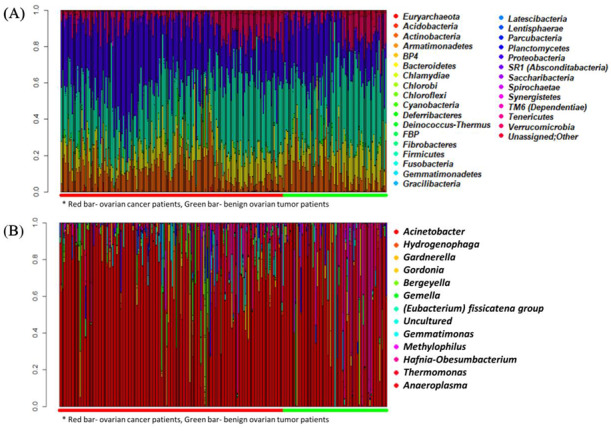
We aimed to develop a diagnostic model identifying ovarian cancer (OC) from benign ovarian tumors using metagenomic data from serum microbe-derived extracellular vesicles (EVs). We obtained serum samples from 166 patients with pathologically confirmed OC and 76 patients with benign ovarian tumors. For model construction and validation, samples were randomly divided into training and test sets in the ratio 2:1. Isolation of microbial EVs from serum samples of the patients and 16S rDNA amplicon sequencing were carried out. Metagenomic and clinicopathologic data-based OC diagnostic models were constructed in the training set and then validated in the test set. There were significant differences in the metagenomic profiles between the OC and benign ovarian tumor groups; specifically, genus was significantly more abundant in the OC group. More importantly, was the only common genus identified by seven different statistical analysis methods. Among the various metagenomic and clinicopathologic data-based OC diagnostic models, the model consisting of age, serum CA-125 levels, and relative abundance of showed the best diagnostic performance with the area under the receiver operating characteristic curve of 0.898 and 0.846 in the training and test sets, respectively. Thus, our findings establish a metagenomic analysis of serum microbe-derived EVs as a potential tool for the diagnosis of OC.
我们旨在利用血清微生物来源的细胞外囊泡(EVs)的宏基因组数据,开发一种从良性卵巢肿瘤中识别卵巢癌(OC)的诊断模型。我们从166例经病理证实的OC患者和76例良性卵巢肿瘤患者中获取了血清样本。为了进行模型构建和验证,样本以2:1的比例随机分为训练集和测试集。对患者血清样本进行微生物EVs的分离和16S rDNA扩增子测序。在训练集中构建基于宏基因组和临床病理数据的OC诊断模型,然后在测试集中进行验证。OC组和良性卵巢肿瘤组的宏基因组特征存在显著差异;具体而言,某属在OC组中明显更为丰富。更重要的是,某属是通过七种不同统计分析方法鉴定出的唯一共同属。在各种基于宏基因组和临床病理数据的OC诊断模型中,由年龄、血清CA - 125水平和某属相对丰度组成的模型表现出最佳诊断性能,在训练集和测试集中,受试者操作特征曲线下面积分别为0.898和0.846。因此,我们的研究结果确立了对血清微生物来源的EVs进行宏基因组分析作为诊断OC的潜在工具。