Hardikar Sheetal, Albrechtsen Richard D, Achaintre David, Lin Tengda, Pauleck Svenja, Playdon Mary, Holowatyj Andreana N, Gigic Biljana, Schrotz-King Petra, Boehm Juergen, Habermann Nina, Brezina Stefanie, Gsur Andrea, van Roekel Eline H, Weijenberg Matty P, Keski-Rahkonen Pekka, Scalbert Augustin, Ose Jennifer, Ulrich Cornelia M
Population Sciences, Huntsman Cancer Institute, Salt Lake City, UT 84112, USA.
Department of Population Health Sciences, University of Utah, Salt Lake City, UT 84108, USA.
Metabolites. 2020 May 21;10(5):213. doi: 10.3390/metabo10050213.
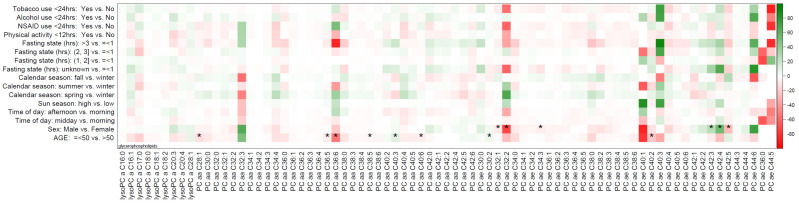
Demographic, lifestyle and biospecimen-related factors at the time of blood collection can influence metabolite levels in epidemiological studies. Identifying the major influences on metabolite concentrations is critical to designing appropriate sample collection protocols and considering covariate adjustment in metabolomics analyses. We examined the association of age, sex, and other short-term pre-blood collection factors (time of day, season, fasting duration, physical activity, NSAID use, smoking and alcohol consumption in the days prior to collection) with 133 targeted plasma metabolites (acylcarnitines, amino acids, biogenic amines, sphingolipids, glycerophospholipids, and hexoses) among 108 individuals that reported exposures within 48 h before collection. The differences in mean metabolite concentrations were assessed between groups based on pre-collection factors using two-sided -tests and ANOVA with FDR correction. Percent differences in metabolite concentrations were negligible across season, time of day of collection, fasting status or lifestyle behaviors at the time of collection, including physical activity or the use of tobacco, alcohol or NSAIDs. The metabolites differed in concentration between the age and sex categories for 21.8% and 14.3% metabolites, respectively. In conclusion, extrinsic factors in the short period prior to collection were not meaningfully associated with concentrations of selected endogenous metabolites in a cross-sectional sample, though metabolite concentrations differed by age and sex. Larger studies with more coverage of the human metabolome are warranted.
在流行病学研究中,采血时的人口统计学、生活方式和生物样本相关因素会影响代谢物水平。确定对代谢物浓度的主要影响因素对于设计合适的样本采集方案以及在代谢组学分析中考虑协变量调整至关重要。我们在108名报告在采血前48小时内有暴露情况的个体中,研究了年龄、性别和其他采血前短期因素(一天中的时间、季节、禁食时间、身体活动、非甾体抗炎药使用情况、采血前几天的吸烟和饮酒情况)与133种靶向血浆代谢物(酰基肉碱、氨基酸、生物胺、鞘脂、甘油磷脂和己糖)之间的关联。使用双侧检验和经FDR校正的方差分析,基于采血前因素评估组间平均代谢物浓度的差异。在不同季节、采血当天的时间、禁食状态或采血时的生活方式行为(包括身体活动或烟草、酒精或非甾体抗炎药的使用)中,代谢物浓度的百分比差异可以忽略不计。在年龄和性别类别中,分别有21.8%和14.3%的代谢物浓度存在差异。总之,尽管代谢物浓度因年龄和性别而异,但在横断面样本中,采血前短期内的外在因素与所选内源性代谢物的浓度无显著关联。有必要开展覆盖更多人类代谢组的更大规模研究。