Department of Life Sciences, Imperial College, London, UK.
Global Climate Cluster, University of Technology Sydney, Sydney, NSW, Australia.
ISME J. 2020 Sep;14(9):2275-2287. doi: 10.1038/s41396-020-0670-y. Epub 2020 May 26.
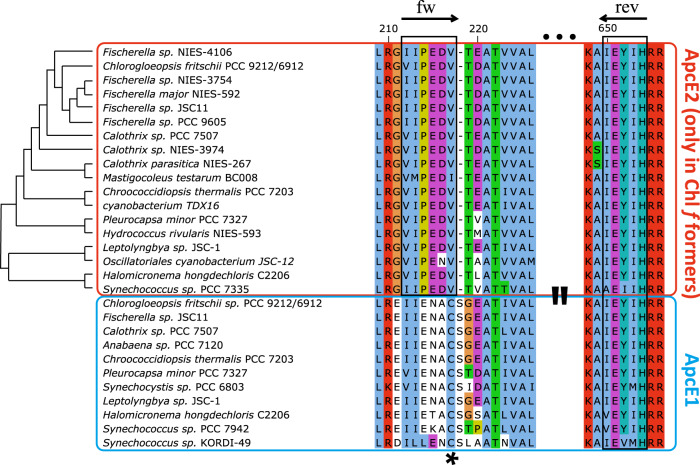
Some cyanobacteria use light outside the visible spectrum for oxygenic photosynthesis. The far-red light (FRL) region is made accessible through a complex acclimation process that involves the formation of new phycobilisomes and photosystems containing chlorophyll f. Diverse cyanobacteria ranging from unicellular to branched-filamentous forms show this response. These organisms have been isolated from shaded environments such as microbial mats, soil, rock, and stromatolites. However, the full spread of chlorophyll f-containing species in nature is still unknown. Currently, discovering new chlorophyll f cyanobacteria involves lengthy incubation times under selective far-red light. We have used a marker gene to detect chlorophyll f organisms in environmental samples and metagenomic data. This marker, apcE2, encodes a phycobilisome linker associated with FRL-photosynthesis. By focusing on a far-red motif within the sequence, degenerate PCR and BLAST searches can effectively discriminate against the normal chlorophyll a-associated apcE. Even short recovered sequences carry enough information for phylogenetic placement. Markers of chlorophyll f photosynthesis were found in metagenomic datasets from diverse environments around the globe, including cyanobacterial symbionts, hypersaline lakes, corals, and the Arctic/Antarctic regions. This additional information enabled higher phylogenetic resolution supporting the hypothesis that vertical descent, as opposed to horizontal gene transfer, is largely responsible for this phenotype's distribution.
一些蓝藻利用可见光谱之外的光进行产氧光合作用。远红光(FRL)区域可通过一个复杂的适应过程获得,该过程涉及新的藻胆体和含有叶绿素 f 的光合系统的形成。从单细胞到分枝丝状形式的各种蓝藻都表现出这种反应。这些生物体已从微生物垫、土壤、岩石和叠层石等阴暗环境中分离出来。然而,叶绿素 f 含物种在自然界中的广泛分布仍不清楚。目前,发现新的叶绿素 f 蓝藻需要在选择性远红光照下进行长时间的孵育。我们使用标记基因来检测环境样本和宏基因组数据中的叶绿素 f 生物。该标记 APCE2 编码与 FRL 光合作用相关的藻胆体连接蛋白。通过聚焦于序列中的远红光基序,可以有效地用简并 PCR 和 BLAST 搜索来区分正常的与叶绿素 a 相关的 APCE。即使是短的回收序列也携带足够的信息进行系统发育定位。来自全球各种环境的宏基因组数据集都发现了叶绿素 f 光合作用的标记,包括蓝藻共生体、高盐湖泊、珊瑚和北极/南极地区。这些额外的信息提高了系统发育分辨率,支持了垂直进化而非水平基因转移是导致这种表型分布的主要原因的假设。