
两种商业分子检测方法与一种实验室开发的对疾病控制与预防中心(CDC)2019新型冠状病毒逆转录聚合酶链反应(PCR)检测法的改良方法用于检测严重急性呼吸综合征冠状病毒2(SARS-CoV-2)的比较
Comparison of Two Commercial Molecular Tests and a Laboratory-Developed Modification of the CDC 2019-nCoV Reverse Transcriptase PCR Assay for the Detection of SARS-CoV-2.
作者信息
Moore Nicholas M, Li Haiying, Schejbal Debra, Lindsley Jennifer, Hayden Mary K
机构信息
Department of Pathology, Rush University Medical Center, Chicago, Illinois, USA
Department of Internal Medicine, Division of Infectious Diseases, Rush University Medical Center, Chicago, Illinois, USA.
出版信息
J Clin Microbiol. 2020 Jul 23;58(8). doi: 10.1128/JCM.00938-20.
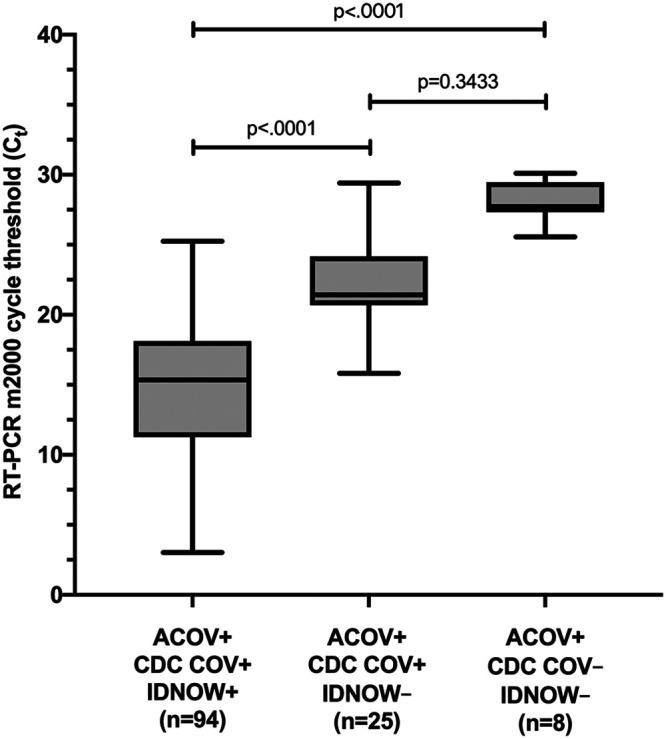
We compared the ability of 2 commercial molecular amplification assays (RealTime SARS-CoV-2 on the 2000 [abbreviated ACOV; Abbott] and ID Now COVID-19 [abbreviated IDNOW; Abbott]) and a laboratory-developed test (modified CDC 2019-nCoV reverse transcriptase PCR [RT-PCR] assay with RNA extraction by eMag [bioMérieux] and amplification on QuantStudio 6 or ABI 7500 real-time PCR system [abbreviated CDC COV]) to detect severe acute respiratory syndrome coronavirus 2 (SARS-CoV-2) RNA in upper respiratory tract specimens. Discrepant results were adjudicated by medical record review. A total of 200 nasopharyngeal swab specimens in viral transport medium (VTM) were collected from symptomatic patients between 27 March and 9 April 2020. Results were concordant for 167 specimens (83.5% overall agreement), including 94 positive and 73 negative specimens. The ACOV assay yielded 33 additional positive results, 25 of which were also positive by the CDC COV assay but not by the IDNOW assay. In a follow-up evaluation, 97 patients for whom a dry nasal swab specimen yielded negative results by IDNOW had a paired nasopharyngeal swab specimen collected in VTM and tested by the ACOV assay; SARS-CoV-2 RNA was detected in 13 (13.4%) of these specimens. Medical record review deemed all discrepant results to be true positives. The IDNOW test was the easiest to perform and provided a result in the shortest time but detected fewer cases of COVID-19. The ACOV assay detected more cases of COVID-19 than the CDC COV or IDNOW assays.
我们比较了两种商用分子扩增检测方法(2000 型实时 SARS-CoV-2 检测法[简称 ACOV;雅培公司]和 ID Now COVID-19 检测法[简称 IDNOW;雅培公司])以及一种实验室自行开发的检测方法(改良的美国疾病控制与预防中心[CDC]2019 新型冠状病毒逆转录聚合酶链反应[RT-PCR]检测法,采用 eMag[生物梅里埃公司]进行 RNA 提取,并在 QuantStudio 6 或 ABI 7500 实时 PCR 系统上进行扩增[简称 CDC COV])检测上呼吸道标本中严重急性呼吸综合征冠状病毒 2(SARS-CoV-2)RNA 的能力。通过查阅病历对有差异的结果进行判定。2020 年 3 月 27 日至 4 月 9 日期间,从有症状的患者中总共收集了 200 份置于病毒运输培养基(VTM)中的鼻咽拭子标本。167 份标本的结果一致(总体一致性为 83.5%),包括 94 份阳性标本和 73 份阴性标本。ACOV 检测法又得出 33 份阳性结果,其中 25 份通过 CDC COV 检测法也呈阳性,但通过 IDNOW 检测法呈阴性。在后续评估中,97 例 IDNOW 检测干燥鼻拭子标本结果为阴性的患者采集了配对的置于 VTM 中的鼻咽拭子标本,并通过 ACOV 检测法进行检测;这些标本中有 13 份(13.4%)检测到 SARS-CoV-2 RNA。病历查阅判定所有有差异的结果均为真阳性。IDNOW 检测法操作最简便,出结果时间最短,但检测出的 COVID-19 病例较少。ACOV 检测法检测出的 COVID-19 病例比 CDC COV 检测法或 IDNOW 检测法更多。

 Zotero 插件