Department of Radiology, Peking University People's Hospital, Beijing, China 100044.
Department of Radiology, Peking University Shenzhen Hospital, Shenzhen, Guangdong, China 518036.
Biomed Res Int. 2020 May 11;2020:9078603. doi: 10.1155/2020/9078603. eCollection 2020.
To determine if osteosarcoma (OS) and Ewing sarcoma (EWS) of the pelvis based on MRI can be differentiated using radiomic analysis.
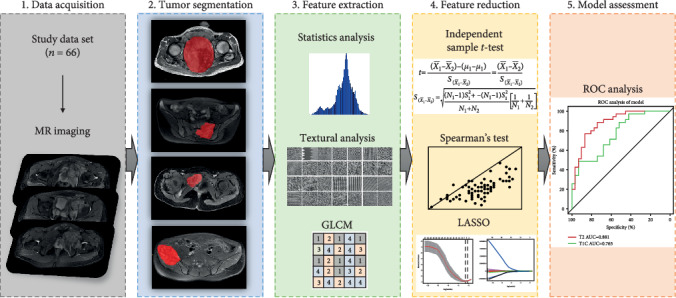
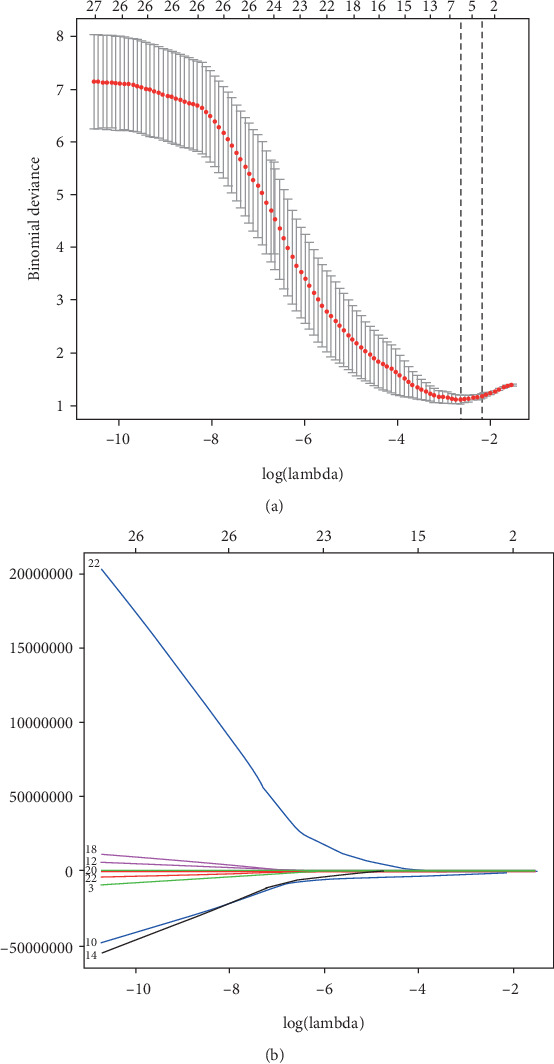
In this study, 3.0 T magnetic resonance (MR) data of 66 patients (40 males and 26 females, mean age 27.6 ± 13.9 years) with pathologically confirmed OS or EWS of the pelvis (35 with OS and 31 with EWS) taken from April 2013 to December 2017 were retrospectively reviewed. T2-weighted fat-saturated (T2-FS) and contrast-enhanced T1-weighted (CET1) images were manually segmented, and imaging features were extracted. Independent-sample -test, Spearman's test, and the least absolute shrinkage and selection operator (LASSO) method were used to select the most useful features from the original data set. The performance of radiomic analysis was investigated by the area under the receiver operating characteristic (ROC) curve (AUC) analysis.
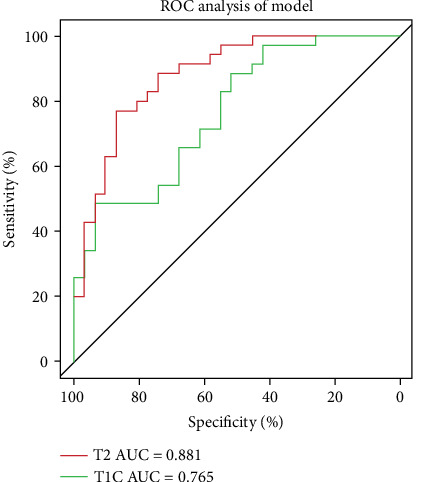
385 initial features were extracted from T2-FS and CET1 MR data. Nine features from T2-FS and 7 features from CET1 were selected by using the LASSO method. The radiomic analysis to differentiate OS and EWS of the pelvis based on T2-FS and CET1 images using the aforementioned selected features achieved AUC values of 0.881 (95% confidence interval (CI): 0.799-0.963) and 0.765 (95% CI: 0.652-0.878), respectively.
Radiomic analysis showed potential in differentiating OS from EWS of the pelvis, in which T2-FS demonstrated better diagnostic value. To differentiate OS from EWS of the pelvis using our multiparametric MRI-based radiomic analysis could preoperatively improve diagnostic accuracy and greatly contribute to therapy planning.
通过放射组学分析,确定骨盆骨肉瘤(OS)和尤因肉瘤(EWS)是否可以基于 MRI 进行区分。
本研究回顾性分析了 2013 年 4 月至 2017 年 12 月期间,经病理证实的骨盆 OS 或 EWS 的 66 例患者(男性 40 例,女性 26 例,平均年龄 27.6±13.9 岁)的 3.0T 磁共振(MR)数据(35 例为 OS,31 例为 EWS)。对 T2 加权脂肪饱和(T2-FS)和对比增强 T1 加权(CET1)图像进行手动分割,并提取成像特征。采用独立样本 t 检验、Spearman 检验和最小绝对收缩和选择算子(LASSO)方法,从原始数据集选择最有用的特征。通过受试者工作特征(ROC)曲线(AUC)分析评估放射组学分析的性能。
从 T2-FS 和 CET1MR 数据中提取了 385 个初始特征。通过 LASSO 方法,从 T2-FS 中选择了 9 个特征,从 CET1 中选择了 7 个特征。基于上述选定特征,利用 T2-FS 和 CET1 图像对骨盆 OS 和 EWS 进行鉴别分析的放射组学分析,AUC 值分别为 0.881(95%置信区间(CI):0.799-0.963)和 0.765(95%CI:0.652-0.878)。
放射组学分析显示出区分骨盆 OS 和 EWS 的潜力,其中 T2-FS 显示出更好的诊断价值。利用我们的基于多参数 MRI 的放射组学分析对骨盆 OS 和 EWS 进行鉴别,可在术前提高诊断准确性,并极大地有助于治疗计划。