Department of Radiology, University of Pittsburgh, Pittsburgh, PA, 15213, USA.
Department of Biostatistics, University of Pittsburgh, Pittsburgh, PA, 15213, USA.
Eur Radiol. 2020 Nov;30(11):6221-6227. doi: 10.1007/s00330-020-06956-w. Epub 2020 Jul 20.
To define the uniqueness of chest CT infiltrative features associated with COVID-19 image characteristics as potential diagnostic biomarkers.
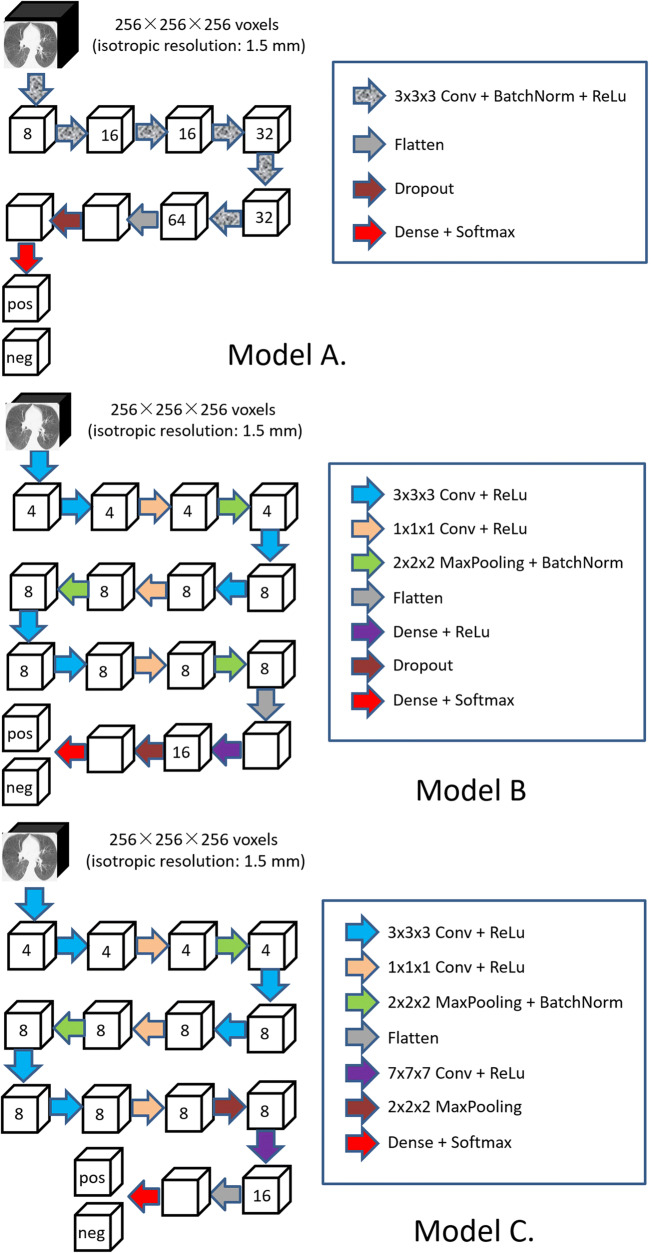
We retrospectively collected chest CT exams including n = 498 on 151 unique patients RT-PCR positive for COVID-19 and n = 497 unique patients with community-acquired pneumonia (CAP). Both COVID-19 and CAP image sets were partitioned into three groups for training, validation, and testing respectively. In an attempt to discriminate COVID-19 from CAP, we developed several classifiers based on three-dimensional (3D) convolutional neural networks (CNNs). We also asked two experienced radiologists to visually interpret the testing set and discriminate COVID-19 from CAP. The classification performance of the computer algorithms and the radiologists was assessed using the receiver operating characteristic (ROC) analysis, and the nonparametric approaches with multiplicity adjustments when necessary.
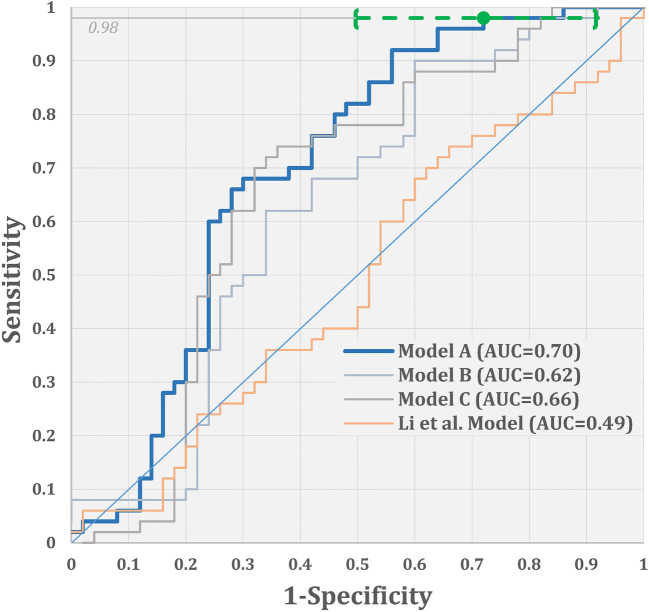
One of the considered models showed non-trivial, but moderate diagnostic ability overall (AUC of 0.70 with 99% CI 0.56-0.85). This model allowed for the identification of 8-50% of CAP patients with only 2% of COVID-19 patients.
Professional or automated interpretation of CT exams has a moderately low ability to distinguish between COVID-19 and CAP cases. However, the automated image analysis is promising for targeted decision-making due to being able to accurately identify a sizable subsect of non-COVID-19 cases.
• Both human experts and artificial intelligent models were used to classify the CT scans. • ROC analysis and the nonparametric approaches were used to analyze the performance of the radiologists and computer algorithms. • Unique image features or patterns may not exist for reliably distinguishing all COVID-19 from CAP; however, there may be imaging markers that can identify a sizable subset of non-COVID-19 cases.
定义与 COVID-19 图像特征相关的胸部 CT 浸润特征的独特性,将其作为潜在的诊断生物标志物。
我们回顾性地收集了胸部 CT 检查,包括 n=151 例经 RT-PCR 检测为 COVID-19 阳性的患者和 n=497 例社区获得性肺炎(CAP)患者的 498 次胸部 CT 检查。将 COVID-19 和 CAP 图像集分别分为三组进行训练、验证和测试。为了尝试将 COVID-19 与 CAP 区分开来,我们基于三维(3D)卷积神经网络(CNN)开发了几种分类器。我们还请两位有经验的放射科医生对测试集进行视觉解释,并将 COVID-19 与 CAP 区分开来。使用受试者工作特征(ROC)分析评估计算机算法和放射科医生的分类性能,并在必要时使用非参数方法进行多重调整。
所考虑的模型之一显示出整体上具有一定但中等的诊断能力(AUC 为 0.70,99%CI 为 0.56-0.85)。该模型允许仅将 2%的 COVID-19 患者识别为 CAP 患者的 8-50%。
专业或自动解读 CT 检查对区分 COVID-19 和 CAP 病例的能力较低。然而,由于能够准确识别相当大一部分非 COVID-19 病例,自动图像分析具有很大的潜力用于有针对性的决策。
专家和人工智能模型都用于对 CT 扫描进行分类。
使用 ROC 分析和非参数方法来分析放射科医生和计算机算法的性能。
可能不存在可靠地区分所有 COVID-19 与 CAP 的独特图像特征或模式;但是,可能存在能够识别相当大一部分非 COVID-19 病例的成像标志物。