Escola Superior Desporto e Lazer, Instituto Politécnico de Viana do Castelo, Rua Escola Industrial e Comercial de Nun'Álvares, 4900-347 Viana do Castelo, Portugal.
N2i, Polytechnic Institute of Maia, 4475-690 Maia, Portugal.
Int J Environ Res Public Health. 2020 May 27;17(11):3803. doi: 10.3390/ijerph17113803.
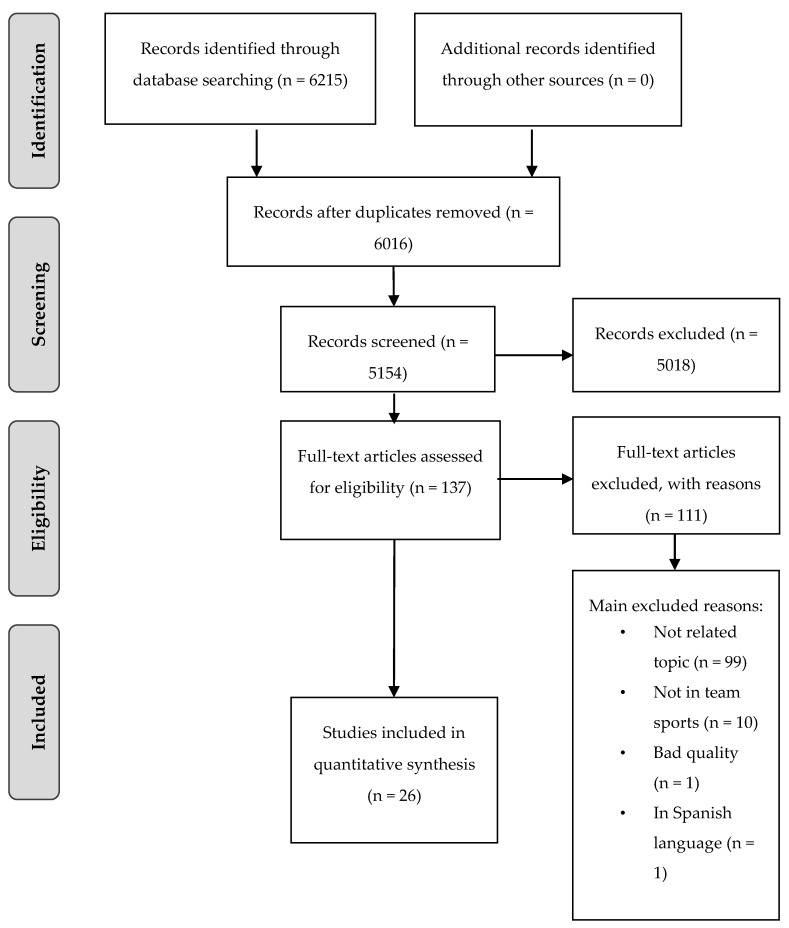
The aim of this systematic review conducted in the topic of youth team-sports players was three-fold: (i) Analyze the variations of decision-making processes between low- and high-level youth players; (ii) analyze the variations of decision-making processes between different age groups; and (iii) analyze the effects of decision-making training-based programs on youth players. Following the preferred reporting items for systematic reviews and meta-analyses (PRISMA) guidelines, this systematic review searched for studies on PubMed, ScienceDirect, Academic Search Complete, SPORTDiscus, and Taylor & Francis Online. The search returned 6215 papers. After screening the records against set criteria, 26 articles were fully reviewed. From the included studies, 9 were focused on comparing the decision-making process between low- and high-level players, 6 compared the decisions made by players from different age categories, and 11 analyzed the effects of decision-making-based training programs on youth players. Comparisons between high- and low-level players suggested that high-level and most talented players present a greater accuracy in the cognitive and executive answers to the game as well as being more adjustable to more complex situations. Considering the comparisons between age groups, a tendency of older players to execute more accurate decisions in the game and to have better tactical knowledge and behavior was observed. Finally, the effects of decision-making training programs suggest a beneficial effect employing practical scenarios (mainly based on small-sided and conditioned games), primarily improving passing decisions and execution. However, the benefits of interventions using videos are not clear.
本系统评价旨在分析青年团队运动员决策过程的差异,具体涉及以下三个方面:(i)分析低水平和高水平青年运动员之间决策过程的变化;(ii)分析不同年龄组之间决策过程的变化;(iii)分析基于决策训练的方案对青年运动员的影响。本系统评价按照系统评价和荟萃分析的首选报告项目(PRISMA)指南进行,在 PubMed、ScienceDirect、Academic Search Complete、SPORTDiscus 和 Taylor & Francis Online 上搜索了相关研究。检索结果共返回 6215 篇论文。经过对记录进行设定标准的筛选,最终对 26 篇文章进行了全面审查。在纳入的研究中,有 9 项研究专注于比较高水平和低水平运动员之间的决策过程,6 项研究比较了不同年龄组运动员的决策,11 项研究分析了基于决策的训练方案对青年运动员的影响。高水平和最有天赋的运动员在认知和执行游戏答案方面表现出更高的准确性,并且能够更好地适应更复杂的情况,这表明高水平和低水平运动员之间存在差异。考虑到年龄组之间的比较,观察到年龄较大的运动员在比赛中做出更准确决策的趋势,并且具有更好的战术知识和行为。最后,决策训练方案的效果表明,采用实际场景(主要基于小场比赛和条件比赛)具有有益效果,主要改善传球决策和执行。然而,使用视频进行干预的效果尚不清楚。