Dabiri Babak, Kampusch Stefan, Geyer Stefan H, Le Van Hoang, Weninger Wolfgang J, Széles Jozsef Constantin, Kaniusas Eugenijus
Institute of Electrodynamics, Microwave and Circuit Engineering, Vienna University of Technology, Vienna, Austria.
SzeleSTIM GmbH, Vienna, Austria.
Front Neuroanat. 2020 May 12;14:22. doi: 10.3389/fnana.2020.00022. eCollection 2020.
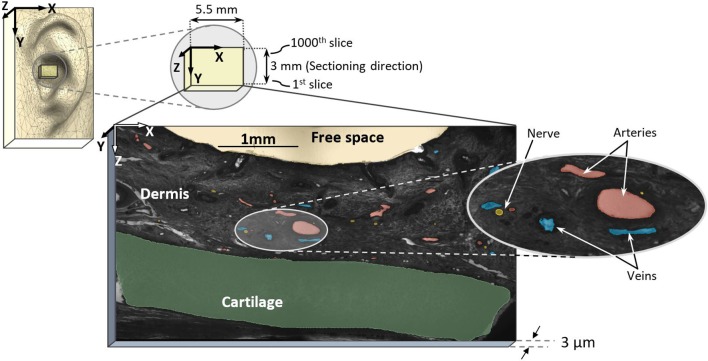
Therapeutic applications of auricular vagus nerve stimulation (VNS) have drawn recent attention. Since the targeted stimulation process and parameters depend on the electrode-tissue interaction, the lack of structural anatomical information on innervation and vascularization of the auricle restrain the current optimization of stimulation paradigms. For the first time, we employed high-resolution episcopic imaging (HREM) to generate histologic volume data from donated human cadaver ears. Optimal parameters for specimen preparation were evaluated. Anatomical 3D vascular and nerve structures were reconstructed in one sample of an auricular cymba conchae (CC). The feasibility of HREM to visualize anatomical structures was assessed in that diameters, occupied areas, volumes, and mutual distances between auricular arteries, nerves, and veins were registered. The selected region of CC (3 × 5.5 mm) showed in its cross-sections 21.7 ± 2.7 (mean ± standard deviation) arteries and 14.66 ± 2.74 nerve fibers. Identified nerve diameters were 33.66 ± 21.71 μm, and arteries had diameters in the range of 71.58 ± 80.70 μm. The respective occupied area showed a share of, on average, 2.71% and 0.3% for arteries and nerves, respectively, and similar volume occupancy for arteries and nerves. Inter-centroid minimum distance between arteries and nerves was 274 ± 222 μm. The density of vessels and nerves around a point within CC on a given grid was assessed, showing that 50% of all vessels and nerves were found in a radial distance of 1.6-1.8 mm from any of these points, which is strategically relevant when using stimulation needles in the auricle for excitation of nerves. HREM seems suitable for anatomical studies of the human ear. A 3D model of CC was established in the micrometer scale, which forms the basis for future optimization of the auricular VNS. Obviously, the presented single cadaver study needs to be validated by additional anatomical data on the innervation and vascularization of the auricle.
耳迷走神经刺激(VNS)的治疗应用近来受到关注。由于靶向刺激过程和参数取决于电极与组织的相互作用,缺乏关于耳廓神经支配和血管形成的结构解剖信息限制了当前刺激模式的优化。我们首次采用高分辨率表面成像(HREM)从捐赠的人类尸体耳朵生成组织学体积数据。评估了标本制备的最佳参数。在一个耳甲艇(CC)样本中重建了解剖学三维血管和神经结构。通过记录耳廓动脉、神经和静脉之间的直径、占据面积、体积和相互距离,评估了HREM可视化解剖结构的可行性。所选的CC区域(3×5.5毫米)在其横截面上显示有21.7±2.7(平均值±标准差)条动脉和14.66±2.74条神经纤维。识别出的神经直径为33.66±21.71微米,动脉直径在71.58±80.70微米范围内。动脉和神经各自的占据面积平均分别为2.71%和0.3%,动脉和神经的体积占有率相似。动脉和神经之间的质心最小距离为274±222微米。评估了给定网格上CC内一点周围血管和神经的密度,结果表明,所有血管和神经的50%位于距这些点中任何一点径向距离1.6 - 1.8毫米处,这在使用耳廓刺激针激发神经时具有重要的战略意义。HREM似乎适用于人类耳朵的解剖学研究。在微米尺度上建立了CC的三维模型,这为未来耳廓VNS的优化奠定了基础。显然,所呈现的单一尸体研究需要通过关于耳廓神经支配和血管形成的额外解剖数据进行验证。