Wu Yijun, Liu Jianghao, Han Chang, Liu Xinyu, Chong Yuming, Wang Zhile, Gong Liang, Zhang Jiaqi, Gao Xuehan, Guo Chao, Liang Naixin, Li Shanqing
Department of Thoracic Surgery, Peking Union Medical College Hospital, Chinese Academy of Medical Sciences and Peking Union Medical College, Beijing, China.
Peking Union Medical College, Eight-year MD Program, Chinese Academy of Medical Sciences, Beijing, China.
Front Oncol. 2020 May 13;10:743. doi: 10.3389/fonc.2020.00743. eCollection 2020.
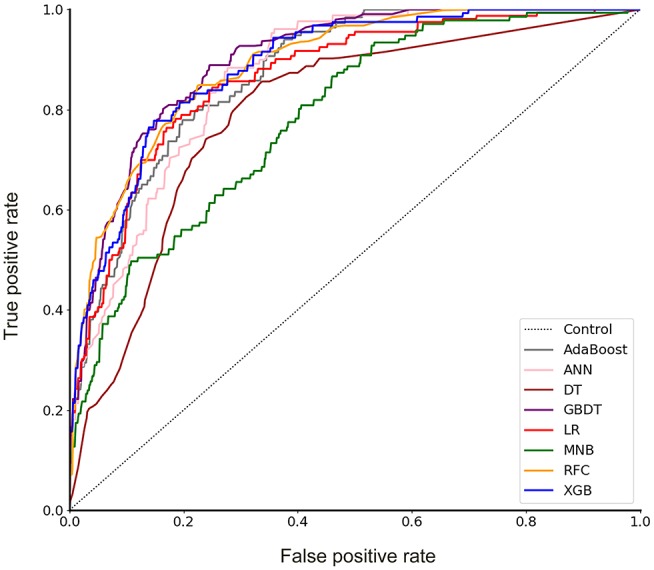
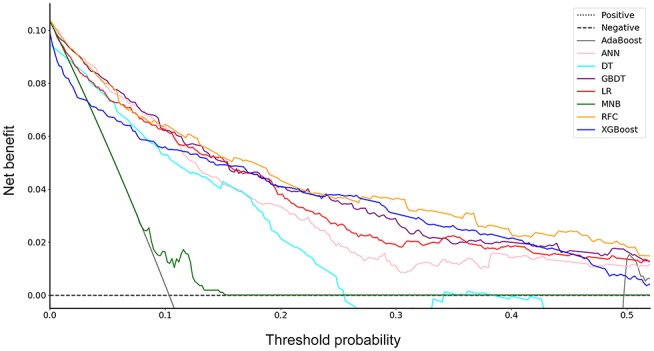
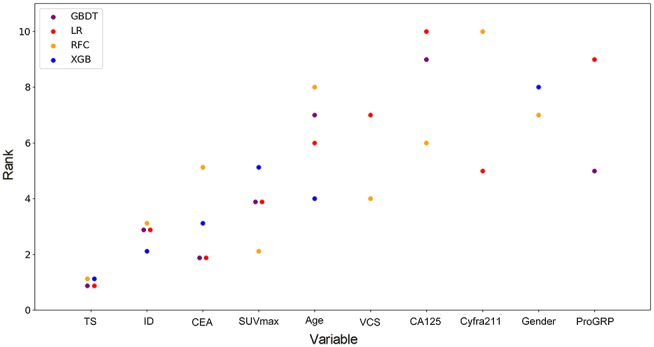
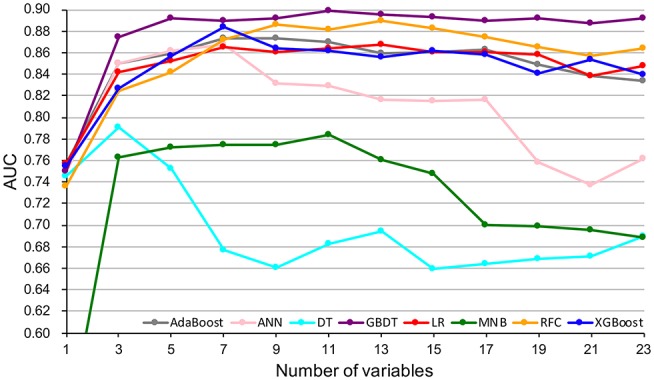
Lymph node metastasis (LNM) is difficult to precisely predict before surgery in patients with early-T-stage non-small cell lung cancer (NSCLC). This study aimed to develop machine learning (ML)-based predictive models for LNM. Clinical characteristics and imaging features were retrospectively collected from 1,102 NSCLC ≤ 2 cm patients. A total of 23 variables were included to develop predictive models for LNM by multiple ML algorithms. The models were evaluated by the receiver operating characteristic (ROC) curve for predictive performance and decision curve analysis (DCA) for clinical values. A feature selection approach was used to identify optimal predictive factors. The areas under the ROC curve (AUCs) of the 8 models ranged from 0.784 to 0.899. Some ML-based models performed better than models using conventional statistical methods in both ROC curves and decision curves. The random forest classifier (RFC) model with 9 variables introduced was identified as the best predictive model. The feature selection indicated the top five predictors were tumor size, imaging density, carcinoembryonic antigen (CEA), maximal standardized uptake value (SUV), and age. By incorporating clinical characteristics and radiographical features, it is feasible to develop ML-based models for the preoperative prediction of LNM in early-T-stage NSCLC, and the RFC model performed best.
对于早期T期非小细胞肺癌(NSCLC)患者,术前很难精确预测淋巴结转移(LNM)。本研究旨在开发基于机器学习(ML)的LNM预测模型。回顾性收集了1102例肿瘤直径≤2 cm的NSCLC患者的临床特征和影像特征。共纳入23个变量,通过多种ML算法建立LNM预测模型。采用受试者工作特征(ROC)曲线评估模型的预测性能,采用决策曲线分析(DCA)评估模型的临床价值。采用特征选择方法确定最佳预测因素。8个模型的ROC曲线下面积(AUC)在0.784至0.899之间。在ROC曲线和决策曲线方面,一些基于ML的模型比使用传统统计方法的模型表现更好。引入9个变量的随机森林分类器(RFC)模型被确定为最佳预测模型。特征选择表明,前五个预测因素是肿瘤大小、影像密度、癌胚抗原(CEA)、最大标准化摄取值(SUV)和年龄。通过整合临床特征和影像学特征,开发基于ML的模型用于早期T期NSCLC患者术前LNM预测是可行的,且RFC模型表现最佳。