Centre d'Ecologie et des Sciences de la Conservation, UMR 7204 MNHN-CNRS-Sorbonne Université, Muséum national d'Histoire naturelle de Paris, 43 rue Buffon, 75005, Paris, France.
Sorbonne Université, CNRS, IRD, INRAE, Université Paris Est Créteil, Institute of Ecology and Environmental Sciences of Paris (iEES-Paris), Paris, France.
Nat Commun. 2020 Jun 1;11(1):2686. doi: 10.1038/s41467-020-16240-6.
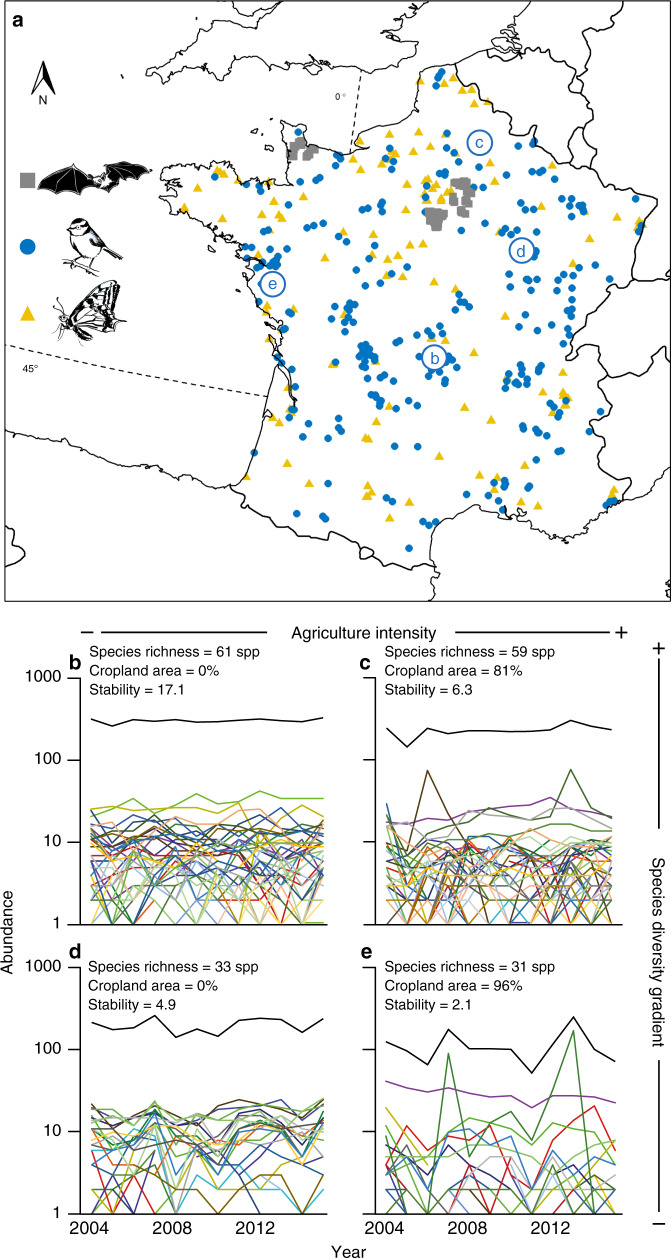
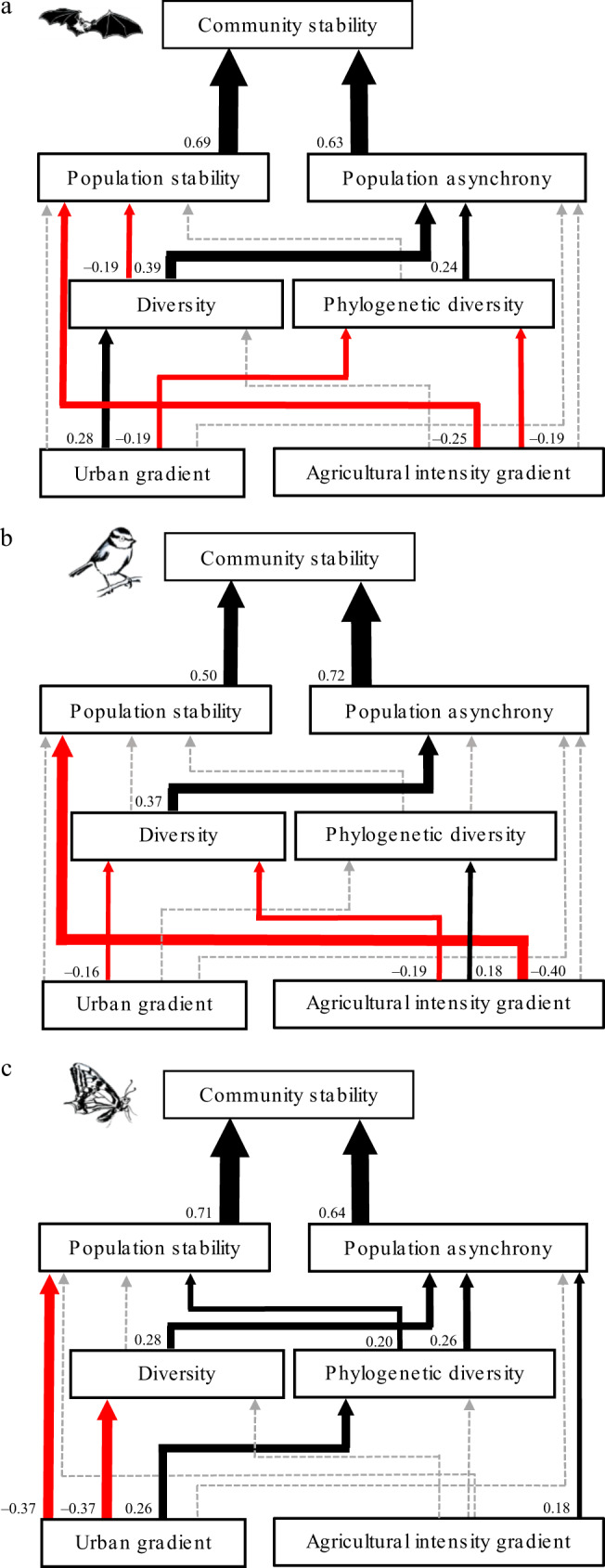
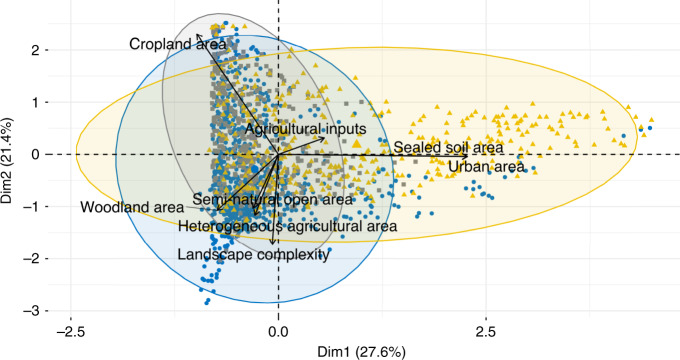
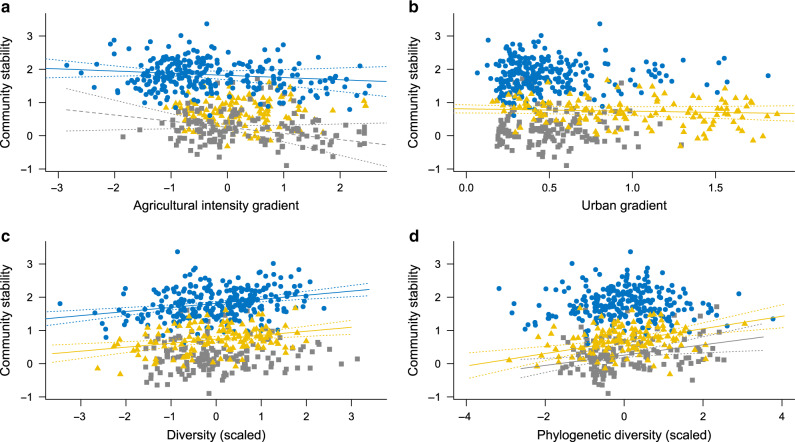
Despite growing concern over consequences of global changes, we still know little about potential interactive effects of anthropogenic perturbations and diversity loss on the stability of local communities, especially for taxa other than plants. Here we analyse the relationships among landscape composition, biodiversity and community stability looking at time series of three types of communities, i.e., bats, birds and butterflies, monitored over the years by citizen science programs in France. We show that urban and intensive agricultural landscapes as well as diversity loss destabilize these communities but in different ways: while diversity loss translates into greater population synchrony, urban and intensive agricultural landscapes mainly decrease mean population stability. In addition to highlight the stabilizing effects of diversity on ecologically important but overlooked taxa, our results further reveal new pathways linking anthropogenic activities to diversity and stability.
尽管人们对全球变化的后果越来越关注,但我们仍然不太了解人为干扰和生物多样性丧失对当地社区稳定性的潜在交互影响,特别是对于植物以外的分类群。在这里,我们通过法国公民科学计划多年来监测的三种类型的群落(蝙蝠、鸟类和蝴蝶)的时间序列,分析了景观组成、生物多样性和群落稳定性之间的关系。我们表明,城市和集约化农业景观以及生物多样性丧失会使这些群落不稳定,但方式不同:虽然生物多样性丧失导致更大的种群同步性,但城市和集约化农业景观主要降低平均种群稳定性。除了强调多样性对生态上重要但被忽视的分类群的稳定作用外,我们的结果还进一步揭示了将人为活动与多样性和稳定性联系起来的新途径。