Department of Kinesiology, Point Loma Nazarene University, San Diego, CA 92106, USA.
College of Health Solutions, Arizona State University, Phoenix, AZ 85004, USA.
Int J Environ Res Public Health. 2020 May 29;17(11):3871. doi: 10.3390/ijerph17113871.
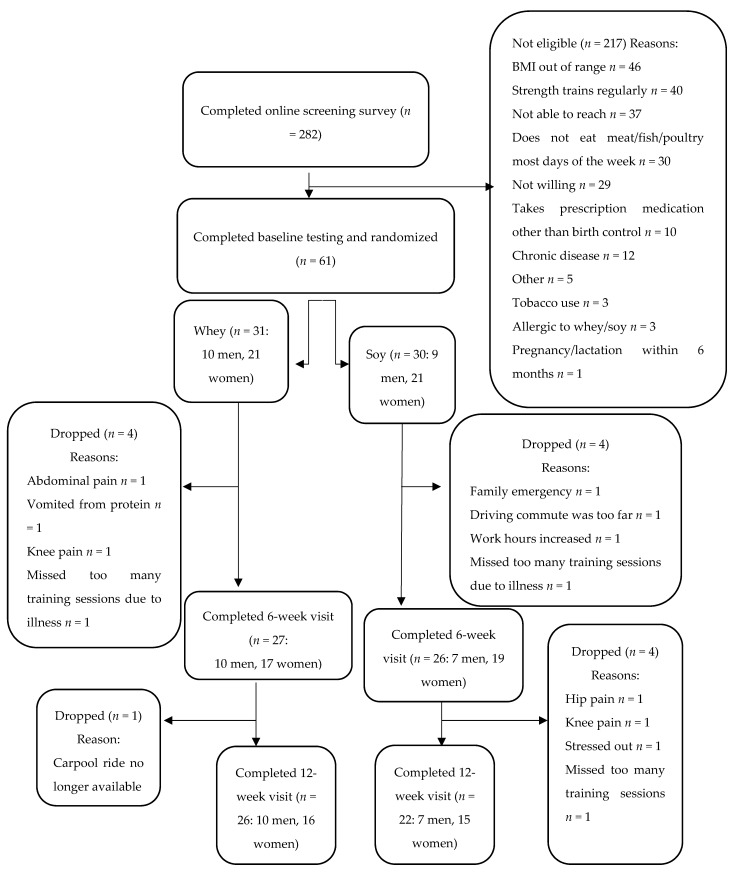
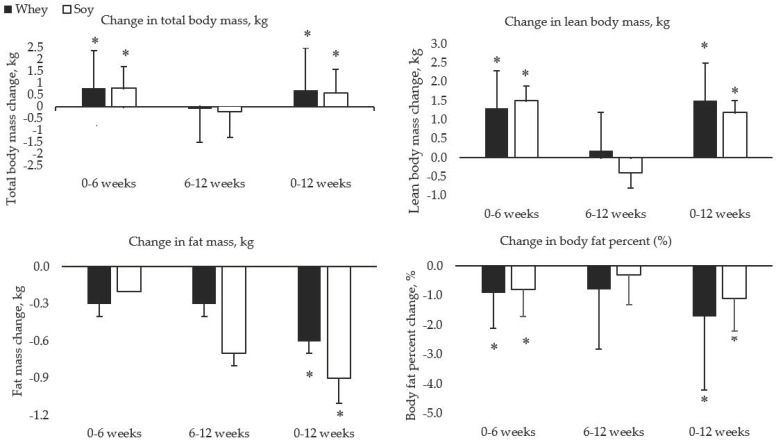
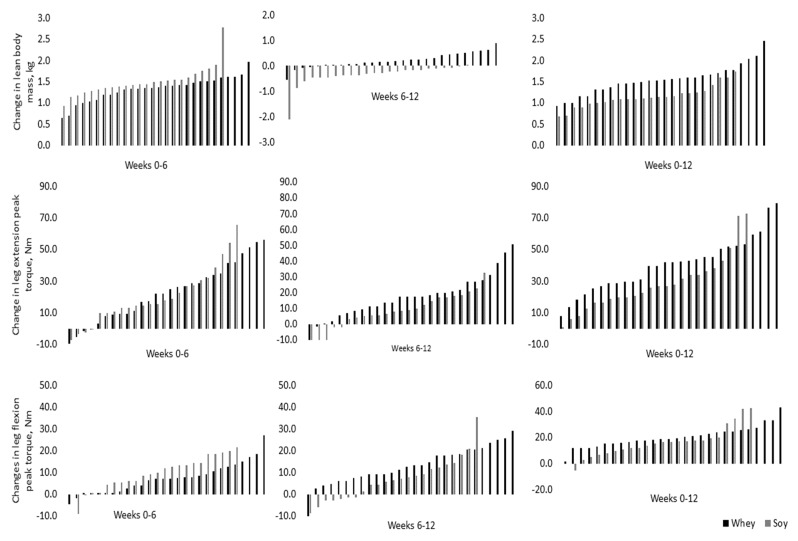
There are conflicting reports regarding the efficacy of plant versus animal-derived protein to support muscle and strength development with resistance training. The purpose of this study was to determine whether soy and whey protein supplements matched for leucine would comparably support strength increases and muscle growth following 12 weeks of resistance training. Sixty-one untrained young men ( = 19) and women ( = 42) (18-35 year) enrolled in this study, and 48 completed the trial (17 men, 31 women). All participants engaged in supervised resistance training 3×/week and consumed 19 grams of whey protein isolate or 26 grams of soy protein isolate, both containing 2 g (grams) of leucine. Multi-level modeling indicated that total body mass (0.68 kg; 95% CI: 0.08, 1.29 kg; < 0.001), lean body mass (1.54 kg; 95% CI: 0.94, 2.15 kg; < 0.001), and peak torque of leg extensors (40.27 Nm; 95% CI: 28.98, 51.57 Nm, < 0.001) and flexors (20.44 Nm; 95% CI: 12.10, 28.79 Nm; < 0.001) increased in both groups. Vastus lateralis muscle thickness tended to increase, but this did not reach statistical significance (0.12 cm; 95% CI: -0.01, 0.26 cm; = 0.08). No differences between groups were observed ( > 0.05). These data indicate that increases in lean mass and strength in untrained participants are comparable when strength training and supplementing with soy or whey matched for leucine.
关于植物性蛋白和动物性蛋白在抗阻训练中促进肌肉和力量发展的效果,目前存在相互矛盾的报告。本研究旨在确定在 12 周抗阻训练后,等量亮氨酸的大豆蛋白和乳清蛋白补充剂是否能同样促进力量增加和肌肉生长。61 名未经训练的年轻男性(n=19)和女性(n=42)(18-35 岁)参与了这项研究,其中 48 人完成了试验(17 名男性,31 名女性)。所有参与者均接受监督下的抗阻训练,每周 3 次,摄入 19 克乳清蛋白分离物或 26 克大豆蛋白分离物,两者均含有 2 克亮氨酸。多层次模型表明,全身质量(0.68 公斤;95%置信区间:0.08,1.29 公斤;<0.001)、瘦体重(1.54 公斤;95%置信区间:0.94,2.15 公斤;<0.001)和腿伸肌(40.27 牛米;95%置信区间:28.98,51.57 牛米;<0.001)和屈肌(20.44 牛米;95%置信区间:12.10,28.79 牛米;<0.001)在两组中均增加。股外侧肌厚度有增加的趋势,但未达到统计学意义(0.12 厘米;95%置信区间:-0.01,0.26 厘米;=0.08)。两组之间没有观察到差异(>0.05)。这些数据表明,在进行抗阻训练和补充等量亮氨酸的大豆蛋白和乳清蛋白时,未经训练的参与者的瘦体重和力量增加是相当的。